The warping effects of a credit based currency are just now being realized as the Greek crisis reaches some sort of denouement. Up until now the usual suspects have been hooting about how the Greeks must pay their bills, not realizing the fraud at the heart of those bills. The structure of Greek debt is truly novel, even if the scale seems familiar.
In a democracy, the saying goes, if you promise to rob Peter to pay Paul, you will always get Paul’s vote. The math of this arrangement is pretty simple. Once you run out of Peter’s to rob, you can no longer buy Paul’s vote. Similarly, when the Peters gain a majority, then having Paul’s vote no longer matters. At some point, a balance must be struck.
For most of human history, mathematics was the natural constraint on profligate spending to buy support. To use another hoary chestnut, you eventually run out of other people’s money to spend. In the 70’s, that was the crisis of social democracy. In order to keep the plates spinning, the state needed more money, but the voters were tapped out. They tried printing more money, but that proved to be disastrous.
The solution was the credit economy. The Louvre Accords were negotiated to arrest the decline of the dollar and resolve the currency war that had raged off and on for two decades. The US, Europe and Japan had taken turns exporting inflation to one another and the goal was to put an end to that by stabilizing the currencies.
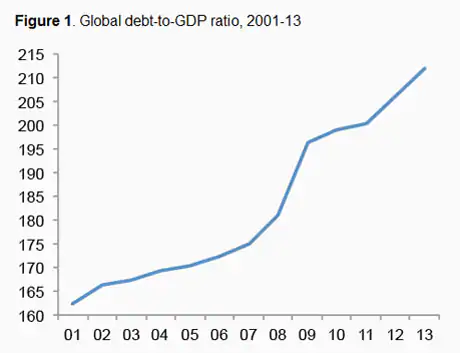
What no one anticipated is what would happen to banking, finance and sovereign debt. As if by magic, Western governments could tap low interest debt to finance operations. Central banks, charged with keeping the plates spinning used unlimited credit emissions to suppress rates, hoping to spur growth. As a result, global debt has metastasized.
How does this happen?
In a social democracy, the people are asked to vote on trade-offs. The political types offer their preferred trade-offs and the public picks amongst the options. One camp says spend more on the poor and less on bombs. Another says cut taxes and spending. A third says bomb the muzzies and screw the poor. In a rational world, politics is about priorities, because there’s a finite amount of money to go around.
In a credit economy, the trade-offs are distorted by time. The benefit comes today and the cost is somewhere in the future when we’re all dead. Not only are governments rolling over debt and paying just interest, they are doing so at ridiculous interest rates. Right now the US government is borrowing at 2%, give or take.
This changes the relationship between the citizen and the politician. Since the trade-offs are not apparent due to the time element, the pols only talk about one side of the transaction, the free stuff. In 2008, Clinton and Obama competed for who would give away the most stuff once elected. republicans fight over who will lower taxes more, because deficits no longer matter. Just charge it!
That’s what happened in Greece. The main parties took turns promising a free lunch. You can say that the people should have known better, but how could they know? Supposedly the state’s finances were on firm footing. All the smart people said so. Why shouldn’t the voters then pick the best meal on offer?
That’s the thing with a credit society. It makes for bad citizens and even worse politicians. Prudence is punished and profligacy is rewarded. I’m old enough to remember when a trillion in debt was laughable because no one imagined a trillion of anything could exist. Today the US government has $16 trillion in outstanding debt.
But wait, it gets worse!
The Greek problem would not be a big problem if people would keep buying Greek bonds at 2% rather than demanding 10% or more. Across the West, budgets are based on paying debt service at near zero rates. If borrowing costs reverted back to historic norms, every nation in the West defaults within five years.
That means all efforts, like we’re seeing with the Euro, are aimed at keeping those borrowing rates low. They have no choice. Even small hikes could make some American states insolvent. Given the way government debt works, a small default can unleash hell on the biggest states, which is why Puerto Rico is a big deal.
The West is trapped in a box of its own making. There are two ways out of it. One is everyone commits suicide and the other is to begin restructuring so that over debts levels begin to decline as borrowing rates slowly return to normal. The latter is politically impossible so that leaves the former.
In ancient times, there were Jubilees, the orderly repudiations of all debt on given days, scheduled many years in advance. This kept the issuance of debt from becoming too large, as the lenders knew that the borrowers would be allowed to walk away from what they owed, eventually. So debts remained short term in maturity and small in size.
As debt is often eventually repudiated anyway, better an orderly repudiation based on the calendar, rather than a disorderly one based on the limits of the system to bear the debt burden.
Z-man has a deliciously dry sense of humor, like an good martini – the very last paragraph a perfect example. Another reason I love his blog: Deliberately or not he keeps young know-nothings off the premises. No one under 45 will understand the spinning plates metaphor. (Sullivan died in ’74). More re: Sullivan. This in his Wiki, attributed to a Time magazine piece on him from 1955: (Sullivan resembled)…” a cigar-store Indian, the Cardiff Giant and a stone-faced monument just off the boat from Easter Island. He moves like a sleepwalker; his smile is that of a man sucking a… Read more »
One of the issues in the modern world is the sale of credit. A number of years ago I became aware of a company who sold sofas, and located in some non-city centre places attracted attention by continually offered “sales” in which the prices were reportedly generously cut. They did well enough to expand the number of outlets to almost be in city centres. But as a colleague told me, they weren’t interested in selling sofas at all. They were far more interested in selling credit. Buy a sofa and pay over 5 years and the credit deal for the… Read more »
Everything is effed. Thanks grandpa
In nature, the end of an era is often marked by gigantism. In politics, gigantism is centralization and uniformity. Nature hates uniformity, but it is in the nature of people to crave it. Around and around we go.
[…] The West is trapped in a box of its own making. There are two ways out of it. One is everyone commits suicide and the other is to begin restructuring so that over debts levels begin to decline as borrowing rates slowly return to normal. The latter is politically impossible so that leaves the former.” —The Z Man […]