
I’m a healthy sort. I don’t go crazy about it, but I try to eat a balanced diet, exercise and so forth. As such, I keep track of my calories. The thing about calories counting is it does not work. Calories counts on food are estimates and no one really knows how accurate they are or even if they are close. McDonalds, for example, claims a Big Mac is 550 calories. I’m sure it is probably pretty close, given the swarm of scumbag lawyers constantly circling major corporations looking for a reason to sue. Still, you have no idea if it is true.
That’s why you should avoid eating junk food. As a treat on occasion, it is fine. Life is for living. The same is true of chains that laughably claim they are better than “junk food.” This story in Vox is a good example.
The ranges on menu items are so vast that, depending on what your order looks like, a burrito could have 350 or 970 calories – nearly a threefold difference. (Never mind that it is nearly impossible to order the lowest-calorie Chipotle burrito, which consists of a flour tortilla with beans.)
This is a problem that lots of fast food chains are confronting now that the health care law requires them to post calorie counts on their menus. At establishments where menu items are highly customizable, places like Chipotle or Dominos, coming up with accurate calorie counts is a vexingly difficult tax.
Chipotle has settled on providing consumers with a calorie range that is, well, quite large. And when consumers see that range, a new study in the Journal of Public Health Nutrition finds, they underestimate the calories in their own burrito by 21 percent.
For starters, Chipotle is just a sit down Taco Bell. Pretty much the same crap. Taco Bell is honest about what their doing, while Chipotle is not. Both sell highly processed food loaded with salt and fat. If you are trying to lose weight or you are on a special diet, STAY OUT OF CHIPOTLE!.
This is better than when eaters don’t have any calorie information at all. In that scenario, researchers found that eaters underestimated the calories in their burrito by a full third.
But there’s a small tweak that can make Chipotle’s calorie labels even more effective: adding examples of how many calories are in the burritos used as the end points of calorie range. This is what that looks like, spelled out (the calorie ranges Chipotle uses appears to have dropped slightly downward since this study was conducted and when I picked up a menu today).
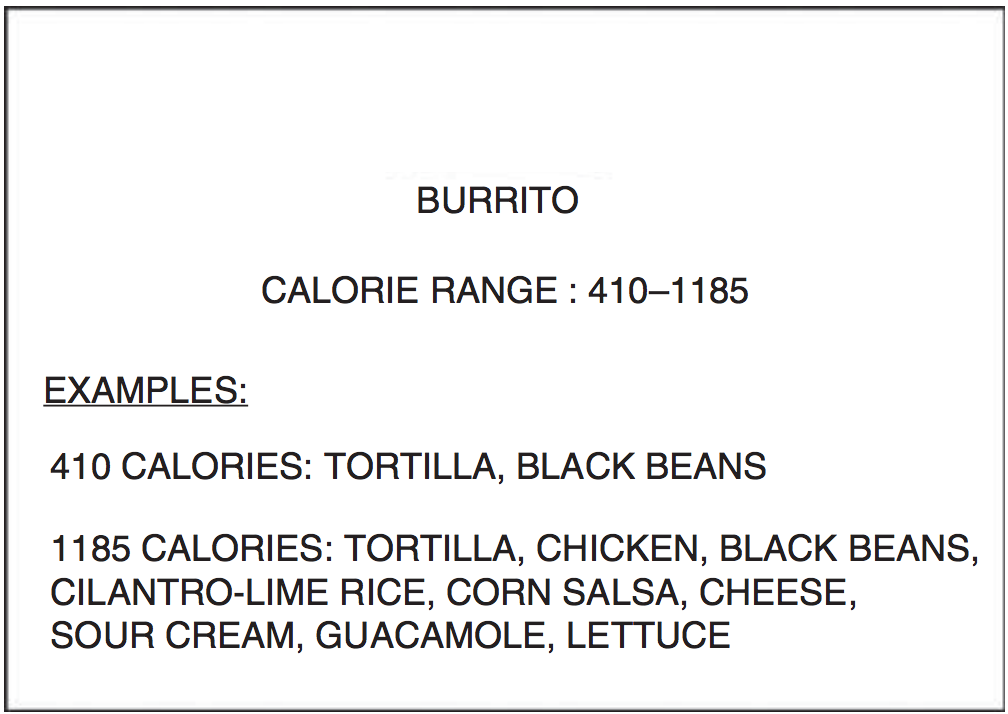
There’s zero evidence that this will make any difference in the real world, other than drive up the price of food and give lawyers a new avenue to suck blood from the economy. It is the fundamental flaw of the totalitarian mind on constant display at places like Vox.
The Obamacare requirement to post calorie labels, however, favors the range approach. In regulations published in 2011, the Food and Drug Administration directed restaurants to publish a range from the lowest calorie version of an item to the highest. But it doesn’t say anything about including examples of what’s included at each end.
“Critics of calorie-count regulations are correct to point out that we cannot justify the costs of such requirements if the mandated information does not improve consumer understanding,” study co-authors Peter Ubel and Peggy Liu write at the Monkey Cage Blog. “The FDA should require restaurants to define the endpoints of calorie ranges. Consumers deserve comprehensible information about their food choices.”
Again, if you care about what you eat, you stay out of fast food joints. If you care about what other people eat, then you harass private business with these insane regulations. The little Eichmans that worship Ezra Klein think this is great, but that’s the nature of the totalitarian.
This post has already been linked to 926 times!
Chipotle isn’t highly processed and it’s several steps higher than Taco Bell
Yeah, let’s leave Chipotle out of this.