Legalizing the Weed

This story in the NYTimes is becoming common.

Five months after Colorado became the first state to allow recreational marijuana sales, the battle over legalization is still raging. Law enforcement officers in Colorado and neighboring states, emergency room doctors and legalization opponents increasingly are highlighting a series of recent problems as cautionary lessons for other states flirting with loosening marijuana laws.

Everyone who had been making big money from the war on weed is screaming bloody murder about legalization. There are legitimate arguments against some of this, but the general tone suggests the prohibitionists are unlikely to make them.

There is the Denver man who, hours after buying a package of marijuana-infused Karma Kandy from one of Colorado’s new recreational marijuana shops, began raving about the end of the world and then pulled a handgun from the family safe and killed his wife, the authorities say. Some hospital officials say they are treating growing numbers of children and adults sickened by potent doses of edible marijuana. Sheriffs in neighboring states complain about stoned drivers streaming out of Colorado and through their towns.

“I think, by any measure, the experience of Colorado has not been a good one unless you’re in the marijuana business,” said Kevin A. Sabet, executive director of Smart Approaches to Marijuana, which opposes legalization. “We’ve seen lives damaged. We’ve seen deaths directly attributed to marijuana legalization. We’ve seen marijuana slipping through Colorado’s borders. We’ve seen marijuana getting into the hands of kids.”

One of the features of the modern social welfare state is official lying. By that I mean people telling obvious lies, but everyone pretending they are just alternative opinions. Calling your organization “Smart Approaches to Marijuana”, when you’re clearly not smart or interested in anything other than prohibition, is an obvious lie. What Kevin Sabet goes onto to say is clearly made up nonsense that no adult would ever believe.

Yet, here we are with the NYTimes treating this crook like a legitimate source of knowledge.

Despite such anecdotes, there is scant hard data. Because of the lag in reporting many health statistics, it may take years to know legal marijuana’s effect — if any — on teenage drug use, school expulsions or the number of fatal car crashes.

It was only in January, for example, that the Colorado State Patrol began tracking the number of people pulled over for driving while stoned. Since then, marijuana-impaired drivers have made up about 1.5 percent of all citations for driving under the influence of drugs or alcohol.

Proponents of legalization argue that the critics are cherry-picking anecdotes to tarnish a young industry that has been flourishing under intense scrutiny.

The vast majority of the state’s medical and recreational marijuana stores are living up to stringent state rules, they say. The stores have sold marijuana to hundreds of thousands of customers without incident. The industry has generated $12.6 million in taxes and fees so far, though the revenues have not matched some early projections.

Marijuana supporters note that violent crimes in Denver — where the bulk of Colorado’s pot retailers are — are down so far this year. The number of robberies from January through April fell by 4.8 percent from the same time in 2013, and assaults were down by 3.7 percent. Over all, crime in Denver is down by about 10 percent, though it is impossible to say whether changes to marijuana laws played any role in that decline.

That’s not a lot to go on, but at least it is honest. Maybe the NYTimes highlighted the hysterical nonsense as a way to support the legalization case. It is hard to know. Propaganda sheets like the Times are expert at this sort of subtle campaigning.

If I were to guess, I’d say the potheads are winning right now. They are handing the pols money in the form of new taxes. They have avoided any trouble, which keeps the suburban moms off their back. Most important, their critics sound foolish. Being blessed by the right enemies is always the key to winning public debate.

I’m not enthusiastic about legalization, but I was never enthusiastic about prohibition. I’d prefer a world where people did not smoke pot. It makes you stupid and it causes you to think idleness is a good thing. That said, it is not going to bring down civilization if some people smoke pot. There are other ways to discourage bad behavior that don’t require the state shooting citizens and locking them in cages. Just look at cigarettes.

Still, there are trade-offs to everything. We don’t know what else comes with legalizing weed, but we do know something does come with it.
The Trouble with Fake Nerds

Being a nerd has become the cool kid thing to be. A few years back I heard a Washington parasite call one of the big press events a “nerd ball” because it attracted all of the “policy wonks” in DC. The fact that few of these people can do basic mathematics does not matter.

They wear the right costumes and strike the right pose so they can pretend to be bookish nerds. All of my liberal friends pretend to be science geeks, even though none of them have any background in science.

But, fads are what they are and no group is more faddish than the Left. The trouble with this one is that incredibly stupid ideas get passed around like settled science, to use a common refrain. Here’s a good example from Tech Crunch, a site that caters to the fake nerd crowd.

Here’s an idea crazy enough that it just might work: Pave the streets with solar-powered panels that have their own built-in heat and LED lights. That’s what Scott and Julie Brusaw hope to accomplish with their ongoing Solar Roadways project, which they just funded through a hugely popular crowdfunding campaign.

The husband-and-wife team has spent the better part of the last decade developing solar-powered modular panels that could be installed in roadways and parking lots, and would be able to collect power from the sun. Those panels could also keep streets clear of snow and ice, while illuminating them with LEDs.

Rather than paving streets and driveways with asphalt, the Solar Roadways panels would theoretically be able to decrease our nation’s dependence on fossil fuels by generating massive amounts of clean energy. Panels are made from ruggedized glass and connect to one another through a mesh network, so that even if one panel fails the system will notify repair crews that it needs to be replaced.

Actually, the theory is nonsense. Asphalt is black and that means it absorbs sunlight readily. The light is converted into heat, which is why the road is smoking hot in the middle of summer. It is also why the snow melts away even when it is below freezing, once the road is exposed. The road is converting close to 100% of the sunlight into heat.

Solar panels, on the other hand, convert about 15% of sunlight into electricity. For that reason alone you have a huge loss of energy using solar panels instead of asphalt.

Then you have the issue of storage. If you want to use solar to light the roads, then you have to store the energy because lighting them in the daytime is stupid. That means batteries. They have a loss of energy, but they also cost a boatload of money and have to be replaced regularly.

We’re not even at the hard parts. Building a road from solar panels would require new materials capable of handling the massive abuse that comes from being driven over by trucks and cars. Those materials could not be smooth as the cars would fly off the roads in the rain.

Anyone with a mastery of basic science would spot this as nonsense, but the fake nerd trend means these people get to con a bunch of fake nerds into “crowdfunding” their alchemy.

Fake Safety

I’m a cyclist. I have been into cycling, of and on, for forty years. In the summer, I’ll do two or three rides a week over more than 20 miles each. I maintain a pace of 15 mph on rough surfaces and 18 mph on asphalt. That’s not Tour speed, but I’m an old man and I’m not an athlete. The point being I have a lot of time in the saddle and know pretty much everything there is to know about cycling.

I never wear a helmet. I find them uncomfortable and they look stupid. I’ve never thought they were much of a safety device either.

It turns out I was right.

A leading neurosurgeon has controversially claimed that cyclists who wear helmets are wasting their time.

Henry Marsh, who works at St George’s Hospital in Tooting, London, said that many of his patients who have been involved in bike accidents have been wearing helmets that were ‘too flimsy’ to be beneficial.

He made the comments while speaking at the Hay Festival during a discussion with Ian McEwan, whose 2005 novel Saturday featured a neurosurgeon.

He cited evidence from the University of Bath that suggests that wearing a helmet may even put cyclists at greater risk. The research showed that drivers get around 3 inches closer to cyclists who wear helmets because they perceive them as safer.

He said: “I ride a bike and I never wear a helmet. In the countries where bike helmets are compulsory there has been no reduction in bike injuries whatsoever.

Of course not. Think about the ways you can crash on a bike. One is you just fall over. Unless you strike your head on a curb or similar, you bruise an elbow and that’s it. Since this is less likely than falling down the stairs and we don’t wear helmets walking around the house, it makes no sense to wear a helmet on a bike to mitigate against this possibility.

Another way to crash is you hit something and go over the bars. That’s going to hurt, but you’re much more likely to break an arm or wrist than break your melon. That’s why broken arms and wrists are vastly more common than broken heads. More important, that flimsy piece of plastic is not saving your head if you take a direct hit.

The other possibility is you get hit by a car. A broken melon is the least of your worries. I was hit by car twenty years ago and was thrown over a bunch of parked cars. My head was fine. It was the rest of me. I had bruises on top of bruises. No broken bones, oddly enough. Bouncing off the cars actually cushioned the blow a bit.

“I see lots of people in bike accidents and these flimsy little helmets don’t help.”

Mr Marsh said that he had been riding his bike for 40 years, wearing a cowboy hat, and had only fallen off once.

“I have been cycling for 40 years and have only been knocked off once. I wear a cowboy hat and cowboy boots. I look completely mad.”

Cyclists travel around 3.1 billion miles each year in Britain. Lights and reflectors are a legal obligation after dark, and reflective jackets an increasingly common sight.

But helmets are not compulsory in the UK, unlike in Australia and parts of the US, yet the government encourages cyclists to wear one.

Research conducted by Dr Ian Walker, a professor of traffic psychology at the University of Bath, showed that motorists drove around 8cm closer when overtaking cyclists with helmets.

He suggested that drivers think helmeted cyclists are more sensible, predicable and experienced, so therefore the driver doesn’t need to give them much space when overtaking.

Non-helmeted cyclists, especially non helmeted “women” are less predictable and experienced, according to this study and so motorists give them more room.

This is something I learned long ago. When riding on the streets, I make sure to be in the right lane and not the shoulder. That way, the driver has a better chance to see me and will be less likely to fly past me.

This post has already been linked to 1107 times!

The Drinking Nations of America

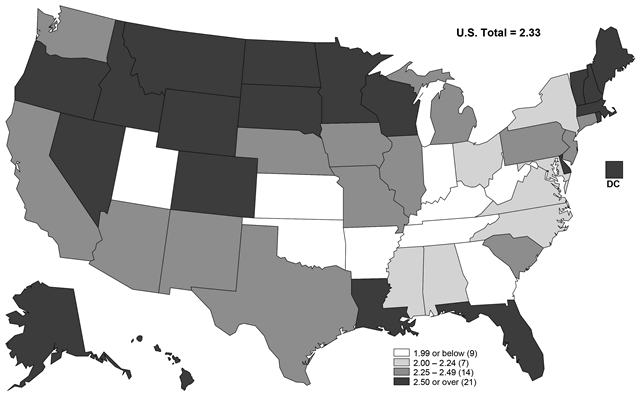
This story made the rounds last week. It is what newspaper men used to call a hardy perennial. Some variation of the theme is done every year. Booze, sex, crime and anything related makes good copy. It lets the lesser critics make broad statements about the implications. I probably heard a dozen people say “Of course they drink in New Hampshire. What else are they going to do?”

The source report is a bit more interesting. The map I like is this one:

Even to an untrained eye there seems to be a pattern, but one that is counter intuitive. The stoic Yankees are heavy boozers, but that can be explained by the Irish. But what about those drunken hillbillies of Appalachia? They appear to be not so drunk after all.

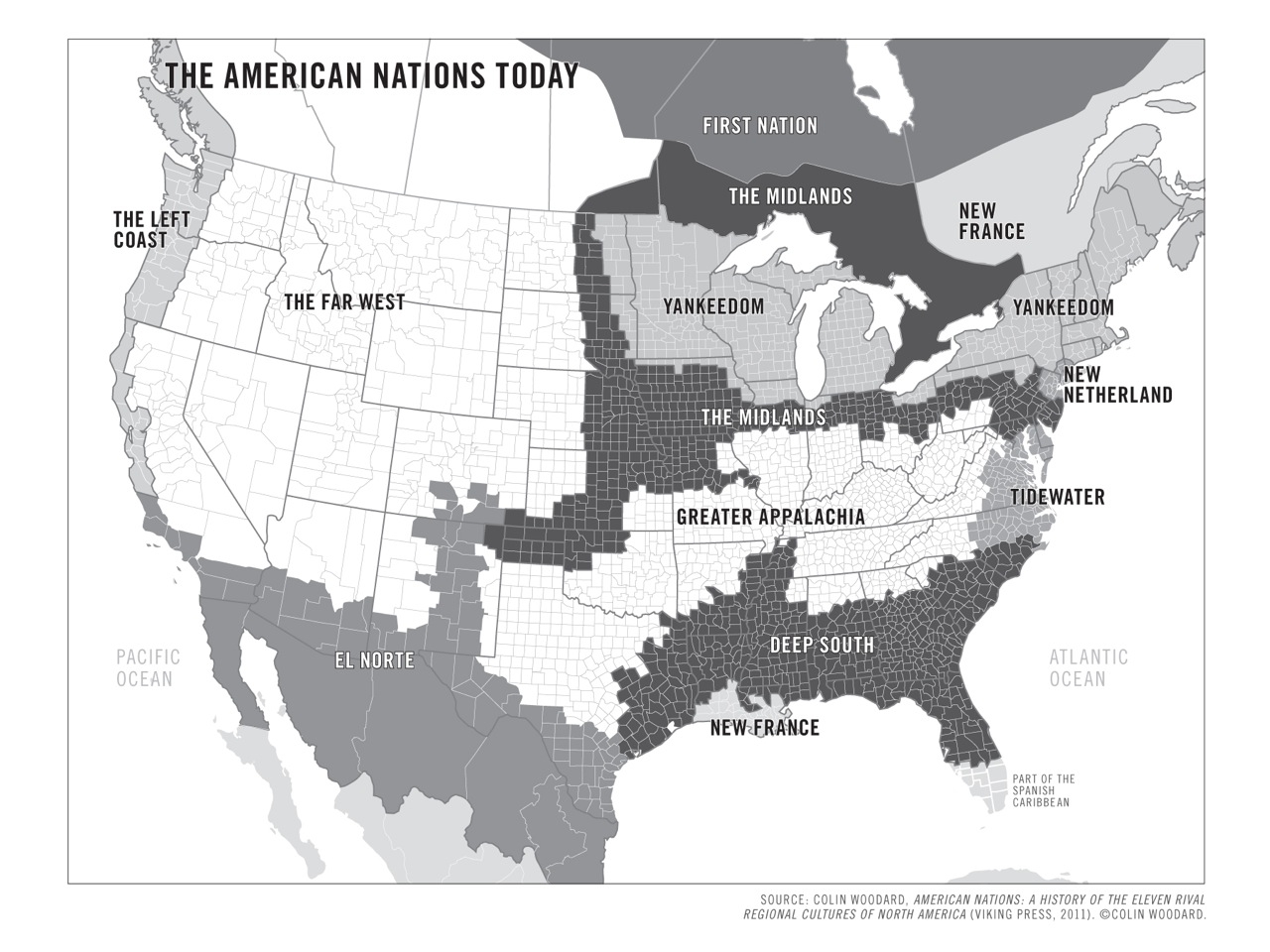
Here’s a cool map[1] from Colin Woodard’s American Nations:

That starts to explain the drinking habits a bit more, doesn’t it? Now, look at this map from the same source:


You’ll note that the light drinking areas tend to have a lot of Native Americans. Despite the image of the drunken Indian, they tend to drink a lot less than the pale faces. Very little hooch is required to get your average Indian drunk. Those stoic Yankees, on the other hand, are mostly British. The Brits are well known boozers.

The central claim of science versus social science, is that people have been and continue to evolve. Isolated from one another, human groups develop traits unique to them and their conditions. They carry these traits with them as they move around. A German in Pennsylvania is going to be more like Germans back home than a Swede living in North Dakota.

That drinking map is one example of why the science is with science and against social science.

This map is why it is very hard to sort nature, from nurture from noise:

Not all Germans are the same. You can do this with just about any country of the civilized world.

[1]I’m linking to the images posted on jayman’s blog.

This post has already been linked to 1043 times!

The Police State

Way back in the olden thymes, it was common for liberals to say something along the lines that all power is eventually abused. They tend to get religion on this stuff whenever the bogeyman is in office. In the Reagan years they were always grousing about the “imperial presidency.” Every liberal in DC was suddenly Oliver Cromwell whenever Reagan threw on a tuxedo.

In the Bush years the Left was chanting about Bush-Hitler and the rise of “American fascism.” If you want to stroll down memory lane, put “Bush Fascist” in your nearest Google machine.

Fundamentally, the Left is right about the abuse of power. Men are not angels. That’s why a certain amount of corruption is a given whenever you talk about government. The Left’s inability to accept that is what leads them into trouble. Burkean conservatives, however, have a trust in institutions that can get them in trouble as well. When their guys are in office they wax romantic about respecting the office and traditions of American governance.

A steady distrust of the state is the wise position. Specifically, it should always be assumed that all state power will be abused to the maximum possible. That’s the check on new laws and new powers. Here’s a perfect example.

“Henry. A SWAT team from Homeland Security just raided our factory!”

“What? This must be a joke.”

“No this is really serious. We got guys with guns, they put all our people out in the parking lot and won’t let us go into the plant.”

“Whoa.”

What is happening?” asks Gibson Guitar CEO Henry Juszkiewicz when he arrives at his Nashville factory to question the officers. “We can’t tell you.” “What are you talking about, you can’t tell me, you can’t just come in and …” “We have a warrant!” Well, lemme see the warrant.” “We can’t show that to you because it’s sealed.”

While 30 men in SWAT attire dispatched from Homeland Security and the U.S. Fish and Wildlife Service cart away about half a million dollars of wood and guitars, seven armed agents interrogate an employee without benefit of a lawyer. The next day Juszkiewicz receives a letter warning that he cannot touch any guitar left in the plant, under threat of being charged with a separate federal offense for each “violation,” punishable by a jail term.

The men in the SWAT gear surely think they are good men. They think they are liberty loving Americans. They probably vote for conservative candidates who extol the virtues of freedom. Yet, they are perfectly willing to gun down their fellow citizens for a paycheck. They are no different than the guards at Auschwitz.

Up until that point Gibson had not received so much as a postcard telling the company it might be doing something wrong. Thus began a five-year saga, extensively covered by the press, with reputation-destroying leaks and shady allegations that Gibson was illegally importing wood from endangered tree species. In the end, formal charges were never filed, but the disruption to Gibson’s business and the mounting legal fees and threat of imprisonment induced Juszkiewicz to settle for $250,000—with an additional $50,000 “donation” piled on to pay off an environmental activist group.

This is how the mafia works. They give you two choices. Pay up or get your legs broken. Of course free men freely choose to pay!

Two months before the raid, lobbyists slipped some arcane supply-chain reporting provisions into an extension of the Lacey Act of 1900 that changed the technical definition of “fingerboard blanks,” which are legal to import.

With no clear legal standards, a sealed warrant the company has not been allowed to see too this day, no formal charges filed, and the threat of a prison term hanging over any executive who does not take “due care” to abide by this absurdly vague law, Gibson settled. “You’re fighting a very well organized political machine in the unions,” Juszkiewicz concluded. “And the conservation guys have sort of gone along.” Hey, what’s not to like about $50,000?

The rest of the story is well worth a read. What’s jarring about this story is not the gross abuse of power. That’s becoming a daily occurrence. What’s jarring is no politician has taken up the cause. Imagine a presidential candidate making an issue of this. It gets people’s attention and is easy to understand. Instead, we get silence.

This post has already been linked to 905 times!

The Eloi

If you hang around the websites of central planners or read their blogs, you can’t help but notice they are concerned and puzzled by the labor markets. All over the developed world, the number of people working is in decline. The US labor market never fully recovered from the crash. Countries like Spain, Portugal and Greece have unemployment rates reaching 30%. Everyone expected the labor markets to be back to normal by now.

One argument is that technology is eliminating job growth. The warehouse is not adding new people as the business grows, it is adding new robots. This is most certainly true. I know of a few businesses that have doubled their size in the last decade without adding new people. Even mom and pop operations can afford software and mobile devices to automate big chunks of their business. The book The Second Machine Age takes the concept to the extreme, imagining a world without work.

While I’m skeptical about the claims made by futurist, we may be heading into a time of less work. We have been conditioned to accept work as a feature of life. Christianity built it into the religion. Even pagan cults had mystical explanations for why man was forced to toil for food. In modern times when most men do not actually toil in fields, year round work has been the norm for generations. We head into the office in all sorts of weather and under all sorts of burdens.

It was not always so. Hunter gatherers probably only worked 20 hours per week. Fighting and mating took up an equal amount of time. Early farmers did not farm all year long. In northern climates, people had loads of free time from harvest until planting. From spring through fall they worked very long hours, but there were long breaks in there as well. Once the crops are in the ground, there’s not a lot of tending to them so farmers had time off in the summer. Still, farming life was most certainly more time consuming than foraging.

The industrial age brought year round work and crazy long houts to the masses. My grandfather told stories about working as a steamfitter ten hours a day and then night shift as a mill with some weekend work when he could get it. From the 19th century forward, all consuming work with little time off was the norm until we get into the middle of the 20th century. This is the world we have always known, but it may not be the world of the future. This story from Sweden is a possible sign of things to come.

Gothenburg (Sweden) (AFP) – Robert Nilsson, a 25-year-old mechanic in Sweden’s second city Gothenburg, may be the harbinger of a future where people work less and still enjoy a high standard of living.

He gets out of bed at the same time as everyone else, but instead of rushing to work, he takes it easy, goes for a jog, enjoys his breakfast, and doesn’t arrive at his Toyota workshop until noon, only to punch out again at 6:00 pm.

“My friends hate me. Most of them think because I work six hours, I shouldn’t be paid for eight,” Nilsson said, talking while fitting part of a rear window onto a Toyota Prius with swift, expert moves.

Sweden often stuns first-time visitors with its laid-back prosperity, making foreigners wonder how it is possible to have both lots of money and lots of leisure.

Scandinavians are always stunned by how much Americans work. They get over 30 paid holidays a year, while Americans get half that number.

Part of the answer, according to economists, is a productive and well-educated workforce that adapts to new technologies quicker than most.

Exactly how much –- or how little –- Swedes work compared with other nations is a somewhat open question.

“We have a 40-hour work week, but also we have a little more absence than many people and we start work late in life because we study longer,” said Malin Sahlen, an analyst at Timbro, a libertarian Stockholm-based think tank.

In 2012, the average Swede worked a total of 1,621 hours, according to the Paris-based Organisation for Economic Co-operation and Development.

This is more than the Netherlands with 1,381 hours, but less than Britain with 1,654 hours or the United States with 1,790 hours – and way below Chile’s 2,029 and Mexico’s 2,226 hours.

It also helps to have a nation full of Swedes too. Let’s ship over a few of our Detroits and see what happens.

But far from looking to increase time spent at work, some in Sweden are out to prove that less is more and that cutting hours can boost productivity.

In an international productivity ranking by the Conference Board, a non-profit business research organisation, Sweden was already placed close to the top, coming 11th out of 61 countries.

The United States was third, the Netherlands number five, and Britain number 13, whereas Chile and Mexico were both in the bottom third.

Now, the Social Democrat-led city government in Gothenburg is planning to test the impact of shorter hours on productivity, in an experiment beginning on July 1.

One group of government workers in the elderly care sector are to work six hours a day, while another will work the eight they are used to.

There’s a bit of an undiscussed truth about most work these days. People screw off a lot more than in a previous era. The culture has changed, but having the Internet at your fingertips is the biggest issue. It is simply too easy to goof off at work. You can shorten the work day, but demand the same work product. It’s a trade-off most people would accept.

The thing is we may be reaching a point where we need fewer and fewer people working. If we can have all of the material wealth of today, but have robots doing the work, is that such a bad thing? It would revolutionize social relationships. Think about all the rules, written and unwritten, that are linked to work. Think about how much of our politics is geared to issues related to work. Taxes, jobs, growth, trade labor law, etc.

That’s where the futurists fall on their faces. They always assume people will be the same in the future. It will just be a super high tech version of today. That’s not how it works. As the environment changes, humans change. When our old customs no longer meet our needs, new customs rise up to replace them. A society without work will have vastly different rules than modern society.

Or, we will simply be food for those who still work.

This post has already been linked to 961 times!

Colorado Legalizes Slavery

In celebration of the 150th anniversary of the Civil War, Colorado has brought back slavery. Some weird Stalinist court has ordered Jack Phillips to work for two men against his will.

Colorado’s Civil Rights Commission on Friday ordered a baker to make wedding cakes for same-sex couples, finding his religious objections to the practice did not trump the state’s anti-discrimination statutes.

The unanimous ruling from the seven-member commission upheld an administrative law judge’s finding in December that Jack Phillips violated civil rights law when he refused to make a wedding cake for a gay couple in 2012. The couple sued.

“I can believe anything I want, but if I’m going to do business here, I’d ought to not discriminate against people,” Commissioner Raju Jaram said.

Phillips, a devout Christian who owns the Masterpiece Cakeshop in the Denver suburb of Lakewood, said the decision violates his First Amendment rights to free speech and free exercise of his religion. “I will stand by my convictions until somebody shuts me down,” he told reporters after the ruling.

He added his bakery has been so overwhelmed by supporters eager to buy cookies and brownies that he does not currently make wedding cakes.

The couple who sued Phillips, Dave Mullins and Charlie Craig, were pleased that the commission roundly rejected Phillips’ arguments. “We’re just thrilled by that,” Mullins said.

Phillips should make a cake in the shape of Priapus. That will make the perverts happy.


This post has already been linked to 911 times!

A Glimmer of Hope?

I was decidedly unimpressed with the European elections. In some ways, they reminded me of the 2010 congressional elections. I wanted to think the people woke up and realized it was a horrible mistake putting the liberal democrats in power, but I knew better. I wanted to think the GOP learned some hard lessons and was ready to become a right of center political party. Again, I knew better. Two years later the GOP put up the Monopoly Guy and the people voted for the head nitwit in charge.

This from Virginia has me thinking I may be too pessimistic. Cantor should sail to victory. His primary opponent is a nobody and his district is R+11 according to the Cooke Partisan Voter Index. Given the tenor of this election, Cantor should expect to win by a landslide.

The campaign manager for House Majority Leader Eric Cantor isn’t backing down from their new campaign-trail flyer lauding Cantor for fighting against President Barack Obama’s amnesty bill.

“He stopped the bill when it came out of the Senate,” Ray Allen, Cantor’s campaign manager, told The Daily Caller.

The defender-against-amnesty claim appeared in flyers sent to GOP primary voters near Richmond, Va., two weeks before the vote on June 10. “Conservative Republican Eric Cantor is stopping the Obama [and Sen. Harry] Reid plan to give illegal aliens amnesty,” says one of the flyers.

I’ve been around enough politicians to know they do nothing without cause. Cantor is no dummy and he knows he cannot flip-flop on this now that he has staked out this ground. There’s a reason for it.

But his critics, including primary challenger and economist Dave Brat, are hitting back: Cantor’s claim has prompted hoots of contempt, some anger and some Bronx cheers from the many activists who have fought the massive push by progressives, media outlets and business groups to double the current inflow of 2 million immigrants and guest workers each year.

“7th district votes are not going to fall for these outright lies that Brat is selling,” Allen said.

But the flyers “suggest that Eric Cantor is scared,” said Zachary Werrell, Brat’s campaign manager.

Cantor said “immigration reform” was a top priority for 2013, said Werrell, but now “he’s realizing that voters in his district are overwhelmingly against it, and all of a sudden, he’s saying he’s against amnesty.”

“Is there any limit to the degree of lying that may be deemed off limits during the campaign?” said an article by Daniel Horowitz, policy director for The Madison Project.

“It is perfidious that these people use their money collected from pro-amnesty special interests to paint themselves as anti-amnesty so they can win re-election and pass amnesty,” said Horowitz, in an article headlined “Establishment Campaign Strategy: Shameless, Cowardly, and Perfidious.”

There are a few possibilities. One is this is an inside Washington game. There are financial benefits to playing both sides of the fence. With billions being poured into the amnesty push, driving a hard bargain is good business for a greedy pol. Cantor has always struck me as unusually craven, even by modern political standards. I think the guy would pawn his children for political advantage.
The most obvious and most likely answer is their internal polling is concerning. This story from a couple weeks back suggests his primary opponent is doing a bit better than expected. This could just have been a ham-handed way to sure up support. Republican consultants continue to operate as if the Internet was never invented and voters cannot look up past statements and the candidate’s voting record. Still, picking an immigration fight is not the smart play.
Except maybe if immigration is starting to make the ground shake. I’m generally pro-immigration and what our ruling class is pushing makes me want to vomit. It is hard to know where the public stands because the polling is so sketchy. This from the Wall Street Journal is a good example. None of the questions get at the issue in a sensible way.  Option three may as well ask the respondent if they would like a ride on a flying carpet.  I found this old story covering a few polls and the results are mixed.
The thing polling does not capture and what is most important to politicians. That is which way the tide is going. They obsess over it. It is not enough to be the on the right side of the issue after it has majority support. A wise pol is right there at the front of the mob when they have the advantage. That may be what we’re seeing with immigration and Cantor. The tide is rising and he wants to get on the right side of the issue, even if he takes some lumps in the process.
If that’s true, then maybe there’s hope for us yet.


This post has already been linked to 1265 times!

It’s Always Something

I have a friend in the stock rackets. I nicknamed him “green light” years ago. The reason is he always has a reason to buy stocks. If the market is falling, it is a great time to bargain hunt. If the market is soaring, you have to ride the wave. A nuclear strike incinerating NYC and the markets would not be enough to discourage the guy. He’s not unusual. That’s the business. That’s why you should never take advice from stock brokers or gamblers.

CNBC is the quintessential green light operation. No matter what, they can see the bright side. Today’s revised Q1 GDP is a good example.

The U.S. economy contracted in the first quarter for the first time in three years as it buckled under the weight of a severe winter, but there are signs activity has since rebounded.

Yeah, suddenly we’re all hot house flowers incapable of handling a little snow.

The decline in output, which also reflected a plunge in business spending on nonresidential structures, was sharper than Wall Street’s expectations. Economists had expected the revision to show GDP contracting at a 0.5 percent rate.

The economy grew at a 2.6 percent pace in the fourth quarter. U.S. financial markets are likely to shrug off the report, given the temporary factors that weighed down on growth and the fact that economic activity is rebounding.

Data ranging from employment to manufacturing suggests growth will accelerate sharply in the second quarter.

Economists estimate severe weather could have chopped off as much as 1.5 percentage points from GDP growth. The government, however, gave no details on the impact of the weather.

Weather could have been a cause. Magic evil leprechauns could be the cause too. We don’t know, but let’s go with weather because we don’t think it was leprechauns.

Businesses accumulated $49.0 billion worth of inventories, far less than the $87.4 billion estimated last month.

It was the smallest amount in a year and left inventories subtracting 1.62 percentage points from first-quarter growth. But inventories should be a boost to second-quarter growth.

While the decline in exports was not as severe as initially thought, import growth was stronger. That resulted in a trade deficit that sliced off 0.95 percentage point from GDP growth.

A measure of domestic demand that strips out exports and inventories expanded at a 1.6 percent rate, rather than a 1.5 percent rate, indicating underlying strength in the economy.

Consumer spending, which accounts for more than two-thirds of U.S. economic activity, increased at a 3.1 percent rate. It was previously reported to have advanced at a 3.0 percent pace.

Spending was boosted by the Affordable Healthcare Act, which expanded healthcare coverage to many Americans. Consumer spending had increased at a brisk 3.3 percent pace in the fourth quarter.

Business spending on nonresidential structures, such as gas drilling, contracted at a 7.5 percent rate. It had previously been reported to have increased at a 0.2 percent pace. The report showed corporate profits after tax plunged at a 13.7 percent rate, the biggest drop since the fourth quarter of 2008.

Let’s see. Demand was higher, but profits were smaller. Business, for some reason, reduced inventories. But wait. Consumer spending was not higher on things people want like new TV’s and cars. It was higher for stuff they don’t want like health care. My goodness. Does anyone even bother to read the copy before it goes to press?


Crazy, Stupid & Creepy

This weird and stupid column by some old broad in the Washington Post is getting lots of traffic. I have never heard of the writer, but I’ll assume she is famous for something.

As deranged manifestos go, the final YouTube video made by suspected Isla Vista, Calif., mass murderer Elliot Rodger was remarkably well-made. Filmed by Rodger in his black BMW, with palm trees in the background and his face bathed in magic-hour key light, the six-minute diatribe — during which he vows revenge on all the women who rejected him and men who were enjoying fun and sex while he was “rotting in loneliness” — might easily have been mistaken for a scene from one of the movies Rodger’s father, Peter Rodger, worked on as a director and cinematographer.

Indeed, as important as it is to understand Rodger’s actions within the context of the mental illness he clearly suffered, it’s just as clear that his delusions were inflated, if not created, by the entertainment industry he grew up in. With his florid rhetoric of self-pity, aggression and awkwardly forced “evil laugh,” Rodger resembled a noxious cross between Christian Bale’s slick sociopath in “American Psycho,” the thwarted womanizer in James Toback’s “The Pick-Up Artist” and every Bond villain in the canon.

David Berkowitz thought his dog was telling him to kill people. The dog did not make him crazy or make him kill people. Berkowitz was crazy and crazy people think the family dog is telling them to kill. Some percentage of crazy people act on these delusions. It’s sad and we all hope that one day science can address these biological problems so that spree killing can be eliminated from life. Until then, crazy is a feature of human existence.

That’s where the stupid comes in. Stupid people like Ann Hornaday will still be out there looking to “find meaning” in the randomness of biology. Lacking the IQ to add anything to the stock of human understanding, she will make up nonsense about movies causing beta males to kill. I’m not sure which I would like solved first. Is it better to fix the crazy people or do something about the stupid people, who pollute the air with dumb ideas?

Speaking of beta males, Lion of the Blosphere has nine posts on the Elliot Rodgers story. The guy rarely posts anymore and he has nine posts on this one topic in two days. They are long posts as well. He appears to have read the killer’s manifesto and is deep in the weeds analyzing the mind of this one beta male. I’ve not read all of the posts, but it is rather clear the poor guy feels a kinship with the beta male killer.

The blogger formerly known as Half Sigma is an odd person. This old post about his many aliases maybe explains his fascination with beta male life and this story. The fact that he has such a large following says something too. What exactly, I’m not sure. Maybe I’ll post at length on the topic some other time, after I’ve had time to think about it. I just find the whole thing creepy and strange, but perhaps I’m just showing my age. In my day….


This post has already been linked to 1158 times!