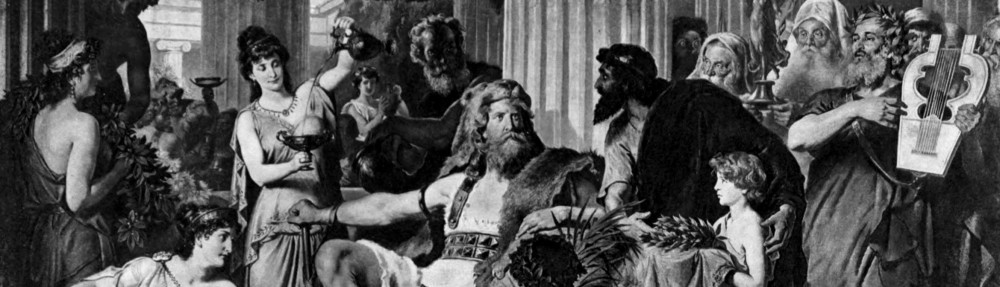
A Time For Choosing

There is an old joke about the topic of free will that goes something like, “If free will did not exist, we would have no choice but to invent it.” In addition to the obvious contradiction lies the fact that everything about human society relies, to some degree, on the existence of free will. What is meant exactly by free will is never clear, but there is always the assumption that when people have choices, they choose based on their sense of what is the morally right or wrong option.

At first this might seem wrong because after all, you choosing to have vanilla ice cream rather than chocolate is not a moral issue, but you still go through a process by which you decide one over the other. If, however, you think about it in terms of costs and benefits, then picking a desert is no different from not robbing a bank. You pick vanilla because you like vanilla more than the other choices. Similarly, you choose not to rob the local bank because you like your freedom.

This concept of free will assumes that humans seek that which brings pleasure and reject that which brings displeasure. Of course, this is also the argument against free will as it suggests humans merely respond to the conditions they encounter. If your genetic makeup means you detest the taste of chocolate, then once you are presented with vanilla and chocolate, you do not have a choice at all. The counter here is that you can always choose to skip dessert.

As Steve Stewart-Williams explains in this short post on the topic of free will, there are three states for us humans. There are those in which we can choose while completely free of coercion, those where we choose with some understanding of the potential consequences of each choice and then conditions in which we have no choice, even though multiple options are available. The first is an illusion, the second is useful and the third is probably closest to reality.

This may seem like a pointless topic, but it lies at the center of human society, because in every collection of humans there will be those who choose not to submit to the decisions of the majority. The majority will usually bargain with these people until they reach a point where the will of the majority must prevail. The easiest way to force compliance is to assume the person knows the morally right choice, but refuses to take it, so they must be compelled to conform.

It is why the people called conservatives invest all their time creating elaborate arguments in favor of their opinions. They lack the will and ability to force people to agree with them, but they resort to a form of pleading. It is the slave mentality, which assumes the master can choose to be good to the slave, so the slave must find some way to coax that good behavior from the master. The assumed free will of the master also flatters the slave’s sense of right and wrong.

Of course, democratic politics rests on the assumption that people are both rational and able to choose freely. Collectively, the choices made by the people will reflect the general will and form public policy and the institutions of society. It is why factionalism is a feature of all democratic systems. Like-minded people come together to scheme up ways to trick the rest into going along with them. This game of liar’s poker we call democracy assumes we possess free will.

This is why the people constantly breying about democracy are also the biggest enemies of the human sciences. Even statistical models like the famous “bell curve” offend them because it suggests we may not have absolute free will. If people are not infinitely malleable, then many of the assumptions within what they call democracy cease to make any sense at all. This is why as the talk of democracy has increased, respect for human diversity has decreased.

It is also why AI makes so many people uncomfortable. It is not the image of hyper-violent machines enslaving humanity. We have been subjected to thirty years of neoconservatism and the Israel lobby, so the rise of the machines is not all that violent or terrifying by comparison. What spooks people the most is that AI suggests that we are not all that variable. In fact, we are highly predictable, and that predictability can now easily be modeled and presented back to us.

There is the main appeal of free will. If we are free to choose and we can overcome our biases, prejudices, and the coercion of others, then it means we can individually and collectively choose a different future than the one before us. The existence of free will means all futures are possible. If, on the other hand, our lives are just the result of probability and circumstance, then the future is also going to be the result of the great roll of the dice, over which we have no control.

The good news is that AI is not very smart and is unlikely to become a genuine artificial intelligence, so we are safe to indulge in the fantasy of free will. To test this, ask your favorite AI tool to create an image of a full glass of wine. It cannot do it, because humans have not bothered to create an image of a wine glass filled to the brim, while calling it a “full glass of wine.” There are other tricks like this that reveal AI to be nothing more than a very good search engine.

All of this sounds pointless, but it lies at the heart of the current crisis. The ruling class of the West assumes they can engineer the cultural conditions in such a way that people will choose the “right” options. This is what lies at the heart of every radical political movement. It is not a rejection of the human condition, but the assertion that the human condition is a social construct. Change the social construct and mankind can choose to overcome even his physical limitations.

One response to this is to find new cultural engineers who have more appealing goals and expectations. Fascism was the response to both communism and liberalism in the last century. It is why today’s radicals assume all opponents are fascists. The other option is to accept free will as a useful workaround but that the human condition is immutable and the variety of normative conditions we see are rooted in things well beyond our ability to control. The choice is ours.


If you like my work and wish to donate, you can buy me a beer. You can sign up for a SubscribeStar or a Substack subscription and get some extra content. You can donate via PayPal. My crypto addresses are here for those who prefer that option. You can send gold bars through the postal service to: Z Media LLC P.O. Box 1047 Berkeley Springs, WV 25411-3047. Thank you for your support!


Whither Europe

In the 2016 election cycle, the majority of the American people signaled that they were done with the ideological politics that had reigned since the Cold War. While Trump did not win a majority in the general election, the election as a whole, including the primaries, made clear that the public was ready to move on. The way to view the last three election cycles is as a long struggle by the public to drag the economic elites out of their isolation and back into politics.

That is what we saw in 2024 and what we are seeing now. What is happening in Washington is both revolutionary and just the start. The cutting of government payrolls is one part of a bigger change in how America operates. The United States is about to end its empire phase and return to being a big powerful country. It is a long overdue transformation that has been made possible by the economic elites realizing things had to change if they were going to remain elites.

Left out of this is what it means for Europe. The issue of Ukraine, for example, has the Europeans on the sidelines, muttering mad ideas to one another about how they will get along as American vassal states without America. They are drawing up grand schemes for re-arming Germany and developing their own nuclear arsenal, so they can pretend Brussels is an imperial hegemon and the political classes of the European states can continue as dysfunctional flunkies.

It is strange to see the Europeans, both their media and their politicians, carry on as if nothing has changed. In the United States, the talk is about the DOGE audits and making deals with the Russians and Chinese. In Europe they are locking people up for speech crimes and looking under their bed for you-know-who, when the closest they will come to seeing him is in the mirror. Suddenly, Europe is a land of poor people wearing yesterday’s fashions.

The problem is most obvious in British politics. The Economist had a cover featuring British Prime Minister Keir Starmer as Winston Churchill. The motivation behind it is the British elites are still suffering from the 1938 disease that used to rage in the United States until the antidote of the 2024 election. If they had made Starmer look like a guest at Studio 54 it would have been less cringe. British politics is a mess of yesterday men looking for a reason to exist.

This post in the Spectator about Nigel Farage inadvertently gets at the problem faced by the Brits and all of Europe. Farage is a generational talent in terms of democratic appeal, but he is worthless as a politician because he accepts the fact that he lacks elite support, especially support from economic elites. As a result, he is always getting close to the important issues facing his people, but he always pulls up just as he is about to engage directly and candidly with them.

What you always sense with Farage is that he desperately wants an invite to the cool kid’s table, so everything he does is aimed at keeping that option open. He could give the ridiculous fops on the continent a tough time, but he never levels the same charges at the local fops, because that would mean giving up forever the chance to sit with them at the cool kid’s table. He may not like their policies, but the dream of being accepted by them still controls his actions.

It is why he is always negotiating with himself when it comes to issues like immigration or Ukraine. Nowhere on earth is there a majority in favor of immigration and in most places, even the thoroughly demoralized portion of the population wants an end to the open border’s madness. This should be a trillion-dollar bill on the ground for Farage to pick up, but he just cannot do it.  He gets close, but always has a reason to leave it there, staring up at him.

What Farage lacks is the backbone that comes from elite support, especially from the economic elite. The reason for that is the indigenous economic elite of the UK was transformed into a local office of American Inc. It could act only with the permission of the bosses in the main office, who for decades were happy to leave things to the managers, both at home and abroad. The result is that the economic elites in Europe have the same managerial mindset as the managers.

The problem can be seen in the list of “British” billionaires. We must put “British” in quotes because the man topping the list is Gopi Hinduja. Number three on the list is Sir Leonard Blavatnik from Ukraine. Fifth on the list is Lakshmi Mittal. This feature of the British economic elite is shared on the continent. What passes for the European economic elite are people who gained their opposition by doing business with the Americans by the rules of the Americans.

The reason the UK is becoming a garbage island is because the “owners” have no connection to it. The servants of those “owners”, huddles in the swanky neighborhoods of London, define themselves by their opposition to the British people. The people of the British Isles got better treatment from the Vikings. The reason Farage can never get elite support is because the elites have no interest in a populist, nationalist message, so Farage reduced to being a charming rumpswab.

There are other forces at play, but all of them have their roots in the fact that Europe has been under American rule for eight decades. The reason Farage cannot be the UK Donald Trump is that Farage is not a member of the economic elite. Trump is a billionaire and sees himself as an equal to the billionaires. His perseverance over the last eight years won over the economic elite. Such a thing is not possible in the UK or on the continent, so they cannot produce their version of Donald Trump.

This does not mean things are hopeless in Europe. In fact, the United States suddenly joining the rest of the world in the 21st century is setting the stage for Europe to finally escape the 20th century as well. It will require a longer and more painful process, like what Russia experience after the Cold War. The reason is Europe will need to rebuild its institutions and develop its own elites. That can only happen when America finally kicks Europe out of the imperial nest.


If you like my work and wish to donate, you can buy me a beer. You can sign up for a SubscribeStar or a Substack subscription and get some extra content. You can donate via PayPal. My crypto addresses are here for those who prefer that option. You can send gold bars through the postal service to: Z Media LLC P.O. Box 1047 Berkeley Springs, WV 25411-3047. Thank you for your support!


A Weird End For A Weird War

Note #1: Last Wednesday was the third edition of a show I am doing with Paul Ramsey every Wednesday at 8:00 which you can watch live on Rumble and YouTube and, of course, watch at your leisure after the fact.


Note #2: Behind the green door, there is a post about Trump’s speech to the joint session of Congress, a post about driving in Hell, and the Sunday podcast. Subscribe here or here.


Note #3: Since we are getting signs of spring, it means it will not be long before it is hot, which means t-shirt weather. Just in time for t-shirt season, we have a new shirt for The Occidental Club, which you can buy here.


The war in Ukraine will go down as one of the stranger conflicts in American history, mostly because it has been a phony war. That is, the American government spent most of the war pretending to not be part of the war, while supplying the Ukrainians with hundreds of billions in war material. With a new administration bringing realism back to foreign policy, the end of the war promises to be strange as well. While the end is known, the path remains a mystery.

The story over the last few weeks has been the squeeze the administration has put on Zelensky to get him to agree to peace talks and agree to sign over the country’s natural resources as compensation for the hundreds of billions in aid. The process has revealed to the administration that Zelensky is an unreliable partner in a peace deal, so his future is now limited. You cannot make a deal with a guy that no one trusts, so whatever peace comes to Ukraine will not include Zelensky.

You see this with the peace talks coming this week between officials from the Trump administration and a Ukrainian delegation. Saudi Arabia is hosting the talks, and one man has been told not to attend. That man is Zelensky. Not only was he excluded from the meeting, but he was also barred from traveling with the delegation. Zelensky had planned to just hang around Saudi Arabia during the talks. Clearly, these meetings are about life after Zelensky.

The main point of the meeting is to find out if there is any support in Ukrainian politics for a peace deal. Getting rid of Zelensky is not a great challenge. Finding a replacement is not a great challenge. The issue is finding a new leader who can sign a peace deal without the country collapsing into turmoil. The Trump administration needs to find someone that can act as an interim leader, get the political factions to accept a peace deal and then hold elections.

If elections were held today, the most likely winner would be the former commander of the Ukrainian army, Valery Zaluzhny. While he has the respect of the army and the respect of the public, he is tightly tied with the ultranationalists. There are a lot of pictures of Zaluzhny posing next to iconography reminiscent of a certain period in German history, because he is extremely fond of that time. That means he is probably not a reliable option as a peaceful leader of Ukraine.

Another option is Petro Poroshenko, an oligarch who got rich in the aftermath of the collapse of the Soviet Union. He first got rich in the candy business, which earned him the nickname of the “Chocolate King.” He also owned media companies, natural resources firms and manufacturing concerns. He has lost a lot of his power over the last five years as Zelensky consolidated his own power in Kiev. Poroshenko is also an outlandishly corrupt figure with ties to the ultranationalists.

Another option is Yulia Tymoshenko, who made some headlines in the West when she briefly became the face of the “Orange Revolution.” She is the leader of the Batkivshchyna (Fatherland) political party and strongly anti-Russian, but she has been a critic of the war and Zelensky’s handling of it. She is an oligarch as well, having got rich in the energy business. This earned her the nickname “The Gas Princess”, which may be one of the better nicknamed in politics.

Within Ukrainian media, the betting favorite at the moment is Tymoshenko for the simple reason that she does not have the ultranationalist baggage. She has her own party outside the Zelensky machine, and she seems willing to strike a deal. It may also be easier for a woman to sell peace to the public. There are millions of wives and mothers of men who have been killed or maimed in the war. That might be enough to overcome opposition from the ultranationalists.

A major challenge to finding a replacement for Zelensky is Europe. The scheming ladies of Brussels view Zelensky as an essential part of their scheme to turn the EU into a replacement for NATO. This is why they are offering him unconditional support for his efforts to scuttle any peace deal with Russia. Then you have individual leaders like Keir Starmer and Emmanuel Macron, who are trying hard to make Zelensky seem like the most honest man in Europe.

Further complicating matters is the condition of the Ukraine army. They are now being routed in the Kursk region. Thousands of their best soldiers are now trapped in a cauldron with no chance of escape. Thousands of others have surrendered and thousands more have died fleeing toward the border. An army low on morale, hearing that its main benefactor wants a peace deal, is not going to respond well to news that its best units have been routed.

Since everything about this proxy war has been strange, it is fitting that its last acts will be strange as well. Normally in a long war of attrition, the side with the upper hand is willing to press on with the war, while the other side wants peace. In this case, the winning side wants a deal, while the losing side demands to fight on, even as its main benefactor demands peace. It will be another reminder that this part of the world produces nothing but misery for everyone around it.


If you like my work and wish to donate, you can buy me a beer. You can sign up for a SubscribeStar or a Substack subscription and get some extra content. You can donate via PayPal. My crypto addresses are here for those who prefer that option. You can send gold bars through the postal service to: Z Media LLC P.O. Box 1047 Berkeley Springs, WV 25411-3047. Thank you for your support!


Radio Derb March 07 2025

This Week’s Show

Contents

  • 00m54s Movies: the long farewell
  • 07m05s Spellbound and swallowed
  • 15m28s Trump’s address to Congress
  • 24m55s Trump-Zelensky style clash
  • 26m49s Help the Brunswick Three!
  • 28m21s The Brits catch “disparate impact”
  • 31m03s Romania should know
  • 33m41s Signoff: It ain’t Joan

Direct Download, The iTunes, Podcast Addict, RSS Feed

Full Show On Spreaker

Full Show On Rumble

Full Show On Odysee 

Transcript

01 — Intro.     And Radio Derb is on the air! Welcome, listeners. That was Haydn’s Derbyshire March No. 2 and this is your briefly genial host John Derbyshire.

I say “briefly” because I am currently oppressed by tasks demanding my time, and so must borrow time from the podcast. I shall not borrow much, but I apologize anyway, and shall proceed direct to this week’s commentary.

02 — Movies: the long farewell.     Last Saturday evening, March 1st, Mrs Derbyshire and I went to the movies. Yes: we left the house, drove down to the village, parked in the supermarket parking lot, and crossed over to the movie theater.

I note the event because it was our first movie night for … well, longer than I can remember. Oh sure, we watch movies. Like most people today, though, we watch them at home via a streaming service. Going out to the movies is nowadays a luxury choice. At eighteen dollars a ticket, sixteen for seniors, it’s not a very extravagant one; but hey, you can’t stay at home all the time.

That there are still movie theaters seems to violate the laws of economics. Our local establishment has eight studios, eight movies playing simultaneously in the one building. All that space, all that equipment; are there really enough customers to justify it?

It didn’t look like it on Saturday evening. This was the 9:15 showing in Studio 8, which has 150 seats. We shared it with about a dozen other people — ten percent occupancy at prime viewing time on a weekend evening.

There are allowances to be made. Our movie was the Bob Dylan biopic A Complete Unknown: a nostalgiafest for Boomers, and also for Silents like Dylan himself and your genial host here, but I guess of limited interest to anyone much under sixty. Our companions in Studio 8 were all geezers and geezerettes.

It’s possible that Studios 1 through 7 were packed. We didn’t see any evidence of that on our way to Studio 8, though. Mrs Derbyshire was the only customer at the popcorn stand in the main lobby.

For those of us who remember the Picture Palaces of the mid-20th century, this didn’t seem like movie-going at all. Where were the lines of people buying tickets? (We bought ours online beforehand. So apparently did everyone else.) Where were the usherettes to escort us to our seats; and then, in the interval, to come out and progress slowly up the aisles selling ice cream from the trays strapped to their waists? (My brother married a movie usherette.) Where were the upstairs balconies for the overflow crowds? Where were the ashtrays on the seat backs, so that the person seated behind you could smoke as he viewed?

Even with streaming services, the whole movie business has dwindled somehow. Sunday evening we watched the Oscars on TV at home, curious to see whether A Complete Unknown won any. It didn’t; and what we saw of those that did left us wondering how many people would bother to watch them. Anora, which won Best Picture, cost only six million dollars to make — the lowest budget for any top Oscar winner, ever.

The Oscar ceremony itself gave off an unmistakable vibe of trying too hard. It was way too long, the audience of movie people too doggedly cheerful, the song’n’dance intervals too plainly pointless. We were watching people trying real hard to keep something propped up.

Movies just aren’t big any more. They are drifting off to the fringes of our common culture.

You can tell that from the catch-phrases they no longer generate. For decades you could be sure that if you uttered one of those catch-phrases in conversation, everyone would get the reference.

  • “Frankly, my dear, I don’t give a damn.”
  • “I coulda been a contender.”
  • “Make my day.”
  • “You talkin’ to me?”
  • “I’ll be back.”
  • “I want what she’s having.”

That last one is from a 1989 movie. It was the latest catch-phrase I can recall hearing in everyday socializing. You may be able to come up with something later; but not, I’m pretty sure, much later, probably not from this century.

Do we even have a common culture any more?

03 — Spellbound and swallowed.     What about the movie itself, though, Derb? Is it any good?

Sure, we both enjoyed it. For me, as I said, it was a great nostaglia feed. For my lady it was a lesson in recent American cultural history, seasoned with some complex romantic interest of the kind that always holds the female attention.

And I should say, having somewhat slighted the local movie theater, that I greatly appreciated the big, comfortable recliner seats; and also that it’s a great civilizational improvement to not have a forest of upward-drifting cigarette smoke between oneself and the movie screen.

And there are of course much grander movie theaters than our suburban AMC. There’s the Parisian Art Deco in downtown New York City, for example. Quote from a New York Post story about the place, quote:

Tickets, which go up to $215 (tax and gratuity not included), grant access to a formerly private theater, where attendees lounge artfully in gold velvet loveseats and plush chairs beneath an exquisitely apropos gold-leaf ceiling.

End quote.

Back to Saturday night’s movie: Timothée Chalamet is a very good Dylan, both in appearance and scratchy personality. He had obviously worked hard at being Dylan the musician: voice, guitar, and harmonica. Edward Norton is a credible Pete Seeger.

I thought it a bit odd that Suze Rotolo was renamed Sylvia Russo for the movie’s purposes, but that was apparently at Dylan’s request. Elle Fanning was anyway good in the role, although we get very little of the issues Dylan had with Suze’s family, those issues he later so regretted having musicalized as Ballad in Plain D. Monica Barbaro does as good a Joan Baez as anyone could do that is not actually Joan Baez.

That’s as much movie criticism as I am capable of. The main satisfaction for me in watching A Complete Unknown was, as I have said, nostalgic.

I clearly recall my first encounter with Dylan’s music. This was my second year at university in London, late 1964 to early 1965. I was living in Crouch End. No, that’s not some painful disorder of the lower bowel or a fielding position in the game of cricket; it’s a district of North London. In the 1960s Crouch End was lower-middle-class residential, a bit shabby and with a lot of bedsitters — rented rooms in private houses, sharing a bathroom with the other inhabitants of the house.

Wikipedia tells me that Crouch End has since become much more tony, artsy, and expensive. Quote: “In 2023, it was voted the best place to live in London.” End quote. That would have astounded the young Derb. I come too early to every party, darn it.

My bedsit was in a house belonging to a middle-aged lady whose husband had left for some reason. Her son and her daughter were also in residence, both about my age — late teens or early twenties. The daughter had a job and a busy social life, so she was rarely at home. The son was a student at a local art college.

Art students were the cultural avant-garde, always first to pick up on new fads and trends. Bob Dylan’s music had been known to these British art-school pioneers for a year or more at that point, but his name was not in general circulation.

I first heard both name and music from my landlady’s son when he had just bought the fourth album, Another Side of Bob Dylan. In his room one night he played me one of the tracks, “Chimes of Freedom.” I was bowled over.

[Brief clip from “Chimes of Freedom.”]

Sorry that’s a short clip. Dylan’s people are notoriously vigilant about unauthorized broadcasting of his voice recordings, and I don’t need a lawsuit.

The song just wasn’t like any other I’d heard. It was sui generis. It — words and music together, a unity — got and held my attention. I learned on Saturday night that it still holds my attention sixty years later.

I caught the lefty vibes in Dylan’s lyrics, of course, but I didn’t mind them. I was a nineteen-year-old undergraduate, a member of my college Socialist Society. Of course I didn’t mind them. To judge from his later career, Dylan’s interest in political and social issues did not in any case run very deep — nothing like deep enough to invalidate his songwriting genius.

As you can probably tell, I’m a major Dylan fan to this day. The man is still with us, coming up to 84 years old, living mostly in Malibu. I hope his property didn’t take a hit from these recent fires. Long life to you, Sir, and thanks for some beautiful songs.

04 — Trump’s address to Congress.     Domestic political news this week was dominated by President Trump’s address to Congress on Tuesday evening.

I didn’t watch it. For reasons why I didn’t watch it I refer you to Chapter Three of my momentous 2009 political testimony We Are Doomed, where I gave a long and detailed lashing to the State of the Union address, as it had developed in recent decades.

I’m not clear on whether Trump’s Tuesday evening effusion counts as a State of the Union speech, but it might as well: the format and staging are identical. There was even an array of Lenny Skutniks for our admiration and applause.

To spare you the effort of reaching for your copy of We Are Doomed, let me summarize my critique.

In my book I blasted the State of the Union spectacle, as it has developed, as too grandiose and imperial for a modest commercial republic. I called it a “Stalinesque extravaganza,” and urged that the President’s annual message should be delivered in writing to Congress, as it was for most of our nation’s history and as late as Richard Nixon’s fourth address.

My opinions haven’t changed since I wrote that book, so of course I didn’t watch the Tuesday evening show.

A young friend with opinions much like mine did watch it. Quote from his email:

I have never, ever watched a State of the Union type speech all the way through, because they are boring. Not this time. Trump was masterful. Patriotic and light hearted. So many good lines. My dad used to have us listen to Reagan on the family radio, and I enjoyed Reagan. But Trump was even better than I remember Reagan was. A speech that should go down in history.

End quote.

Coming from a friend I trust, that moved me to guilt somehow, so I pulled down the YouTube video of the speech and sat down to watch it. A little over an hour in, I got bored and annoyed by all the breaks for applause, so I just scanned the New York Times transcript for the remainder of the speech.

All right, not bad. Trump gave a clear picture of his intentions, and spoke with conviction and force. There were lots of good lines, right on target, like, quote:

The nation founded by pioneers and risk-takers now drowns under millions and millions of pages of regulations and debt.

End quote.

Still, though, like the Oscars it was much too long: one hour, 39 minutes and 33 seconds, according to YouTube — 99½ minutes plus three seconds.

That’s more than twice the limit they teach you on public-speaking courses. On mine, at any rate, the instructor repeatedly hammered the point that no-one can sit and listen with uninterrupted attention to another person speaking for more than forty-five minutes. Forty-five minutes was, he told us, a universal constant, like the speed of light, independent of circumstances — of speaker, audience, topic, anything.

To be fair to my President, some of those 99½ minutes was not him speaking, it was his supporters applauding or Representative Al Green being escorted out.

How much was Trump speaking? To get some kind of handle on that I fed the transcript into Microsoft Word for a word count, after pruning out anything not Trump. Answer: 9,836 words.

That’s still a mighty lot of words. By way of comparison, last week’s Radio Derb had a spoken portion of 3,879 words. That lasted 41 minutes and ten seconds. At that speed, to speak the 9,836 words the President spoke would take me one hour, 44 minutes, and 23 seconds.

All right: Trump’s busy American diction is faster than my laid-back Old World style. I’m none the less going to assert that in those 99½ minutes on Tuesday evening, even if you subtract out applause and interruptions, Trump was actually speaking for a lot more than forty-five minutes. Too long!

My advice to our President, and to all his successors, is as follows.

  • To fulfill the Article II constitutional requirement that you, quote, “shall from time to time give to Congress information of the State of the Union and recommend to their Consideration such measures as [you] shall judge necessary and expedient,” end quote:  mail it in.
  • If you want to directly address not just Congress but us citizens at large, do so in sound clips on TV, radio, or social media, no sound clip exceeding forty-five minutes. In fact I think bite-size pieces just ten or fifteen minutes long would have more punch.

Beginning his second term as president of the Massachusetts State Senate in January 1915, Calvin Coolidge delivered the following address to the assembled senators. Quote:

Honorable Senators: My sincerest thanks I offer you. Conserve the firm foundations of our institutions. Do your work with the spirit of a soldier in the public service. Be loyal to the Commonwealth and to yourselves and be brief; above all be brief.

End quote.

That’s 44 words: less than half a percent as long as Trump’s Tuesday evening oration, but in it own small-“r” republican way, just as potent.

05 — Miscellany.     Pressed by circumstances temporarily beyond my control and with President Coolidge’s injunction ringing in my ears, I shall proceed to our closing miscellany of brief items.

Imprimis:  Last Friday’s fiasco at the White House with Ukraine’s President Zelensky holding a public meeting with our own President and Vice President generated much commentary. It seems to me to have been a clash of fundamental outlooks.

I persist in seeing the Russia-Ukraine War as I saw it seven weeks into the hostilities, as a war between the world’s two most corrupt white nations.

President Zelensky was, and is, a characteristic product of one of those nations. He is steeped in the style, the thinking, the manners, of a political establishment ruled by cynicism and corruption. So, of course, is Putin.

Trump’s style is entirely different. Trump has spent his life in the transactional world of business dealing, where interpersonal trust and judgment play key roles. There is some cheating and dishonesty, of course, just as there is occasional truth and sincerity in Zelensky’s world; it’s a matter of proportions, of everyday assumptions.

The two outlooks may be fundamentally incompatible. I think Trump understands this; I don’t think Zelensky does.

Item:  I have many, many times expressed my belief that the arrest and sentencing of the Brunswick Three in the death of Ahmaud Arbery five years ago was an outrageous miscarriage of justice.

If you are still not convinced, or don’t know the appalling details of the case, I strongly recommend you read Jack Cashill’s very full account in the February 15th American Spectator. I hope the Spectator won’t mind my having downloaded a PDF of Cashill’s article to my personal account where you can read it for free.

The oldest of the Brunswick Three is Gregory McMichael, currently held at the state medical prison in Augusta, Georgia. His wife Leigh runs a website where you can get on her mailing list for updates about the appeals and instructions on how to donate to the defense fund.

This is a terrible story of gross injustice. Please do anything you can for the Brunswick Three.

Item:  Even if I were not unusually pressed for time I would not be able to give you a full account of the latest development in Britain’s decline to a Third World slum. I remember too well what a lovely country she used to be, and the pain of speaking about what she has become is too great.

So here is the latest, in very brief. Within the British justice department is an outfit called the Sentencing Council, independent of the rest of the government. The council’s rulings on correct sentencing can’t be over-ruled without legislation in Parliament.

Their most recent ruling is that when pondering a sentence for someone convicted of a crime, the courts must, quote “avoid disparity of outcomes for different groups,” end quote.

For what different groups? Among some obvious ones — pregnant, first offender, addict, primary care-giver for dependent relative — the Council specifies defendants, quote: “from an ethnic minority, cultural minority, and/or faith minority community.” End quote.

Yes: the stupid and evil doctrine of “disparate impact” is being written into the British judicial process. The proportions of blacks and Muslims in the country’s prisons are higher than in the general population. Sentences must be reduced for them, or increased for whites and non-Muslims, to make the proportions equal.

Those currently higher proportions must, after all, be the result of racial or religious prejudice lurking in the courts. What else could possibly be causing them?

Item:  A couple of weeks ago I mentioned the annulling of December’s presidential election in Romania. The ruling class in that country got the election annulled because it had been won by Călin Georgescu, a populist-nationalist candidate.

February 26th Georgescu was sort-of arrested. He wasn’t actually dragged off to jail, but he was barred from leaving Romania and from using social media. There seems to be an element of house arrest, too: the New York Times told us on the 27th that, quote:

Police officers on Thursday visited his home near Bucharest, Romania’s capital, to check on his whereabouts and activities.

End quote.

This week we’ve been getting reports of huge crowds out in the streets protesting the treatment of Georgescu.

I have no idea how this will end up. Those scenes of demonstrating crowds did, though stir happy memories of Christmas 1989.

Four days before Christmas the communist dictator of Romania, Nicolae Ceauşescu, had been giving a routine dictator speech from his balcony to a big crowd of citizens in the square below when the crowd suddenly turned against him.

Ceauşescu scurried back indoors. Next day he and his wife fled from the capital by helicopter. They were soon arrested, though. On Christmas Day they were tried and shot, and the Ceauşescu dictatorship ended.

The rulers of Romania should surely know, if anyone should, that the voice of the people will sooner or later be heard.

06 — Signoff.     That’s all, ladies and gents. Thank you for your time and attention.

Peter Brimelow tweeted on Wednesday that, tweet:

VDARE just paid legal bills for February: nearly $15k. After nearly 3 years, we’ve still not been charged with ANYTHING: we’re just fighting to keep writers’ and donors’ names out of NYAG Letitia James’ hands.

End tweet.

If you can help. please do: by subscribing to Peter Brimelow’s Substack account, or with a check to the VDARE Foundation itself at P.O. Box 211, Litchfield-with-a-“t”, CT 06759. You can support me personally by earmarking that check with my name, or by any of the other options spelled out on my personal website. You can also support me indirectly by subscribing to that splendid monthly magazine Chronicles, to which I am now a regular contributor. Thank you!

For signoff music … you guessed it: I’m going to give you some Dylan. As I’ve mentioned, though, the Dylan people are ever watchful, so I shall cheat a little. I’m going to give you the lovely voice of Joan Baez singing Dylan’s lyrics.

Here was the lady sixty years ago — just at the time, or shortly after it, when her affair with Dylan had ended, breaking her heart.

There will be more from Radio Derb next week.

Foreign Policy Realism

One of the interesting things about the shift in foreign policy initiated by the Trump administration is that it is a break from what has been policy for a century. This sudden lurch into realism is a departure from Wilsonian democracy. Trump wants to center policy on the material interests of the country. Up until now, policy was centered around moral claims about how the world ought to be ordered.

Through the Cold War it was assumed that pragmatism was the rule because of the threat of nuclear annihilation. The better way to view it is that Wilsonian democracy was on a leash for forty years. Once the Cold War ended, it was like a hyperactive dog that got under the fence. The last thirty years has been an explosion of Wilsonian democracy playing catchup for lost time.

Even during the Cold War, American policy makers and politicians had a fondness for moralizing about the world. There were endless debates over the morality of dealing with dictators who happened to be anti-Soviet. This was finally resolved in the 1980’s with the distinction between authoritarian and totalitarian. The former was a temporary compromise, while the later was a forever enemy.

Once totalitarianism ended, then it was a race to go around the world addressing the temporary tolerance for governments not up to American standards. Now it seems this has run out of road and necessity is once again forcing a return of realism in the foreign policy realm. That is the show this week. It is a general primer on realism versus the idealism that is now being abandoned.


For sites like this to exist, it requires people like you chipping in a few bucks a month to keep the lights on and the people fed. Five bucks a month is not a lot to ask. If you don’t want to commit to a subscription, make a one time donation via crypto. You can send money to: Z Media LLC P.O. Box 1047 Berkeley Springs, WV 25411-3047. You can also use PayPal to send a few bucks. Thank you for your support!


This Week’s Show

Contents

  • Intro
  • Foreign Policy: How Nations Behave
  • Just War
  • Wilsonian Democracy
  • Liberalism
  • Thucydides
  • Realism

Direct DownloadThe iTunes, iHeart Radio, RSS Feed

Full Show On Spreaker

Full Show On Rumble

Full Show On Odysee

The Death Of Hollywood

Show Announcement: Last night was the third episode of the award winning livestream that you can watch on Rumble and YouTube.


The Academy Awards show was this week and outside of the bugmen on YouTube, there was not much interest in the program. They claim it drew 19.69 million viewers, but they also claim that it is a five-year high, even though the number they claimed last year was slightly higher. Like everything else about the entertainment business, television ratings are mostly fake. There was a time when this award show was a big deal, but now it is mostly fodder for critics and comedians.

There are a lot of reasons why people have stopped caring about the awards shows, but one big reason is the product is dreadful. The nominees for best picture were a who’s who of films no one watched. The winner for best picture was a film called Anora, which appears to be a low-budget Slavic version of Pretty Woman. One of the runners up was a film called The Brutalist, which is about hideous architecture. It was also a low-budget, low-interest film that went straight to home video.

According to the bugmen who follow this stuff, the winner was supposed to be a film called Emilia Pérez, but the people who decide these things changed their minds at the last minute because the transvestite star had once held unapproved opinions about blacks and Muslims or whatever. Apparently, there is a hierarchy of degeneracy that the carnies are required to respect. It is Hollywood, so who knows if any of it is true, but it gets to why these awards show are floundering.

The Oscars used to be a popular topic because people were curious about how their opinions of the films stacked up with the insiders. Women liked watching the stars parade on stage and do their act in a social atmosphere. That only works when people watch the films and recognize the so-called stars. A Spanish man dressed as a woman, who is totally unfamiliar to Americans, lumbering on stage to get an award is not going to be a big draw for an American audience.

The fact is, Hollywood no longer serves the American audience. You see it in the box office for this year. The top grossing film is comic book movie that is popular with non-English speakers because it is mostly special effects and stupid dialogue. Half its gross is from overseas and you can be sure that a big chunk of the domestic box office is from people who are on the lookout for Tom Homan. Remove the nonwhite box office and Hollywood does out of business.

Of course, the dependence on foreign sales and non-English-speaking domestic customers is driven by the general decline in quality. Who is the biggest male lead in Hollywood these days? If you do not know, you are not alone, but it is probably a homosexual or a nonwhite. The same is true for female stars. The days of Hollywood stars being glamourous and recognizable are gone. Instead, it is a freakshow of random carnies picked from the diversity lottery.

Starting about ten years ago, Hollywood began to see a steady decline in revenues in North America, for both movies and television. Every year the gross declines, with some years seeing double digit declines. The remedy is to make an increasingly offensive product, which drives down the numbers further. Even easy things like remakes of classics turn into fiascos. The live-action Snow White has been repeatedly delayed because the diversity loons turned it into a punchline.

The funny thing about the collapse of Hollywood is that it is a good proxy for what we have seen in society as a whole. Unlike the government, colleges or the media, Hollywood needs to move product and that means they have to provide a product that the audience wants to buy. It is the ultimate test of the social fads pushed by the radicals over the last ten years. The fact that it was a disaster in the market should have been a clue to what was coming.

Things are about to get worse for the entrainment rackets. AI will soon make writers obsolete as software will generate scripts. Given that we know there are a finite number of plots and character types, and there is data on how these combinations appeal to audiences, it is easy to see what happens. Software will generate scripts that have the highest probability of success that year. That means all the experts on what is trending will be working at Home Depot.

Of course, the content itself will soon be generated by robots. You can now generate believable audio conversations using hints and suggestions. Businesses are already doing this for training and development. Video is coming online next. This not only will replace the actors, but it will lower the barrier to entry of filmmaking. Soon, teenagers will be making feature films that they find interesting. Just as digital audio killed music sales, AI will kill the Hollywood production studio.

To fill this out a bit, imagine you want to watch a film and you want something like the old spy thrillers of the past. You talk to your television about what you have in mind and it creates a feature film using your suggestions. Maybe it first suggests content made by others who had the same idea. Or maybe it recreates a James Bond film using period correct actors, but with changes based on your inputs. This is something that will soon be possible with AI.

What all this points to is that the woke lunacy that has raged for the last decade may have been the last effort at ideological control of the culture. The slow and steady erosion of the control mechanisms coincided with the woke rage. Perhaps the blue haired rage head was a reaction to the steady disaggregation of the culture that has been brought on by the technological revolution. She was not the vanguard, but a desperate rearguard action that has failed.


If you like my work and wish to donate, you can buy me a beer. You can sign up for a SubscribeStar or a Substack subscription and get some extra content. You can donate via PayPal. My crypto addresses are here for those who prefer that option. You can send gold bars through the postal service to: Z Media LLC P.O. Box 1047 Berkeley Springs, WV 25411-3047. Thank you for your support!


The Blanche DuBois Problem

Show Announcement: Tonight at 8:00 PM eastern, Paul Ramsey and I will be discussing communists and the best way to execute them. You can tune in live on YouTube and on Rumble.


Over the last thirty years, many people have noticed that all moral claims within the public policy sphere can be reduced to a few time periods. In the realm of foreign policy, it is always about 1938 and the events around that time. If it is a domestic issue in the United States, then it is always 1968. Perhaps the slow Progressives will try to make it about the 1980’s when their hero was president. For Americans, public policy is trapped in one of three historical frameworks.

On the foreign policy side, it is easy to see how this works. There have been so many new Hitlers on the stage, no one can keep count. Every foolish and destructive misadventure by Washington involves a Hitler figure. They are not just a generic bad guy in the propaganda sense of it, but they represent the re-emergence of the timeless enemy and the timeless struggle. Everything about American foreign policy since the Cold War is about preventing an imaginary past.

This cognitive defect has made its way across the ocean to Europe. Whenever there is a meeting of the local satraps of the American empire, they take turns looking worried in front of the cameras, talking about the possible reemergence of you know who and the danger of resembling Neville Chamberlain. This moral framework is so powerful that they were unable to notice the irony of the Ukrainians using German tanks to attack the Russians in the Kursk region.

In the United States, the other great moral framework is the Civil Rights movement, into which every local issue is jammed. Every black politician imagines herself as the you-go-girl version of Martin Luther King, which means even mundane issues like maintaining the roads is a civil rights issue. Every man in a dress not being called “ma’am” by the clerk is Rosa Parks. This framing has gone so far that nonwhites are routinely called white supremacists.

One of the features of those who have crossed the great divide is that they see the past as the past, not as an emotional support framework. Whatever lessons can be learned from the past in order to navigate the future are studied, but otherwise, the modern dissident accepts that tomorrow does not lie in yesterday. For those trapped in the 20th century, it is an endless singing of “Tomorrow Belongs To Me” and morality tales where they are the hero.

This irrational attachment to the past is ironic, in that the whole point of the Progressive ideology was to advance human society forward, with forward defined as an advanced state of moral existence. While Progressives of the past often focused on material improvement, the spring has always been eschatological. Better stuff was proof of better living and better living was always a normative issue. It is why they continue to see themselves as the Elect.

The thing about ideology is that it tries to replace something that the Christian West eventually took for granted. Within Christianity there is an assumed point to living within the bounds of Christian ethics. Live a Christian life and your reward is eternal life at the feet of God. Ideology cannot offer this because ideology rejects God as the moral authority, so there must be some other reason to follow the moral demands of the ideology, which becomes the project of the ideology.

Marx probably understood this when he described life in a socialist society as a world of men able “to hunt in the morning, fish in the afternoon, rear cattle in the evening, criticize after dinner.” He was criticizing specialization and its dehumanizing qualities, but he was also describing a world where men were liberated from the human condition, free to be what they chose. Communism always imagined an end point that recreated heaven on earth.

At some point, every ideology must at least imply a vision of the future as a reason to continue to live within and fight for the moral claims of the ideology. If the point of the ideology is more of the same, then why bother? Therefore, central to every ideology is a point to the struggle, a destination that promises to liberate people from whatever vexes the ideology. Therein lies the reason why the modern Progressive remain trapped in and obsessed with past struggles.

Progressivism was always a weird hybrid of Protestantism and liberalism, so it could leave unsaid the promise of Christianity, while refashioning the ethics of Christianity around claims to universalism, egalitarianism and eventually the blank slate. At its peak, it was a restatement of Winthrop’s sermon “A Model of Christian Charity,” but stripped of all Scriptural references. It resonated with an audience that continued to be informed by the vestigial Christianity they inherited.

The implied destination of Progressivism no longer works on an audience lacking even a basic Christian frame of reference. This void has been filled with a circular version of history in which events of today are recast as versions of the old glorious struggles of the past, where the good guys won, and the bad guys were sent fleeing. The Elect in this arrangement are those who can imagine themselves wearing the white rose of resistance or riding a bus in the Jim Crow South.

In this regard, Progressivism has become a hive without a queen. The queen is the promised land, and the hive is the habits of mind that form the ideology. They are the Christian zealots with no conception of God and only a vague understanding of what lies after this moment in time. This void is filled with anger, which is why they have become so vicious in defense of the absurd. The source of their rage is their spiritual death, which they cannot comprehend.

This obsession over 1938 and 1968 is not just a way to solve the pointlessness of Progressivism, but also a way to escape present reality. Every Progressive, whether of the fast or slow variety, is a version of Blanche DuBois, saddling the next generations with themselves and their stories of the past. The rest of us are now struggling to figure out what to do with them. They are an unwanted and useless presence to the people of the present, trying to move into the future.


If you like my work and wish to donate, you can buy me a beer. You can sign up for a SubscribeStar or a Substack subscription and get some extra content. You can donate via PayPal. My crypto addresses are here for those who prefer that option. You can send gold bars through the postal service to: Z Media LLC P.O. Box 1047 Berkeley Springs, WV 25411-3047. Thank you for your support!


The Ghost Of The People’s Party

Note #3: Since we are getting signs of spring, it means it will not be long before it is hot, which means t-shirt weather. Just in time for t-shirt season, we have a new shirt for The Occidental Club, which you can buy here.


Most of the ideas that shaped 20th century America boiled up during the 19th century in the aftermath of the Civil War. Some arrived from the Old World before and during the war, things like nationalism and socialism, but most were homegrown ideas that arose out of American Protestantism and the struggle with secularization. Interestingly, the Progressive ideology that emerged was sparked by the populist forces at the time and is now threatened by the same populist forces.

The 19th century was a wild time in America. Prior to the Civil War, it became increasingly clear to the industrializing North that the Constitutional framework was not working for them. The Hartford Conventions, largely erased from the history books now, were a series of conferences in the North to debate leaving the Union. This process was short-circuited by the War of 1812, but the sentiment merely found a new home in abolitionism and finally flowered in the Civil War.

The post-Civil War period was no less tumultuous. Reconstruction was a failure, but a foreshadowing of what would be a feature of the progressive ideology. That is the belief that societies can be reordered in such a way that the people in those societies change how they think about themselves, their neighbors, and the state. The abolitionist fanatics did not abandon these beliefs after the failure of reconstruction. They continued to refine this belief as progressivism flowered in the 20th century.

Of course, progressivism itself is a 19th century phenomenon. It emerged out of American Protestantism as a belief that human society can only advance through relentless social reform. The same people who were sure they could reinvent society to accommodate the freed slaves as equals were now sure they could use the lessons from industrialization to reorder America and the world. Religious social reform became a secular political movement.

The engine that made progressivism possible was populism, which was not unique to America or even unique to the 19th century, but if you look at the populist movements of the 19th century, you see many of the features of what would later be the progressive movement and then progressivism. The populists were not angry mobs assembled outside of the homes of the rich, demanding redress of their grievances. They had an agenda that was mostly crafted by elites in waiting.

For example, the Ocala Demands were a platform of economic and political reforms that became the basis of the People’s Party. It was “produced” by the various farmer’s alliances that had sprung up as mutual aid societies following the Civil War. These groups were brought together in the Marion Opera House in Ocala, Florida, where they approved this list of demands. This was formally called the Ocala Demands and was adopted by the People’s Party.

When you read the demands, the first thing that is clear is that they were not written by a collection of dirt farmers in the South. It was not the work of the Colored Farmers’ National Alliance and Cooperative Union either. That was a real group that participated in the Ocala convention, along with the Southern Farmers’ Alliance. These were not people debating the abolishment of the futures markets, the regulation of the money supply or the imposition of a graduated income tax.

The platform was the work of intellectuals and reformers who saw an opportunity to ride the wave of populism to power and influence. They saw a grassroots movement of disaffected farmers as a vehicle for building a coalition in support of their reform ideas, so they attached themselves to it. It is not an accident that the populist agenda looked a lot like the progressive agenda that would emerge in the 20th century. Progressivism would not have been possible without populism.

It is why it is fair to wonder if what we are seeing and have been seeing for the last few decades is the death of the last remaining ideology, progressivism. Populism seems to be an end of cycle phenomenon. It is, after all, a disorganized revolt against the current order, which has reached its maturity and is entering decline. What follows a populist uprising is either a replacement of the old order, a reform that replaces the old elite or a reform effort by the elites themselves.

The assault on the Blob by the Trump administration, led by Elon Musk, is clearly an assault on the old managerial order. Elon Musk is the face of the new technological elite, so it is fitting that he is the point man for this task. Managerialism is the traveling partner of ideology. It was a feature of both fascism and communism. Its looming demise at the hands of the Trump administration, which was powered by a populist uprising against it, fits the historical pattern.

Progressivism has had a long run, but for most of the 20th century it served as a bulwark against fascism and then communism. Its social reforms stopped making any sense by the latter half of the 20th century and either disappeared from the agenda entirely or morphed into bizarre sexual fetishes. Its main reason to exist was to fight communism, but once communism was gone, it was left without a devil, so it has gone insane over the last decades in search of Old Scratch.

The populism that brought Trump to the White House in 2016, sustained him in his wilderness years and then returned him the White House was driven by the excesses and insanity of progressives. Populism is usually framed as the people versus elites, but in this case, it was normal people versus crazy people. The best way to describe the first weeks of the Trump administration is the return of normalcy, unless you are a member of the hive we call the left.

In the fullness of time, what this period may be known for is the death of the last ideology, knocked off by the same forces that spawned it. American populism has always been a check on the excesses of the elite, not as a physical or even political force, but as a cultural force. Ideology is always about changing culture, so it is ironic that the last ideology will be vanquished by a cultural phenomenon. The ghost of the People’s Party has finally called progressivism home.


If you like my work and wish to donate, you can buy me a beer. You can sign up for a SubscribeStar or a Substack subscription and get some extra content. You can donate via PayPal. My crypto addresses are here for those who prefer that option. You can send gold bars through the postal service to: Z Media LLC P.O. Box 1047 Berkeley Springs, WV 25411-3047. Thank you for your support!


The Zelensky Problem

Note #1: Last Wednesday was the second edition of a show I am doing with Paul Ramsey every Wednesday at 8:00 which you can watch live on Rumble and YouTube and, of course, watch at your leisure after the fact.


Note #2: Behind the green door, there is a post about the events of last Friday, a post about the importance of knowing who is in charge, and the Sunday podcast. Subscribe here or here. I was also on with the boys from the Old Glory Club where we discussed the events of the day. The replay is here.


Note #3: Since we are getting signs of spring, it means it will not be long before it is hot, which means t-shirt weather. Just in time for t-shirt season, we have a new shirt for The Occidental Club, which you can buy here.


Ronald Reagan was famous for saying that “the closest thing to immortality is a government program.” He was not the first person to say it. There are examples of American politicians saying a version of this going back to the 1930’s. There are probably versions of this concept going back to the Kingdom of Ur, because it is the nature of government to create constituencies in favor of its actions and those constituencies always lobby for more of what created them.

You see this with Project Ukraine, which was largely created by a small number of zealots called the neocons in the Obama administration. They overthrew the government of Ukraine, installed an anti-Russian government and just like that there was money and opportunity in Ukraine. By the time Trump came along in 2016, the Ukraine project had a sizable constituency in the Western ruling class, which is why Trump was impeached. He threatened the project.

Since the war broke out in 2022, the power of the Project Ukraine constituency has grown much stronger for monetary and political reasons. Important interests in Western countries are making money from the war, so they support politicians who seek to keep the war going. The politicians are happy to oblige, as the war is a nice distraction from the boring tasks the voters expect from government, tasks that the political class has thoroughly and completely ignored.

There is also the fact that the European political class operates like a preschool, where they are the children, and the United States is the teacher. Ending Project Ukraine is like forcing them into regular school or maybe sending them home to parents who do not fawn over them like their teachers. The reality of Europe is bleak, largely due to the perfidy of the Europeans political class. They prefer not to face that and instead fixate on this glorious adventure in which they are the heroes.

Of course, like all government programs, there is the program itself, which always adheres to the iron law of bureaucracy. In any bureaucratic organization there will be two kinds of people. There will be those who are devoted to the goals of the organization and those dedicated to the organization itself. The second group will gain and keep control of the organization. We see this with how the Blob is fighting DOGE like Grendel facing off against Beowulf.

This is what we see with Zelensky. He is the anthropomorphized government program, consumed with defending its prerogatives. It is why he was so nasty in his trip to the Trump White House. He could not believe that these people would have the audacity to make demands upon him. He is the indispensable man, on whose shoulders rests the fate of the free world and through him is expressed the hopes and dreams of the managerial class that created him.

This is the problem the Trump administration faces as they seek to wind down what they consider to be a pointless and costly enterprise. They wisely drove a stake through the heart of that part of the Blob that has controlled American foreign policy, which is why official Washington is struggling to defend Project Ukraine. Legacy media is simultaneously calling Trump Chamberlain and Hitler – he is somehow appeasing himself – but otherwise they have no answers.

The Europeans are another matter. They see themselves like the tax eaters in Washington getting memos from Elon Musk. For them, Project Ukraine is their reason to exist now, so Trump’s plans to end it are an existential threat. It is why they cooked up the scheme to trick Trump into going along with their peacekeeper idea last week and why they are now busy cooking up a new scheme. Ukraine is their teddy bear, and they cannot think of being without it.

Zelensky is the key here, as his very life probably depends on this war never ending, at least not until he has an exit strategy. He cannot make a deal with the Russians because the ultra-nationalist will not tolerate it. The only deal he could make is one that requires Russia to surrender, which is not a possibility. His other choice is fleeing the country, but he would no doubt be tracked down by enemies. That leaves him with no other choice but to keep the war going.

One of the truths of a government program is that when it is finally killed off, the world never ends and the people dependent upon it find something else. After the initial sobbing and moaning, the dogs bark and the caravan moves on. That will be the case with Project Ukraine. What must happen first is Zelensky must exit the stage, and either be replaced by chaos or by someone willing to do a deal to end the war. At that point, the Europeans will adjust to the new reality.

This is where things stand now. At some level the Europeans seem to know it, which is why they put on a show over the weekend featuring their favorite comedian. It was a funeral where they could all hug and reminisce, except the corpse was still walking and talking, demanding more money and weapons. The reason Zelensky keeps talking about resigning is he knows that for this program to finally end, he must exit the stage, so he is hoping to create conditions which drag that out a bit longer.

While it may feel like government programs are immortal, immune to all efforts to slay them, nothing lasts forever. That is what we are now seeing. Along with the death of the 20th century mindset in American foreign policy is the death of its last great program, Project Ukraine and its anthropomorphized representation of it. Once Zelensky is gone, the war ends, and the process of developing new, normalized relations in Europe begins as we exit the post-Cold War world.


If you like my work and wish to donate, you can buy me a beer. You can sign up for a SubscribeStar or a Substack subscription and get some extra content. You can donate via PayPal. My crypto addresses are here for those who prefer that option. You can send gold bars through the postal service to: Z Media LLC P.O. Box 1047 Berkeley Springs, WV 25411-3047. Thank you for your support!


Radio Derb February 28 2025

This Week’s Show

Contents

  • 03m05s Snobs & Slobs, Euro style
  • 10m11s Trump trashes Ukraine
  • 15m12s The mystery of South Africa
  • 21m29s Don’t look up
  • 28m31s Scatter the feds!
  • 31m16s Fort Knox, wha?
  • 34m30s Return of Butch & Suni
  • 36m16s World Hippo Day
  • 39m05s Silly signoff

Direct Download, The iTunes, Podcast Addict, RSS Feed

Full Show On Spreaker

Full Show On Rumble

Full Show On Odysee 

Transcript

01 — Intro.     And Radio Derb is on the air! Greetings, listeners, this last day of February, greetings from your normatively genial Radio Derb host John Derbyshire.

The first thing you want to know is of course whether I can list five things I got done last week to justify my employment. Of course I can! Five? How about eight? That’s the number of segments in last week’s podcast, not counting Intro and Signoff. There was a carefully-crafted segment on each of the following:

  1. Vice President J.D. Vance at the Munich Security Conference.
  2. President Trump giving the elbow to Ukraine.
  3. The condition of South Africa.
  4. A possible asteroid strike.
  5. Scattering federal departments out of D.C.
  6. Securing Fort Knox.
  7. Getting our astronauts home from the International Space Station.
  8. World Hippo Day.

Talk about spanning the globe! Note that list includes three segments on foreign affairs, after my confessing openly that I don’t much care about them. My scope even includes interplanetary space.

So yes, Elon, I have no difficulty responding to your Saturday email demand; although since I am not a federal employee my response is entirely voluntary.

Perhaps I should be a federal employee. What’s the healthcare plan like?

02 — CPAC report.     Radio Derb goes on the air Friday evening or early Saturday, so my report on Saturday events comes six days later at week end.

That’s a shame as news ages fast. The news from six days ago is yellowish and curled up at the edges, and it’s starting to smell bad.

So it is with most news items, anyway. There are some exceptions: news items so piercingly relevant and forcefully presented, they’re still farm fresh — still fun to listen to — six days later.

I’ll give you an example. Last Saturday was the closing day, the third full day, of CPAC 2025. In the afterglow of Donald Trump’s election victory, spirits were of course high, and a lot of good speeches were made those three days: J.D. Vance, Nigel Farage, Stephen Miller, Steve Bannon, Doug Burgum, Giorgia Pippalina, … something for everybody. Probably the visual that everyone will remember was Elon Musk brandishing a chain saw that had been given to him by Argentina’s Trumpish President Javier Milei, who also made a speech.

President Trump himself made the keynote speech. At an hour and a quarter it was much too long, and I found my thoughts drifting wistfully to Calvin Coolidge; but given what Trump’s achieved, and the trials — including of course literal trials — that he’s been through, I’m not going to begrudge the man indulging his natural prolixity.

The farm-fresh fragment I’m going to play for you here is not from Trump’s speech anyway, it’s from the speech by Tom Homan, Trump’s Border Czar. Don’t worry, I’m not going to give you the whole speech, just the first two minutes. Here’s Tom.

[Clip:  How ya doing? (Cheers.) Look … let me start out by saying this: If I offend anybody today, I don’t give a shit. (Cheers and applause.) Don’t care. The media are in the back room. I’m sure I’ll be reading a lot of hit pieces on me tomorrow. I don’t give a shit what you think about me. (Cheers and applause.) I get asked all the time: there’s a body … There’s a big part of this country that hates your guts. I don’t care. I don’t care, because we’ve got a job to do.

Y’know, I wake up every day for the last four years pissed off because the Dryden [sic] administration took the most secure border in my lifetime and un-secured it on purpose. Right?

I worked for six Presidents, starting with Ronald Reagan, and every President I ever worked for took steps to secure the border. Even Clinton and Obama took steps to secure the border because they clearly understood you can’t have national security without border security. They got it. Joe Biden’s the first President in the history of the nation that came into office and un-secured the border on purpose!

So for four years I wake up every day pissed off. That changed November fifth. (Cheers and applause.) Now I wake up every day excited because I work for the greatest President of my lifetime: Donald J. Trump! (Prolonged cheers and applause.)]

Now there’s a plain-speaking guy. All strength to your arm, Sir.

03 — Dems in the doldrums.     The triumphalist high spirits at CPAC made a striking contrast with the gloom and doom that seems to prevail on the other side of the political divide — which mostly means among Democrats.

It’s bad, although just how bad depends to some degree on your news source. My Monday New York Post told me that, quote:

Unlike during the first Trump administration, Democrats are finding themselves demoralized, divided, low on energy as they attempt to counter the president’s blitz of executive orders, appointments and Oval Office directives.

End quote.

Last Saturday’s New York Times, on the other hand, tried to put some optimistic spin on things. Quote:

One month after President Trump was sworn in for a second term, Democratic despair and denial are giving way to an angry message from party activists and voters to their leaders.

Do something.

Across the country, anti-Trump protests and fiery town halls are flickering back to life …

End quote.

If progressive activism is flickering back to life, it’s time for us normal people to man the fire hoses.

Now, if you read much political commentary you’ll know that the word “normal” has been a topic of discussion recently. Headline from UnHerd.com, February 28th: “How the woke Right stole normality,” end headline. I picked that at random: there have been many similar.

What is normal depends on where you are standing, and who you are standing with. Until a few weeks ago our Tutsi ruling class all believed that their positions were normal, while the evil MAGA cult was a sinister Hutu aberration. After November’s election, and a month of watching MAGA actually at work in the White House to approving poll numbers, naturally the Tutsis are disoriented.

The more open-minded among them now understand that much of what they have cherished as normal beliefs — that biological sex is an illusion, unlimited immigration a blessing, energy from fossil fuels an evil — are scorned by most Americans. As the current cliché has it: the Tutsis are in the 20 zone of an 80-20 opinion split.

Some of those open-minded types are adjusting their positions accordingly, generating epiphemomena like Jeff Bezos this week re-orienting the opinion pages of the Washington Post MAGA-wise.

However, the New York Times‘ optimism is not misplaced. Tutsi progressivism is indeed showing signs of flickering back to life, or whatever counts as life up there in the woke stratosphere.

Last Saturday night, for example, Kamala Harris emerged from her mansion to give a speech at the NAACP annual awards ceremony, she being of course the awardee. It was indeed highly flammable stuff. Sample quote from that same New York Post report, quote:

Some see the flames on our horizons, the rising waters in our cities, the shadows gathering over our democracy and ask, “What do we do now?” … But we know exactly what to do, because we have done it before. And we will do it again. We use our power. We organize. We mobilize. We educate. We advocate.

End quote.

She forgot to add: “We bribe, we intimidate, we destroy with lawfare, …” but hey, some things are better left unsaid.

So yes, I’m gloating along with other Trumpies at the energy and authority coming out of the White House this past six weeks. The enemy will regroup, though. Probably they’ll adjust their public pronouncements in a more moderate direction. Perhaps fossil fuels won’t destroy the planet if sensibly managed. Perhaps there are only two sexes, tiny minorities of genetic abnormality aside. The true believers will still believe, but they’ll keep their beliefs strategically masked.

Here at the end of February, we shall soon be emerging from winter into spring. I’m looking forward to the Trump Spring, when I am sure we shall see a great and historic correction to America’s course.

Progressivism will not sleep, though. We need to keep our defenses fully manned.

04 — Immigration innovation: the Registry.     We also need to keep a wary eye on the Dear Leader. Donald Trump has lived his entire life in circumstances of great wealth. That doesn’t necessarily destroy a person; it may endow him with wisdom not otherwise easily attainable, as I believe it has in Trump’s case. In other respects, though, it may also tilt him away somewhat from common sense.

This week saw two new immigration initiatives from the administration. My grading of them is A-minus for the first, C-minus for the second.

The first, announced Tuesday by the Department of Homeland Security, aims to make to make illegal aliens age 14 or older in the United States register and provide their fingerprints to DHS within thirty days of entry or potentially face criminal prosecution.

This, we are told, will make it easier for ICE to round up anyone who entered the country illegally; aliens who can’t prove their immigration status and who haven’t registered will be subject to immediate arrest.

Just to clarify this: When you see or hear news or commentary that is supportive of ICE rounding up illegal aliens for deportation, the reporters usually lean hard on the word “criminal.” That’s defensive on the reporters’ part. “See, we are not going after that pleasant, friendly guy who mows your lawn. We’re going after muggers, dealers, rapists, and gang members.”

Fair enough. The truth is, though, that only a small minority of illegal aliens are muggers, dealers, rapists, et cetera. The great majority are harmless. The only law they’ve broken is immigration law. I speak here from the experience of having been one such person.

Here in fact is a wrinkle that I’ve never been able to iron out to my own satisfaction.

Apologists for the illegals always hasten to tell you that under current practice, aliens in the country illegally while not violating any other laws are considered to be committing a civil offense, not a criminal one.

My rudimentary understanding of jurisprudence has never been able to make sense of that. A civil offense, I have always supposed, is committed when some one person, or something with a legal personality — usually a corporation — wrongs some other person. The word “wrong” there, a schoolmaster told me back in the Eisenhower administration, encompasses four malefactions: nuisance, negligence, defamation, and trespass.

Which of those four applies in the case of an illegal alien? It’s never made sense to me, although friends with legal education keep trying patiently to explain.

That aside, back to the main point here: Under this proposed new plan, illegal aliens who don’t register could face a $5,000 fine and up to six months in prison, followed of course by deportation.

I graded this an A because I think people who break our laws should pay a price. They most certainly should not be rewarded.

Then I downgraded slightly to A-minus because, in the first place, this proposed regime will just lead to more clogging up of the courts. Illegal aliens who are lawyered up by one of the NGOs that manages that kind of thing will register to strengthen their cases.

And in the second place, a great many illegal aliens, knowing that if they register they’ll be subject to deportation, just won’t register.

If this proposal had been in place when I lived here for five years on an expired visa, I would not have registered. Sure; some mis-step or stroke of bad luck might have alerted ICE to my illegality, got me arrested and deported. So what? I was a carefree twenty-something young guy sampling life’s adventures.

I said there have been two new immigration initiatives this week, and that I’d graded the second one C-minus. What is it? I’ll give it a segment of its own

05 — Immigration innovation: the Gold Card.     This second one, which President Trump revealed to reporters on Tuesday while signing an unrelated executive order in the Oval Office, is for an upgrade to the current EB-5 visa program, of which I’ll give a brief description.

The “EB” in “EB-5” stands for “Employment-Based.” The “5” indicates fifth preference. When Congress created the EB-5 program in 1990 they tacked it on to the four traditional preference categories for Family-Based Immigration.

So what’s an EB-5 visa? From the website, quote:

Under this program, investors (and their spouses and unmarried children under 21) are eligible to apply for lawful permanent residence (become a Green Card holder) if they:

• Make the necessary investment in a commercial enterprise in the United States;

and

• Plan to create or preserve 10 permanent full-time jobs for qualified U.S. workers.

End quote.

What is the “necessary investment”? Here the EB-5 website descends into legalese that I’ll leave you to study for yourself. The minimum dollar amount, as best I can figure, is $800,000 for investment in an area that’s rural or has high unemployment, with careful definitions for both terms. So for eight hundred grand, EB-5 will get you a Green Card: permanent residence in the U.S.A. for yourself and your family.

Trump’s proposal is to scrap the EB-5 and replace it with an upgraded version that he calls “the Gold Card.” One of those will cost, according to the President, “about five million dollars.” He promised to unveil more details over the next two weeks.

It’ll be a win-win, claims Trump. Foreign entrepreneurs seeking U.S. residence will pay the five million, enriching the U.S. Treasury by that amount, while bringing in skilled workers.

Quote from him: “We’ll be able to sell maybe a million of these cards, maybe more than that. If you add up the numbers, they’re pretty good.” End quote. They sure are: a million times five million dollars is five trillion dollars — more than the Treasury collected in revenue in 2023.

So what’s not to like?

For the full negativity I refer you to Ryan James Girdusky, who has tossed and gored the Trump Gold Card very thoroughly on his Substack, National Populist Newsletter. I’ll give you just a few of his points.

He quotes Trump’s Commerce Secretary Howard Lutnick telling us that applicants for the Gold Card will be, quote from Lutnick, “wonderful world-class global citizens,” end quote. Quote from Girdusky: “Anyone who uses the term ‘global citizens’ should not work in any administration that promises to put ‘America First.’” End quote.

Girdusky then points out that the EB-5 visa and the number of Green Cards altogether are ruled by Acts of Congress, not executive order. Innovations will face the difficulties all legislation faces in a finely-balanced Congress.

Then Girdusky argues that Trump’s arithmetic is too optimistic. Quote from Girdusky: “Only 2.6 million people worldwide have net assets above $5 million, and a third of them already live in the United States.” End quote. I’d like to see a check on those numbers, but that the Gold Card might solve our fiscal problems, I seriously doubt.

And then there are all the issues of fraud and corruption that already plague the EB-5 visa program. A high proportion of the world’s seriously rich people are oligarchs and crooks in places like China, Russia, and Saudi Arabia. The ink won’t be dry on Gold Card legislation before they’ve figured out how to game it to their own advantage — with, of course, some assistance from our own less-scrupulous congresscritters.

Well, read Girdusky’s demolition job for yourself. This is a rich guys’ deal. To re-quote myself: Being rich doesn’t make you bad, and it certainly doesn’t make you dumb. You’re probably a lot smarter than the average. It can, though warp your judgement in some areas, and blind you to unsavory truths that are obvious to the rest of us.

So, the Gold Card? C-minus.

06 — Miscellany.     And now, our closing miscellany of brief items.

Imprimis:  Wednesday Trump held his first full cabinet meeting. Elon Musk, who is not officially a cabinet officer, sat in on the meeting. In an agreeably modest acknowledgment of his role in the administration, Musk sported a black T-shirt reading “Tech Support.”

The emphasis of the meeting was on reductions in the federal workforce and other possible savings. Trump told us that my fellow Long Islander Lee Zeldin, now the Environmental Protection Agency Administrator, was planning to cut that agency’s workforce by up to 65 percent. That would take the EPA’s permanent staff down from well over seventeen thousand to just over six thousand.

I’ll applaud with everyone else if Zeldin can pull that off, while shedding a quiet tear for his having lost the 2022 New York State Governor’s race to the appalling Kathy Hochul.

I’m glad to see you in a cabinet position, Lee; but I’d have been gladder by far to see you in the Governor’s mansion of my state.

Item:  My opinion of military generals in general (so to speak) never really recovered from hearing General George Casey, who was Army chief of staff at the time, telling us, after the murder of thirteen people by a crazy Muslim at Fort Hood in 2009, that, quote: “As horrific as this tragedy was, if our diversity becomes a casualty, I think that’s worse.” End quote.

My opinion sure wasn’t improved twelve years later from hearing General Mark Milley, chairman of the Joint Chiefs of Staff, telling us, quote, “I want to understand White rage.” End quote. (And yes, I know: he was one of Trump’s first-term appointments.)

So I experienced no distress at all while reading about our President and his Defense Secretary Pete Hegseth dismissing six top generals in what the Washington Post called a “Friday night purge” last Friday night.

The purgees included Chairman of the Joint Chiefs of Staff General Charles Q. Brown Jr. Before being appointed Chairman of the Joint Chiefs by Joe Biden in 2023, General Brown had been Chief of Staff of the Air Force.

General Brown is black; suspicions that he was an affirmative-action hire — a sort of military counterpart of Ketanji Brown Jackson — were not softened by his having signed on, while Chief of Staff of the Air Force in 2022, to an official Air Force memorandum specifying, quote, “officer applicant pool goals, broken down by race, ethnicity, and gender,” end quote, and directing his subordinates to, quote, “develop a diversity and inclusion outreach plan,” end quote.

I haven’t researched the other Friday night purgees, but if they are cut from the same cloth as Generals Casey, Milley, and Brown, I believe the American military to be under better control today than it was last Friday morning.

Item:  Monday night Vivek Ramaswamy officially entered his name in next year’s Ohio gubernatorial race.

The New York Post copped an interview with him in which Ramaswamy leaned hard on his plans to improve Ohio’s schools. He will support school choice, make public-school teachers’ pay merit-based, and ban cell-phones from the classrooms.

The first two of those three proposals will fire up the opposition of the teachers’ unions.

I sincerely wish Ramaswamy all success in his campaign; but I urge him to bear in mind that the story of Jack the Giant-Slayer is … just a story.

Item:  In last week’s podcast I included a passing reference to the 1964 movie Goldfinger, which featured Sean Connery as James Bond …  and of course, I can’t forbear mentioning, Honor Blackman as Pussy Galore.

Goldfinger was the third James Bond movie. From the first one in 1962, creative control of the James Bond movie franchise was in the hands of the late Albert Broccoli and then, after his death in 1996, his daughter Barbara and her half-brother Michael Wilson.

Well, a few days ago we heard that Barbara and Michael have handed over control of the franchise to Amazon MGM Studios, which is owned by — of course — Amazon.

The price of the handover is not known for sure, but it seems to be in the region of a billion dollars.

Will Jeff Bezos be the next James Bond? We’ll have to wait and see.

Mention of the early Bond movies stirs personal recollections. In an earlier segment I mentioned having been “a carefree twenty-something young guy sampling life’s adventures.” That was in the early 1970s when Sean Connery’s version of James Bond was firmly planted in everyone’s mind.

Having a British accent in the New York bar scene was a great advantage. I’d strike up a conversation with a single young lady at the bar. Two or three exchanges in, after complimenting me on the accent, she would urge me to say it. “Say it! Go on, say it! ‘My name is Bond, James Bond.’ Say it, please!”

Always glad to oblige, I would say it in my best Bond voice. Game, set, and match: I could order a taxi back to my place right there. Ah, youth!

Item:  No, I’m not going to neglect foreign affairs altogether. Germany had a much-anticipated election on Sunday. The result, however, was deeply unsurprising — barely newsworthy.

Just as all the polls had predicted, Friedrich Merz’s center-right coalition got most votes, 28½ percent, the National Conservative AfD came second with just under 21 percent, the center-left, left, and Greens mopped up the remainder.

Since Merz has sworn a solemn oath not to co-operate with AfD, he’ll work up some kind of parliamentary majority by co-operating with the center-left or Greens.

The ongoing invasion of Germany by Muslims and Africans was a major issue in the election, and a minor one after it. The AfD leader accused Merz of having promised, during the campaign, to close the nation’s borders, then, after his victory, denying that he had so promised.

The fact-checkers tell us that Merz has the better of this. He never promised to close the borders, only to secure the borders. So I guess all those Third Worlders are in no danger of being turned away at Germany’s borders; they’ll just have to smile and submit to a pat-down before passing through.

It’s all very German.

07 — Signoff.     That’s all, ladies and gents. Thank you for your time and attention, and please allow me my usual reminder that you can support the VDARE Foundation by subscribing to Peter Brimelow’s Substack account, or with a check to the Foundation itself at P.O. Box 211, Litchfield-with-a-“t”, CT 06759; and you can support me personally by earmarking that check with my name, or by any of the other options spelled out on my personal website. You can also support me indirectly by subscribing to that fine monthly magazine Chronicles, to which I am now a regular contributor. Thank you!

Last week I gave you a segment on World Hippo Day, February 15th. Then I signed off with a music clip unrelated but just as silly.

Halfway through this week it dawned on me that I’d missed a chance. Hippos … silly song … come on, Derb. So this week I’m making up for it. Here to sing us out are Flanders and Swann with the Hippopotamus Song.

There will be more from Radio Derb next week.\