The Truth About Health Care

Yesterday’s post, was tangentially about health care, but it got a lot of responses about health care. It is a funny subject, in that everyone starts from the premise that everything has been the way it is now since forever. The Left has been so good at proselytizing about government run health care for the last 25 years that the public suffers from collective amnesia. We forget that no one complained about insurance very much a generation ago and no one expected miracles from medicine. Health care was just not a big topic.

After a quarter century of chanting about health care, most everyone seems to buy into the belief that it is a fountain high up on Magic Mountain. It is guarded by the twin dragons of Big Pharma and Big Insurance. The keepers of the faith sent their paladin, Barak Obama, to slay the dragons so that the people could dip their cup into the fountain of health care, getting all they need. His failure to accomplish this is proof that the dragons are mighty and therefore the most extreme weapons must be deployed.

It’s all ridiculous nonsense, of course, but that’s where we are with the topic. All goods and services are rationed. That’s an iron law of the universe. There are no exceptions. The rationing is either done though control of the supply or through price. In America, a massively convoluted system to control supply has evolved so that the people do not see the cost of health services. This lets a long list of skimmers attach themselves to the system so that prices go up, even though the quality of service often declines.

The question no one ever asks is how to make it cheaper. Follow the talking heads on the subject and they will never address making the price of services cheaper. Instead, they prattle on about access and risk pools and other terms they think sound clever. The reason is not that they view health care as a right. It is because they see it as a privilege to be dispensed by the Cloud People to the Dirt People. Allowing a free market for health services would take all the fun out of being a Cloud Person.

Even so, the goal of any health care reform should be making it cheaper, especially the common care items. The two areas where health care has gotten much better and much cheaper are dentistry and eye care, both of which are usually paid for out of pocket and have low barriers to entry. Veterinary medicine is the most obvious example of what happens to prices when you have anything resembling a marketplace. That’s also why the people in charge will never allow competition for health services. Their donors hate it.

The other aspect of health care is the quality of medicine. The truth is, the advance of medicine has been very slow and is not looking to speed up in the near future. The great leaps in health are a) diet, b) antibiotics and c) sanitation and d) a crackdown on quackery. All of these things are products of the last century. Some treatments are much better than fifty years ago, but cure rates for most diseases have not budged. Death, of course, remains a universal constant. Medical advances are glacial, not revolutionary.

As Greg Cochran pointed out the other day, a free market in medicine is probably not the answer, any more than a government monopoly has been. The truth is we don’t know a lot of about the human body and the diseases that afflict it. Genetics promises to open the door to a vast new trove of learning about human biology and medicine, but that’s not going to speed up with any government health care scheme. This is a science problem, not an economics problem and that takes the time it takes.

Finally, the problem of health insurance starts with understanding that there is no such thing as health insurance. What we have in America is an elaborate system of cost shifting. The young are forced to pay for the old. The healthy are forced to pay for the sick. The government and their buddies in the insurance business get a piece of the action. Nowhere in America can you buy insurance in case you have a stroke or just for the chance you fall off your roof.  Everyone’s plan is designed by the government.

This is a problem that is easily solved in theory, but nearly impossible to solve in reality because insurance companies have billions to spend on politicians. There’s also the fact that generations of Americans have become conditioned to having someone else pay their doctor bills. All the reforms that would work require people paying their own way and that will never happen on purpose. It’s why the current system will mostly likely stagger along until it collapses. At that point, we end up with government insurance.

That’s the truth of health care in America. The system, at its best, is a web of lies designed to shield the citizens from reality. At its worst, it is a complicated skimming operations so the people at the top can squeeze a bit more from the middle-class. It does not have to be this way, but until we resurrect the national razor, nothing substantive will change until it collapses. At which point, the “solution” will be something worse like national health care or single payer insurance.

Mass Stupidity

One of the stranger things about the modern age, is watching people in the media discuss topics, as if they are experts, despite the fact they know very little about the subject. The recent “hacking” stories are a great example. Day after day, people who struggle to remember their ATM PIN, went on at length about the details of computer trespass. Of course, these nitwits know nothing about technology, but they were sure super villains from the FSB were secretly gaining access to the computers of the Democrats.

The people “reporting” on this story are not just ignorant about the topic. They think they know lots of things that are hilariously wrong because they get all of their information from television. They keep using the word “hacking”, for example, because they see it used on TV crime shows, along with the scruffy looking slackers, sitting in front of multiple monitors as they gain access to top secret computers. It is the Dunning-Kruger effect or perhaps the Charles Bukowski effect, if that’s your inclination.

The pseudo-intellectual poser has become a feature of our mass media culture. David Brooks, at the New York Times, is a good example of the type. According to his biography he has no math or science, not even a familiarity with economics, but he writes stuff like this anyway.

Believe it or not, we’re not really going to have to spend the next four years wading through wonky drudgery of Russian spy dossiers and hotel sex cameras. At some point we’re going to have a thrilling debate over the most scintillating question in health care policy.

The Republicans are going to try to replace Obamacare. They’re probably going to agree to cover everybody Obama covered, thus essentially granting the Democratic point that health care is a right. But they are going to try to do it using more market-friendly mechanisms.

As you know, the American health care system is not like a normal market. When you make most health care decisions you don’t get much information on comparative cost and quality; the personal bill you get is only vaguely related to the services; the expense is often determined by how many procedures are done, not whether the problem is fixed.

You wouldn’t buy a phone this way.

The Republicans are going to try to introduce more normal market incentives into the process. They are probably going to rely on refundable tax credits and health savings accounts so everybody can afford to shop for their own insurance and care.

As soon as the phrase “market incentives” comes up, you know that there is no existing market. This is phrase cooked up by managerial class types so they can engage in central planning, but pretend they have respect for free markets. Incentives are synthetic creations to get people to do things they otherwise would not do. If you want a market, you don’t want central planners dreaming up incentives to warp the market. What would be the point? You want the buyers and sellers to sort things out among themselves.

Pseudo-intellectual posers like Brooks don’t understand this because he does not have the slightest idea how any of it works, but he is willing to expound on just about everything as if he is an expert. That’s a problem we have in the mass media age. The alleged experts that citizens rely on for opinions, spend all their time filling the air with laughable nonsense. In health care, for example, most Americans not only think it is a right, they think it is a product that should never be rationed. This is compete lunacy, but you can’t blame people for thinking it. All the “smart” people say it on television.

All goods and services are rationed. The question with health care is how is it to be rationed. Will it be by price or by a monopoly of supply? Progressives want the latter so that their coreligionists on the health care boards can murder enemies of the faith by denying them health care. The alternative should be arguments in favor of free markets, but instead we get magical thinking from guys passed off to us a conservatives by the mass media. The result is an increasingly misinformed public.

The assumption at the dawn of the communication age was that the free flow of information, and the explosion of new media, would make for better informed citizens. The result seems to be the opposite. Middle-brow intellectuals, who used to serve the middle-class, are now just pseudo-intellectual dufuses. Their game is not to inform, but to strike the appropriate pose so their readers can have their beliefs validated. One sure way to get rich in this age is to be a media guy who is wrong all the time.

Idiotizing the general public is not necessarily a society killing act, but the people who rule over us appear to be getting drunk off the fumes. Paul Ryan is allegedly the smartest policy wonk in Washington. Yet, he is running around with his own ten thousand page bill he says will make health care free for everyone. We have our spy agencies pretending to investigate Russian hacking because President Camacho is demanding it. There is a limit to how much nonsense a society can believe. We seem to be bumping against that limit.

Essential Knowledge Part I

A while back, someone suggested I do a post on the books I think are important. This was within the context of a back and forth on books related to a specific topic. The first thought was the traditional list with some commentary, but that would end up being either a ridiculously long list that no one would read or a short list that simply revealed my selection bias. Plus, listicles are the lowest form of writing, somewhere below grocery lists and ransom notes.

Instead, I decided to do a series of posts on the topics a modern, educated person should have in his inventory of knowledge. Along the way I’ll recommend books, articles and podcasts I think are useful in learning about the subject. Podcasts are what led me to expand the idea from a simple book list. We live in an age where you can download lectures from experts in any field. I have in my rotation lectures from Yale on Ancient Greece, for example. In other words, books are not the sole storehouse of knowledge.

The thing is, you don’t have to be an expert on everything. Simply knowing the basics and the relevance is enough in many cases. You have the entirety of human knowledge at your fingertips so knowing how to look things up is more important than memorization. Einstein allegedly said he had no reason to memorize how many feet were in a mile because he could find in any book. Today, you can find the details off your phone or laptop in seconds. What you need is an understanding of how to find it.

That’s the first thing a modern person needs to know. How to look things up on-line is an essential skill in the modern age. Working with young interns years ago, I was surprised to discover that none of them knew how to be curious. I had to teach them how to find things on-line. They had no idea how to discover the world by inference. What I ended up telling them is always ask what a thing is, not where a thing is. What is its nature, what does it do. Who thinks it is important. Enter those things in a search engine and you will get close to what you seek.

This is probably obvious to most reading this, but there is a reason browsers have bookmarks and there are services that let you synchronize your bookmarks on all of your devices. Most people store knowledge and then remember where they left it. That has its place, but when searching for things on-line, you may, whether you realize it or not, be looking for unknown unknowns. By thinking about what a thing or event is, you will find things like it or related to it that you never considered or simply did not know existed.

This will no doubt strike some as pedantic, but in the modern age, the ability to quickly acquire necessary information is probably the most valuable skill and therefore, the most essential of knowledge. All of us have at our fingertips the totality of human understanding. Knowing how to quickly dig through it to find what it is you need is vastly more useful and important than the ability to remember how many feet are in a mile or where the book you learned it is on your book shelf.

The other bit of basic, ground floor knowledge a modern person should have is a grasp of math. I don’t mean a working knowledge of linear algebra or even the ability to factor polynomials. These are fine skills if you have a need for them or you simply enjoy math. No, the math one needs is much more general and conceptual. Modern discussions of the oldest of issues now contain references to basic mathematical and statistical concepts. Understanding these concepts and their limits is critical to following along with the discussion.

The first bit of math to grasp is the size and importance of numbers. Most people struggle understanding a billion. A billion dollars for a stadium no longer strikes people as a lot of money, because the word billion gets tossed around so much. Similarly, statistics have become the bane of modern debate mostly because people struggle to understand the basics. Ten people in a room may have an average height of 5’8″, but no one in the room may actually be that height. Of course, probability gets confused with causality all the time.

A good book to read for non-math people is The Universal History of Numbers. It is a history of numbers, written for those that like history, but maybe not math. From One to Zero: A Universal History of Numbers, written by the same guy, is also a useful book. As far as basic statistics, you are spoiled for choice, but if you just want to become familiar with the general concepts, Naked Statistics is a good book to read. It is short and aimed at people who don’t like math. At the minimum, you will understand the general concepts that turn up in modern public debate.

Put the two together and you arrive at the most fundamental of essential skills in the modern world – skepticism. Since you have the totality of human knowledge at your fingertips, you can verify the accuracy of what is presented to you. Having a general grasp of the math, and a way to understand the numbers tossed around in public, let’s you see past the sophistry that is the bulk of public discourse. To be a modern intellectual, you cannot be too skeptical.

I will post the next item in this series next Friday. It’s unclear how long this will go on, but the plan is to do one a week until the subject is exhausted.

Diversity and Reality

In the movie The Godfather, there’s a scene where Don Corleone is giving Michael some advice about life. He says, “I spent my whole life trying not to be careless. Women and children can afford to be careless, but not men.” It’s a great line and it was true for most of human existence. The role of males in society has always exposed them to the greater risk. That and male competition has often been for keeps. When the stakes are high the room for error is smaller so men have always had to be the less reckless of the sexes.

We live in a soft age where women run most things so that means we live in a careless age as well. All sorts of silly and ridiculous things are indulged because the margin for error seems endless. You can make up a bunch of silly diversity rules, for example, on the college campus, because little serious work is done on the college campus. Most of what is done is busy work. In the areas where serious work is done, like the hard sciences, you see very little of the PC nonsense we associate with the academy.

That’s a pretty good measure to keep in mind. In any area where you see lots of PC jaclassery, you can be sure that most of the work is unimportant. Of course, the opposite is true as well. In Silicon Valley, for example, work has to get done and the work is challenging, so they don’t waste a ton of time on counting colors and vaginas in the work force. Even Facebook is forced to comport to reality.

Facebook has put itself at the forefront of efforts to recruit a more diverse workforce, including a targeted internal recruiting strategy in 2015 designed to bring in female, black and Latino software engineers.

Yet within Facebook’s engineering department, the push has been hampered by a multi-layered hiring process that gives a small committee of high-ranking engineers veto power over promising candidates, frustrating recruiters and hindering progress on diversity goals.

Facebook started incentivizing recruiters in 2015 to find engineering candidates who weren’t already well represented at the company – women, black and Latino workers. But during the final stage for engineering hires, the decision-makers were risk-averse, often declining the minority candidates. The engineering leaders making the ultimate choices, almost all white or Asian men, often assessed candidates on traditional metrics like where they attended college, whether they had worked at a top tech firm, or whether current Facebook employees could vouch for them, according to former recruiters, who asked not to be identified because they were not authorized to speak publicly about their work.

The people running Facebook need real work to get done and get done quickly. That means hiring the best people they can find. They don’t have a lot of time to indulge the diversity nonsense so they don’t. If they filled their cubicles with a rainbow of diversity hires, the PC Puritans would love them, but their share holders and users would not. Since the latter pay the bills, Facebook can live with some bad press. Zuckerberg will just donate another billion dollars to some Progressive cause.

That leads to another rule. When a company that appears to doing real work hires a powerskirt to bring diversity to the firm, it means the insiders have cashed out and no longer think the firm is a good bet. Yahoo made that clear when they hired Marrisa Mayer to diversify the company. She immediately went berserk and started firing men and turning the place into an estrogen circus. This was possible because the smart money had left and they could afford to indulge in some PC jackassery.

That’s the thing about modern liberalism. Identity politics cannot survive contact with reality. That’s because it is the ultimate luxury item. It can be indulged only where the consequences are of no consequence. The Federal government can have a workforce that ticks all the boxes on the diversity scorecard, because no one actually wants the government to do anything. Having a collection of incompetent people at a government agency goes unnoticed so they can fill it up with diversity hires.

While the futurists promise us a future where all the required work is done by AI robots, so we can enjoy the long overdue flying cars and jet-packs, that’s not now. In the present, the hard work of keeping society going still needs to be done by competent people. Ask anyone who hires for a living and they will tell you that the demand for competence outstrips the supply in just about every field. That means wherever real work gets done, diversity can never be a top priority, so it will not be a top priority.

Reality. It is the thing that does not go away when you stop believing in it.

Good Riddance

President Obama is about to shuffle off the stage next week as his term finally comes to a close. He has been spending the last weeks of his presidency celebrating himself. This has included giving himself some awards and giving a farewell address that no one bothered to watch. He and his old lady have been popping up on every liberal TV chat show, and sitting with even minor reporters, for farewell interviews. All of which is supposed to be a victory lap, but it feels more like last call at a local dive.

All of this is being done while members of his cult rend their garments and cry out to the void where God used to exist, asking for deliverance from what they imagine comes next. Moonbats from around the nation have been doing what they can to draw attention to their grief over the end of the age of Obama. The last week has been a weird celebration of what will be remembered as an unremarkable time in the nation’s history. In the long run, putting an exotic weirdo in the White House will not seem very significant.

Naturally, the press is feverishly working on their hagiographies about the Obama age, but they are finding the material to be resistant. Obama’s signature achievement is a big bureaucratic nightmare that most people see as a mistake. Everyone in Washington understands ObamaCare has to be removed, root and branch, but the debate is how to do it without hurting the feelings of The Cult. The political class knows they have to do something about the spiraling insurance costs set off by ObamaCare, so it will eventually be repealed.

The rest of the Obama record ranges from the narcissistic to the pointlessly petulant. Normalizing relations with Cuba is probably the only thing he can point to that makes any sense. The Cold War has been over for 25 years. No one is putting missiles in Cuba so there’s no point in maintaining the embargo. The Iran deal promises to be a fiasco in the long run, but for now it is just a big giveaway to his coreligionists in order to spite the Jews. US oil companies also got a big giveaway as they are now allowed to do business with the mullahs. Otherwise, it changes nothing.

Modern presidents get too much credit and too much blame for what happens in their time. To be fair to Obama, he inherited a mess from his predecessor. The Bush Klan blew up the Middle East and left the economy a smoking ruin. You can debate the last part, as that seems like a disaster created by the political class in general, rather than the work of just one party. But, Bush started too unwinnable wars and left them for Obama. The best you can say about the Obama foreign policy, though, is he did not start a third unwinnable war.

Even so, Obama will not go down as the worst president in the post-WW2 era as his legacy is mostly nothing. Like the disco era, this will be a time that people describe with, “You really had to be there to understand why it was important.” Once the people who lived through are gone, no one will have any reason to talk about the first black president, other than on whatever day his cult venerates him. That’s the funny thing about being the first to do anything. Most of the time, being the first is the only thing you did worth mentioning.

The reason Obama was a do-nothing President is he was always just a symbol, rather than a man with his own ideas and agenda. The Cult selected him because he ticked all the boxes, with regards to their fantasy of the perfect black guy. He was black, but you know, not really black. Most important, he confirmed all of their opinions about themselves and their ideology. The Cult of Modern Liberalism never cared much about Obama the man, they only cared for as a symbol on their coat of arms.

Obama came to power with an extraordinary opportunity to pass his agenda. He had a huge majority in the House and a 60-seat majority in the Senate. His first big act was to let Nancy Pelosi pass a massive package of freebies for the Democrat Party supporters. Then he sat by and let them turn health care in to a circus of incompetence. His party’s leaders made clear from the onset that his job was to be their pitchman. They had no interest in what he had to say. His job was to sell their plan to the public.

That’s something the liberal media will skip over as they write their re-imagined histories of the Obama years. The other thing they will skip is the very superficial appeal of Obama. He was always just a black guy. Liberal whites and blacks supported him because he was a black guy, not because of anything he said or proposed to do as President. It’s why no one ever quotes an Obama speech. He was always the smiling black guy on the brochure. His efforts to promote Democratic candidates failed because that narrow charm is never transferable.

All of this belies a greater problem with the Left in the technological age. It is mostly just symbolism and ritual. It has nothing concrete to offer in the digital age because it is an ideology crafted in the industrial age. In 2008, the Left promised an anxious public that this gift to the void where God once stood would usher in the glorious future. Instead it was eight years of a stagnant economy, terrorism and droning speeches from a man who, in the end, had only one thing to say that mattered to anyone.

Good riddance.

The Future Stinks

Try to imagine living as a hunter-gatherer 25 thousand years ago. Naturally, you’ll think about the cavemen you recall seeing on TV or in movies. Museums used to have life sized figures of early humans in their exhibits to give visitors an idea of what it was like to be a person in the Stone Age. Maybe it sounds appealing, maybe not, but most people focus on the material differences. Living in a cave, wearing a loincloth or bearskin, depending upon your locale, would not be fun after a few days. Modern man likes his modern things.

If you think not having cell service would be terrible, imagine a total lack of privacy. Humans in that period did everything in full view of everyone else. They ate together, slept together and did all the other things together. Of course, the lack of complicated shelters made this necessary. It’s hard to have privacy when you don’t have walls. But, there was also the fact that people had no concept of privacy. They did not think of it because it had never existed.

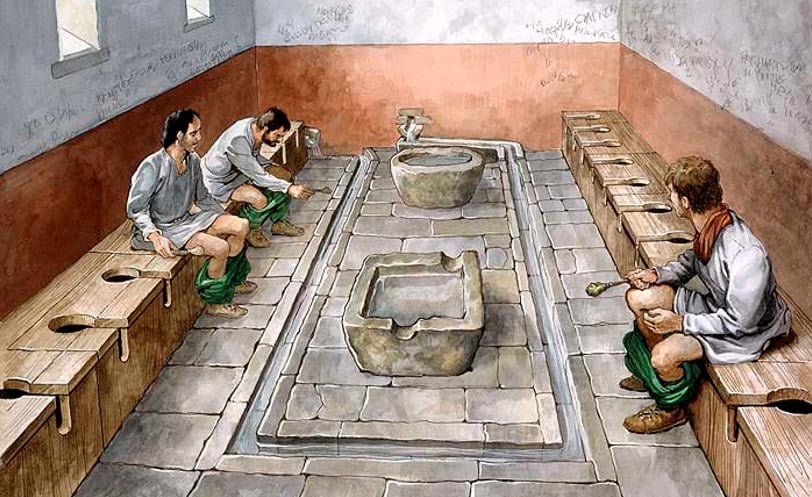
In fact, privacy in the way in which we think of it is fairly new. The Romans famously had public baths and public toilets. Very public toilets. Everyone has probably seen pictures of the remains of Roman public toilets. Here’s a recreation of what it was like to pinch a loaf with your pals. Well into the 19th century, outhouses were common in the West and some of them were two-holers. Abe Lincoln had a three-holer, which was the height of luxury for his day.

The point of all this potty talk is to make the point that personal privacy is relatively new. It is the consequence of wealth and leisure. It’s not just things like flush toilets and indoor plumbing. People’s attitudes about personal privacy changed. We expect our financial affairs, private correspondence, personal foibles, private appetites and so forth to be off-limits from scrutiny. Health companies are required to go to great lengths to guard your medical data, even though no one knows why it matters.

The technological age is promising to change that and maybe do so in a hurry. The roads are now littered with cameras to monitor you as you drive. Street cameras are increasingly common in cities. In the UK, CCTV cameras are everywhere. Big Brother is literally watching you. Of course, big tech companies track your internet habits. The cable companies track your viewing habits. The “internet of things” means your house will be reporting on you to Google, Apple, Amazon et al.

The unwanted gaze is not just at the personal level. Retailers are encouraging people to put themselves into the big database voluntarily. This story about how sports teams are “offering” easy access as long as you let them scan your eyeball on the way in. Of course, they keep track of what you buy and probably how often you cheer. The new payment services are letting our overlords connect your shopping to your mobile phone, which links to all you internet habits.

It does not stop there. The FBI pays computer repair shops to dig around your stuff and report you to the Feds. The tactic is very old school, but the concept is very modern. The combining of our corporate overlords with our government overlords is a handy way around our remaining constitutional protections. How long before your Alexa gets a guilty conscience and reports your drug taking to the Feds? How long before your copy of Quicken starts talking to the IRS about your cash deposits?

This is not a libertarian vision of hell, but a plausible reality that faces us in the technological age. High speed communication, massive data storage capacity and sophisticated search algorithms means all of the particulars of our daily existence, even our private correspondence, can be easily assembled to provide a pretty good picture of our life, without much effort. If the Eye of Sauron falls on you, the authorities will have no problems knowing everything about you but your thoughts. Even those can be surmised by the facts of your life.

So far, people seem to be OK with living in a fishbowl. Maybe they don’t think about it much, but there have been no protests or movements to arrest this trend. Go into any retail shop and customers gladly offer their discount card so the store can put their buying habits into the database. Most people cheer the implementation of video surveillance, in the name of safety. Even the reports of wholesale government surveillance have not been met with much pushback from the public.

Assuming there is no turning back and the surveillance state is inevitable, the question is how does this change how people interact with one another. If you know your most intimate thoughts and deeds could be made public, will you be more careful in your private dealings? Or, will you simply care less about who knows and also stop caring about the private things revealed about others? Hollywood stars live out their lives in public and it has no effect on their conduct. It may even make them less prudent.

Up until fairly recent, people were disgusting. They blew their noses on their sleeves, they farted in public, they went to the bathroom in communal toilets and were generally foul and disgusting. Public manners developed alongside personal privacy. The line between what you would do in public versus what you would do in private, was only possible when privacy was possible. As the material wealth increased, the available privacy increased and good public behavior became enforceable.

If everyone sees you at your worst, there’s no point in hiding it so in a surveillance state, where all our secrets are made public, maybe people will just stop caring. Hollywood always imagines the future to be sterile and clean, a land of stainless steel and glass. Maybe the future will be the opposite. Instead of tidy androgynous people in Lycra jumpsuits, its people with bed-head wearing sweats, scratching themselves in public.The glorious future will be people with nothing to hide and nothing you want to see.

Cars

This post on Sailer’s site the other day struck a chord with me. I’m beginning the process of buying a car so I have been thinking a lot about cars of late. I truly hate the car buying experience for a number of reasons. The biggest one is that it feels like a waste of time. The dealership model is a carryover from a bygone era when a man would spend a lot of time on purchases. Most of us buy on-line now so walking car lots looking for the right car just feels like a time suck to me.

That last bit reveals a bit of reality with regards to how societies work. The car selling business has been immune to change and it has a lot to do with the political power of car dealers. Tesla found that out when they wanted to sell cars in New Jersey. The state had a law requiring car makers to have a dealership in the state in order to sell cars. Tesla finally got the state to yield, but they had to bribe half of Trenton to do it. Car dealers are a powerful lobby in every state and they use their influence to make life tough on anyone with new ideas.

That Sailer post reminded me of something I have noticed among my friends and acquaintances, as I have got into car shopping. It is a very emotional subject. For instance, I’ve asked people for their recommendations and to a man they have refused. I always get something like “You need to test drive them and pick the one you like.” The alternative to this is to just change the subject entirely. It’s as if there is a taboo against giving anyone advice on cars.

I think the reason for the reluctance is two-fold. One is people still view their car as an extension of themselves. If they recommend a car and you reject it, it is as if you told them they have bad taste. On the other side of it, thinking it is an emotional experience, people don’t want to talk you into something you may come to hate. Alternatively, the people I know may not give a damn about my new interest in cars or they simply don’t like me very much. You can never be sure about these things.

The other thing I see, something that turns up in the comments of car posts like the Sailer one, is the car scold. Whenever someone starts showing enthusiasm for buying or owning a car, car scold comes along to tell them he thinks owning a car is a great burden that he suffers through for the good of mankind. This guy has a lot in common with TV scold and music scold. It’s as if enjoying life is such a great sin that the righteous must always be letting everyone know they are in constant pain.

There are, needless to say, a lot of these vinegar drinkers on the right. It is an affectation and a silly one in my opinion. You have but a short time on this earth. Making the most of it, including the fun bits, strikes me as the heart of conservatism. It is the ultimate acknowledgement of reality. Every man has his tastes, but if owning a snappy car brings you pleasure, best of luck with it. I may not share your passion, but I do share your desire to make the most of our time on earth. What’s wrong with that?

The root of this, I suspect, is the dominance of the Left in American culture. The neo-Puritan hags have been screeching at us about how form must always follow function for so long we have lost our sense of style. You see that in cars where the goal of designers is to make them more aerodynamic and pack them with useful functions. The result is a fleet of well-built cars that look like they came from East German film noir during the Cold War. Our cars are ugly because inside, we have become an ugly people.

If you doubt this, look at pics of parking lots from 40-50 years ago. They were a carnival of colors, shapes and sizes. A person’s taste in cars said something about him, a form of advertisement. A people embracing life and its potential were out buying all sorts of cars in all sorts of colors. We are now a people marching to the inevitable end of our miserable existences so we buy cars that are suited for the task. The top three car colors in America are black, grey and white, with dark gray the top interior choice.

Now, one aspect of this self-loathing has been a focus on the engineering of cars and that has resulted in some fantastic options. The cars of my youth were better looking, but they were in no way better built or better engineered. I test drove a Camaro SS the other day and it was like flying a jet. It was fast as hell and so packed with technology it is not accurate to call it a car. It is a transportation platform. Last year I rented a Cadillac on a trip and I needed ten minutes to figure out how to operate it. It is an amazing age.

Even so, we have become a cautious and frightened people, like herd animals waiting to be processed. The sports car buyer in 1965 was looking for risk. He wanted to rocket down the road in something that was probably not entirely safe, but that was part of the thrill. Today, sports cars are packed with safety features intended to let the buyer know he can have the kind of fun that is permitted today. It is part of the overall feminization of the West. Engineers today care about you like a mother.

I saw the other day that a company now sells an add-on for cars that allows parents to spy on their kids and even take control of the car, from their smart phone. The ad is not all that clear on the particulars, but it appears to be a GPS system that also provides some ability to disable the car, sound the horn and flash the lights. That way, if your son is out enjoying himself, you can put an end to it from your couch. Nothing says freedom like having mom watch you as you make out with your girl in the backseat.

The ultimate expression of this is the self-driving car. The quest to take all the fun out of life, and all the risk, leads inevitably to the nanny-state providing a ride service so that you not only get to your destination safely, you get to the correct destination. People naturally think the surveillance state will be Orwellian. No, it will be run by Google and Apple, sold as a market solution to public safety. After all, when it comes to your safety, we can’t let things like freedom, pleasure and privacy get in the way. You’re too important to us!

In the end, that’s why I will be buying some sort of hot rod in the coming weeks. I look around and see that the fun cars are only for the Cloud People, while the rest of us will be stuck with the dreary conveyance units. There are not many mid-priced sports cars on the market. Toyota does not even have a fun car on offer. Neither does Honda. I figure I better get a sports car before I’m too old and the before the state decides, for my own good of course, that they are no longer safe for Dirt People.


New Solutions

The generally accepted theory among archaeologists is that humans began to settle down and transition to agriculture about 15,000 years ago. It did not happen all of a sudden nor did it happen everywhere. The first large scale settlements arose in places that were the most hospitable to people just mastering agriculture. The region between the Yellow River and Yangtze River, Mesopotamia and the Indus River Valley are thought to be the first places humans developed large scale settlements.

The big challenge for the first settled people was how to pick leaders. Hunter-gatherers had an easy solution for this. The best warrior or most senior male would be in charge of the group. Since the groups were small and composed of related males, disputes could be worked out at the personal level. If Trog turned out to be a bad leader, Trog would fall off a cliff or have a hunting accident. Once the group got too big for this to work, cousin Grog would lead his kin off to form a new clan somewhere else.

Once groups of humans began to settle down in close proximity with one another, conflict was inevitable. That’s most likely why the first settled societies happened in the fertile river valleys. They were good for human habitation, so populations grew. Before long the population density made group conflict inevitable. In time, one group would come to dominate and absorb other groups. The old Grog clan from above would take over the Trog clan and maybe some others. The result was a tribe distantly related people.

Picking leaders to rule over unrelated people required different habits and different rules than picking a leader for the small group of related people. Once you get past second cousins, family relations are not all the close. Then you have the habit of marrying off women to other groups in order to broker peace and cement agreements. Governing can no longer be personal. You need a system to develop and select leaders, adjudicate disputes and delegate authority.

There are many ways to pick leaders, but the real challenge is how to deal with a bad selection. The Roman Republic solved this with what amounted to term limits. The Roman Empire relied on assassination to solve the problem. The Chinese never have figured out how to remove defective rulers, but they did come up with a very good way to filter them out before they gained power. Mao remains the best example of what happens when their filtering fails. The Great Leap Forward killed between 30 and 50 million people.

The European method that developed after the fall of Rome was feudalism. The king had to rely on the large land owners for money and soldiers. Those large landowners often relied on lesser nobles to collect food rents and conscript men for soldier work. This system put limits on the power of rulers, so a tyrant or lunatic could be controlled until he fell off his horse or got some bad wine. It was not perfect, but it protected the landowners from a predatory tyrant or a dangerously ambitious monarch.

The other unique thing about Europe that effected the evolution of governance is the fact that no one group was ever able to dominate the rest of the continent. The Qin unified China over 2000 years ago. Various Arab tribes dominated the Near and Middle East for very long periods. The Romans dominated Europe, of course, but that domination was their undoing. The cost of holding the Empire together exceeded the benefits of keeping it, leading to the collapse of the Western Empire. The fact that the Eastern Empire held on is not an accident. Europe is not built for unification.

Europe’s governing structure where rulers were limited and ethnic groups competed with one another, but were never able to fully conquer one another, was probably the recipe that eventually led the West to race ahead of the world economically, militarily and technologically. There’s more to that story, but things like the rule of law and property rights were essential ingredients for the Industrial Revolution. Without property rights and limits on the state’s ability seize property, there’s no reason to save and invest.

The sudden changes in governance that swept Europe coincided with the Industrial Revolution. One way of looking at the French Revolution is that the old governing model was built for an economic system that was being replaced by a new economic system, one that would require a new governing model. Liberal democracy has only flourished in nations with merchants and manufacturing. Industry does not automatically lead to democracy (China), but in order to have self-government you need a market economy.

The point of all this is that social structures like liberal democracy are not the product of inevitable historical forces. The Chinese form of government is the product of the evolutionary history of the Chinese people. Pluralism, openness, self-government, the rule of law, all the things we associate with liberal democracy, are the product of the unique history of the people of Europe. It is why they have proven to be impossible to transplant to other parts of the world. The rest of the world is not built for Western social structures.

That’s a lot of book length material summarized into a few paragraphs, but it is an important lesson of history. The people of the West have unique organizational structures because they have unique histories. As a result, they have different human capital, because the people evolved with those social structures. These small differences on the individual level, roll up to be rather large differences when expressed in customs and social institutions. Just as important is the fact that it is ongoing. People and their societies continue to evolve.

With that in mind, what we call liberal democracy is the product of the industrial age when making and selling things was the core of European economies. The challenge every ruler in Europe faced in the 17th century was how to get the most of the available human capital. That not only meant getting everyone working, it meant increasing each worker’s productivity. If you are going to have a big standing army, for example. your farmers have to produce lots of surplus food and supplies for that army.

The technological revolution is going to lead to a different economic model. Instead of one that gets the most from the available human capital, the new economy will be one that gets the most from technological capital. The robot revolution is oversold, but the future will require fewer people to produce the goods and services we demand. It is not just labor being replaced with machines. It is intellectual capital being replaced with technology. The future is about how best to organize society when technology is handling the bulk of work.

The so-called populist uprising in the West, seen through this prism, takes on a different color. For instance, the reason Hillary Clinton lost is that technology allowed for a different type of campaign and new way around the government controlled media. The establishment showed up in its 1960’s muscle car and the challengers arrived in Teslas. In 2016, the twitter account of thousands of alt-right types carried as much weight as the pages of the New York Times.

This post is going on too long, so let’s wrap this up. In 1789, no one in France could imagine what was coming. That’s in part because they had not noticed the demographic and economic changes that had been going on for generations, which led to the Industrial Revolution. The modern West has been in a post-industrial phase for at least a generation, maybe two. Yet, the organizational model we have is still an industrial one. Consider this. Who has more power? Congress or Google? Your PM or Tim Cook?

It may not be 1789 all over again, but these populist uprisings that are vexing Western leaders could simply be the tremors that precede the earthquake of social upheaval, as the old organization system falters in the face of new challenges. Ours is a less violent age so Madame Guillotine will not be making an appearance, but systematically altering the governance model is not out of the question. Our constitutions were not handed down by God. They were always temporary solutions to immediate challenges. We have new challenges and maybe social democracy has run its course.

Bloody Democracy

One of the more abused words in the English language is the word “democracy” which has come to mean just about anything. Our politicians love talking about the glories of democracy, especially after they have won an election. When they lose, as we are seeing with the Left these days, well, it is an assault on democracy! The word has become a Western version of Juche, the North Korean state ideology. It is not a form of government, but a mystical spirit that is the essence of the people’s goodness.

For Progressives, democracy is one the of the primary abracadabra words in their book of incantations. Whatever they want, it is almost always decorated with the word democracy or some reference to it. It’s not that they have any respect for the will of the people; it is that they truly believe their whims and causes are imbued with the magic they associate with the word democracy. Democracy is what they call that supernatural force that guides history and carries the righteous to the promised land.

This article from the Progressive site Jacobin is a good example. America, of course, is not a democracy. It is a representative republic. In fact, what we have come to know as liberal democracy in the West is explicitly not democracy. Instead, Western nations employ various forms of representative government. The reason for that is experiments with democracy have been disastrous. It turns out that mob rule is not a great way to run a country. The usual result is a blood bath followed by a tyrant.

Of course, the Left is not all that interested in democracy as a form of government. For them, it is trolley they ride from where they are now to the place they wish to be. That place is where they have an iron grip on society. Naturally, while they are waiting for that trolley to take them to the promised land, they sing the glories of the trolley system they call democracy. If things don’t work out as planned, well, the system is not democratic and the proof of that is they lost. After all, the spiritual goodness of the people is on their side.

The linked article is interesting and entertaining for a number of reasons beyond the less than credible claims about the glories of democracy. What’s fascinating about it is what it reveals about the Left. The author, after detailing what he sees as the facts of the undemocratic outcome, falls back on the example of revolutionary France. Appropriately enough, for a site called the Jacobin, the author wants some sort of National Constituent Assembly, where the people can fashion a new constitution.

The National Constituent Assembly lasted two years and can only be viewed as a failure, as it led to the radicalization of the Paris mob and eventually The Reign of Terror. Roughly 16,000 people were sent to the guillotine and another 25,000 were hung, shot or beaten to death by mobs. All of these murders were done in the name of the people. After all, what is more democratic than murdering people in the name of the people? Most of those killed were in no way opposed to the revolution. They either got in the way or failed to do what the radicals expected.

Nowhere in that long piece does the author mention Maximilien Robespierre, Les Enragés (“the enraged ones”) or Madame Guillotine. He later celebrates the Marxist revolts of the 19th century and then the glories of the Bolshevik Revolution in the 20th century. No mention in those cases of the bloody outcomes. That would require either a reconsideration of the glories of radical democracy or the celebration of senseless murder by angry mobs. It’s better to just skip past those problems.

That’s the revealing bit in the piece. The Left has learned nothing from the past, even their own past. The Right is often accused of being captive to a romanticized past, but it is the Left that is trapped in a permanent time warp. The first radicals of the Left followed the logic of Rousseau to its natural conclusion, murdered a bunch of people and then gave way to a tyrant. They keep repeating this pattern without ever having learned from past results. The Bolsheviks, for example, looked to the Jacobins as examples.

Part of this is explained by the radical fixation on the future. The Left has always been blind to the past as they put all of their energy into reaching the glorious future. The bigger issue is that radicalism is an intellectual dead end. When the only acceptable answer to the natural inequality of man is more democracy, you eventually end up with pure democracy, but the same natural inequality. That leaves enforced equality as the logical next step. With coercion naturally comes political violence and then terror.

The End of Anti-Racism

I don’t remember when it was, but I have a recollection of John Derbyshire wondering when racism would become fashionable for young people. It may have been a podcast or a column, but it was long enough ago that I don’t recall much about it, other than the question itself. Everyone is required to think of racism in the same way that people used to think of devil worship or communism. It is, and always will be, the worst form of evil so it can never be normalized. Even thinking about it could be enough to get you in trouble.

I’m not much of a racist myself, but I don’t think about it very much either. Still, I remember Deb’s query because it was so provocative. We live in an age where nothing is sacred, so we are told. Being subversive and outrageous is the highest virtue. Our celebrities exist almost exclusively on  their ability to outrage. Logically, if racism is the great taboo, someone will try to make bank on being racist. Young people with their desire to reject their parent’s morals, would be prime candidates for this sort of thing.

To some degree, the alt-right, at least the social media version, is the first green shoots of hip racism to sprout into public view. Edgy internet personalities like Anthony Cumia and Gavin McInnes dance close to the edge of racism in their performances. Not being a regular listener, I can’t say for sure, but I have no recollection of them saying anything I’d put down as explicitly racist. Like dirty jokes in the 1950’s, there’s lots of innuendo and wink-wink sort of stuff, but even the edgiest guys are careful to avoid being racist.

Racism does seem perfect for mockery and derision by our hipsters. I was reading something the other day about the evolution of people on different continents. An interesting area of inquiry is why people in the Indus River Valley evolved different social structures from the people of Europe or East Asia. Every other paragraph, the writer felt compelled to write something like, “people have avoided asking this question for good reason.” The obvious reason is it might come off as racist and racism is so bad, the writer could be struck by lightning by even asking the question.

It reminded me of this post last year about banning research into IQ and race because, well, the void where God used to reside could be angered by it. Or maybe it is bad juju. Who knows, but the fear of racism is so pervasive that a science magazine is ready to hold a book burning and maybe throw a few heretics onto the fire just to prove he is not racism. It’s the sort of thing we associate with an age when fanatics from the Inquisition were snooping around, looking for sinners to torment.

When a taboo becomes as ridiculous as this, it is a prime candidate for mockery. The people who tend to like mocking social norms are young people. It may not be an accident that the alt-right skews very young. It’s also probably why a guy like Gavin McInnes mocks the pc-types, who are forever worried about racism. He is aiming for a younger audience and lampooning the nonsense young people see from adults is an obvious way to attract that audience. It’s a short trip from there to what Derb had in mind.

It’s natural to think that our current taboos are immutable, but think about the things that used to be off-limits that are now common. In my youth, men used to be sent to prison for making or distributing pornographic films. Now, TV is filled with what my parents would have considered to be pornography. The big New Year story was how Mariah Carey had some sort of screw up during her performance. No one noticed that this portly, middle aged mother of two was half naked, wiggling her goodies around on stage.

There is, of course, homosexual marriage. It went from being the punchline of jokes to being official dogma in a little more than a decade. In less than a generation, we went from a taboo on suggesting it to a taboo on opposing it. It’s a good example of how quickly these things can turn. There’s little reason to think that such a thing could not happen with racism. That’s not to say we will be bringing back Jim Crow, but maybe bringing back Blazing Saddles is not too far off. Perhaps race realism is the next gay marriage.

Of course, there is the issue of elite opinion, which had a lot to do with the sudden shift on an issue like homosexual marriage. So-called conservatives were more than happy to go along with the Left’s latest fads so things like gay marriage faced no opposition. Racism is hysterically opposed by everyone in the managerial class. But, this was true of Trump and that opposition just made him more attractive to voters. Old fogies flipping out over memes on twitter, they consider racist, will only encourage young people to do more of it.

It’s hard to know how this will go, but it is not unreasonable that we are headed into the age of post-anti-racism. The hysterical anti-racism of Boomers could never survive conflict with reality. The young, who have no experience with actual racism, are starting to respond with mockery of both racism and anti-racism. It’s hard to impose moral codes on people who are laughing at you and mocking your taboos. The great moral crusade of this age may not survive conflict with guys like John Rivers and his tweet storms.