Senator Billy Ray Valentine

In the movie Trading Places, two old rich guys make a wager over the debate regarding nature versus nurture. Randolph, played by Don Ameche takes the side of nature, while Mortimer, played by Ralph Bellamy, takes the side of nurture. They decide to settle it by switching the lives of their managing director, Louis Winthorpe III, with the life of Billy Ray Valentine, a black street hustler played by Eddie Murphy.

It’s a classic comedy so this is not new material. It is another version of Pygmalion. That was made into the musical My Fair Lady, which is probably what most people would recognize as the classic of this genre. I have not seen Trading Places in many years, but my recollection is it was very funny. It’s hard to believe, but there was a time when Eddie Murphy was hilarious.

Watching Ricky Rubio talk butch about Donald Trump the other day made me think of this movie. Rubio, like Billy Ray Valentine in the movie, is a creation of some rich patrons, who found him useful. Normal Brahman is a gazillionaire in Florida and he was Rubio’s rabbi in politics. It is a common arrangement in state politics, particularly in the South. Bill Clinton was a creation of the same system.

Rubio has charm and enough sense to not start thinking for himself. Like a good actor, he knows how to internalize his lines so they come out sounding off-the-cuff. He understands his role and that is to make the audience believe. It is the job of other people to write the lines, figure out the policy positions and setup the political fights. Rubio’s job is to show up, say his lines with conviction and win the crowd.

Barak Obama is exactly the same guy. Former Weathermen Bernardine Dohrn and Bill Ayers sponsored Obama in Chicago as their dream boat, a black radical who can charm middle-class white people. After some time in local politics, billionaire progressives backed Obama all the way to the White House. There’s a reason the man does not order lunch without his teleprompter. Obama is smart enough to know his words are never his own.

Kept men are nothing new in politics. Local politics across the Anglosphere have been dominated by this arrangement for centuries. The local rich people pay men to represent their interests in parliaments, town councils, city government and so forth. In America, state government is loaded with these guys. They lobby the other members on behalf of their employers.

What’s new is that the global rich now look at national parliaments in the same way wealthy planters or industrialists used to look at state government. The result is Congress is packed with kept men, who play the role written for them by their handlers. That’s how Obama and Rubio made it to Washington. Their handlers were prepping them for presidential runs. That was the plan for Marco Rubio.

Some things don’t scale up very well. The kept men in politics get away with it in low-profile areas like state government or town councils. In a mass media culture, it’s really hard to pull this off at the national level, at least for very long. That’s why Americans want to seal up Washington and burn the place to the ground right now. They’ve figured out that it is just theater, a sophisticated long con.

There’s also the problem that some gags work just once. Americans have had seven years to watch Obama strut about on stage, doing his version of Hamlet. They know how to spot guys like him now, which is why Rubio went nowhere, despite having the entire conservative media ecosystem coordinating their efforts for him. It turns out that Lincoln was right, even in our mass media culture.

Anyway, watching poor Rubio flail about in the final days of his campaign, I can’t help but feel some sympathy for the guy. He is penniless and now his political career is over. He chose not to run for re-election to his Senate seat so he could focus on his presidential run. His other source of income is his wife’s no-show job at a fake charity run by Norman Braman. Now that Marco is no longer of any use to Norman, that no-show job goes away.

Unlike Billy Ray Valentine, Rubio lacks the moxie and cleverness to turn the tables on his masters. Instead he is running around the country calling Donald Trump a doo-doo head. The hope is he can earn some sympathy from the party and maybe they can hook him up in a no-show job at a bank. John Kasich, Jeb Bush and Eric Cantor got rich playing that game so Rubio probably thinks he can get a similar deal.

Right now, this is he scene Biltmore in Miami.


Reverse Engineering A Belief

I was watching a documentary on the remains of the ice man from the Æneolithic period, found in the Alps 25 years ago. Ötzi is a big deal for anthropologists, historians, geneticists, biologists etc. The ability to get genetic material for analysis offers up enormous research opportunities. For hobbyists with an interest in these subjects, it is always fun to listen to experts discuss their interests in such a rare discovery.

One of the things they have been puzzling over are the weird tattoos on the man’s body. Initially, they assumed they were for decoration, but further research suggested that was unlikely. The markings were not very decorative, but they did correspond to areas that either had prior injuries or signs of disease. In other words, the tattoos were medical treatments of some sort.

This sounds rather loopy to modern people, but it is not hard to see how people could come to believe such things. Grog gets the evil spirits and is close to death. The local Shaman gives him a tattoo so he is properly marked up for the afterlife and Grog suddenly rallies and recovers from the evil spirits. Everyone assumes it was the tattoo. Before long, tattooing the sick is what everyone does.

Belief is a funny thing in that it is self-reinforcing. The people of Ötzi’s time probably understood that tattoos did not always work, but when they got a good result, they just assumed it was the tattoo. What else could it be? Not doing the tattoo treatment, quite logically, became a high risk choice.

Understanding this dynamic is useful when looking at modern times. For example, we believe smoking tobacco causes lung cancer. At some point in the future, when the alien anthropologists are digging through the remains of our age, they will puzzle over “No Smoking” signs in the same way, wondering why they never found “No Child Molesting” signs in the rubble.

The point here is that you can tease out some things about what people believe based on what they do, even in the modern age where we pretend to be irreligious logic machines. That came to mind reading this rather entertaining comment thread on a Marginal Review post. As is often the case, Steve Sailer was making heads explode by noticing things that are on the prohibited list.

The question Steve kept asking in various ways is why economists have never bothered to study, much less calculate, the value of citizenship. If a citizenship card for Somalia and one for Canada were put up for bid, which would fetch more? How much would each get at auction? Who would do the bidding?

These are very interesting and reasonable questions that should be natural areas of interest for modern economists. After all, immigration is the dominant topic of our age and economists are the shaman class, asked to weigh in on every topic. It follows that the “markets in everything” crowd would have come up with a model for the market for citizenship.

As Steve correctly observes, the better question may be why they refuse to even consider it. Read the comments in that post and you see a lot of undefined panic. They don’t know why they should not be talking about this, but they sense it is a taboo subject so they keep trying to change the subject. In a sense, Steve was asking, “why are we tattooing Grog?”

I’m not much for reductionism so I don’t think there’s a conspiracy. What I see is that these people believe all of the things people in the managerial class believe. One of those beliefs is that citizenship is an artifact of a prior age. They dream of being citizens of the world, hopping from Washington to New York to London to Davos. Being an “American” is, if anything, a little embarrassing for them.

It’s why they are puzzled by the resistance to open borders. They live in these wonderful bunkered communities that are surrounded by ethnic restaurants and shops. When they meet friends at the Ethiopian place in Fairfax to reminisce about their trip there in grad school, they wonder how anyone would not want this life. For them, open borders is the paradise of their daily life.

The answer to Steve’s query, it turns out, is a question. Why study something that has no value? From the point of view of economics, citizenship is as valuable as unicorn insurance or stock in the flying carpet company. The market for their skills is in climate magic and monetary policy so that’s why we have a million papers on those topics.

There’s another thing to tease out here, returning to the image of the Cloud People gnoshing on fit-fit at the Ethiopian place. To these people, the horny-handed sons of toil are failures. They have failed to reach the managerial class. Therefore, their habits are the habits of failure. Their shouting about patriotism, the dignity of work and joys of family are just confirmation to the Cloud People that they are the elect.

In a world where one is measured by how many of the correct boxes he ticks, there’s no value in even thinking about the wrong boxes. The neo-mandarin system of the modern managerial class rewards recitation, not inspiration. Why puzzle over the plight of the Dirt People when the people grading the exams don’t care about it? It’s simply easier to believe it does not matter than to wonder why.

After years of examining Ötzi, researchers have determined that he did not freeze to death in the snow. That was the working assumption for years. Everyone assumed he got trapped in bad weather on a hunt or a trip. It turns out that he died from an arrow wound. Ötzi was murdered. While those tattoos may have worked against evil spirits, they were not much use against an arrow in the back.

Flying Cars

Two times in my life I have made predictions about technology that were pure genius. The first time was when I first saw Hypertext Markup Language. At the time, the only websites were gray pages with blue links. I said to a friend at the time that this would replace mail order and probably retail. A storefront on the Internet would let the little guy compete globally for customers. The person I said this to thought I had lost my marbles.

The second time this happened was in a discussion of mobile devices. At the time, palm-top organizers were just hitting the street. Someone said to me that one day someone is going to get rich selling carrying cases for all of these devises. My response was that someone was going to get rich combining them into a single device, like a phone that was an organizer, camera and personal identification. He too thought I was nuts.

This does not make me a genius, of course, as I did nothing with these insights and lots of other people figured it too. The point is I saw the future as something other than a straight line projection from the present. That’s hard to do which is why we rarely do it. Like everyone else, I expect tomorrow to look like an extension of today, because that has been my experience, with some notable exceptions. It’s why most predictions about the future are hilariously wrong.

When I read this story the other day, I immediately thought about those prior times when I had a bit of inspired thought. As long as I have been alive, the dream of personal air travel has been a part of predictions about the future. If it is not flying cars, it is hovercraft, jet-packs or levitation devices. In the future, the ground will be for bugs and losers. The winners will be floating in the clouds, riding thermals to their office and jetting about like Iron Man.

That sounds fun, but my bet is the future or transportation looks a lot different than flying cars or even robot cars. Instead, the future is probably something closer to personal drone transport. People will have quadcoptors that can take them on short trips around town and drop them off safely back onto the ground. This would be fun, safe and solve some of the transportation issues of the modern world.

We already have the technology to build a drone that can navigate around obstacles and use GPS to locate a target. The small drones you can by from hobbyist sites are simple to operate because of the built-in navigation technology. Scaling this up is nothing. Building a drone that can lift a person is basic engineering that has been done to death. Add in the software for guidance and navigation and you have a safe flying gizmo average people could use.

Obviously, the safety issue is the issue. But that’s where the technology of robot cars comes into the mix. If you can safely navigate around a city street, the same technology can be applied to the drone. That way, the typical user does not slam into a building or crash into the ground when landing. Unlike cars, the drone-space would be free of dogs, pedestrians, kids running into the street, potholes, etc.

The other advantage of personal drones transport is that the government can mandate safety at the start. That means, unlike cars, all drones must be wired into the drone-space control system. No classic drones allowed in the drone-space. You are either on the grid or you’re on the ground. That keeps the sky free from being butts-to-nuts with people flying around out of control.

The obvious benefit here is cost. The driverless cars will be prohibitively expensive for decades. Flying cars are never going to be practical. Jet-packs have that sudden fiery explosion issue. A decent drone is now a couple of grand. One for human transport would be comparable to a basic car or motorcycle, even with beefed up safety technology. That means they will be practical for most people from the start.

The down side here is they would not be of much use in bad weather. Flying around in a snow storm is probably not going to be possible. That means these things will be more like motorcycles, a second vehicle for nice weather and nice climates. Unlike a motorcycle, you don’t have to worry about being crushed in the skies by a delivery truck, so more people would be willing to have a drone than a motorcycle.

The other upside here is they will not require trillions in new infrastructure. Electric cars, flying cars and jet-packs present all sorts of issues with the current infrastructure. The drone-space is open range at the moment. We already have laws governing the airspace so limiting where these things could be used is not a hug leap in regulatory policy. The only change in infrastructure would be rooftop landing pads maybe.

So there you go. Cash out the retirement fund, mortgage the house and invest in drones.

Brexit

Fortune favors the bold is one of those expressions popular in political circles because it tends to confirm things people want to believe about themselves. The guy who wins wants to see himself as a swashbuckling risk taker. The guy that loses wants to see himself as an exception, a bold swashbuckler who was not rewarded by fortune. That way, he can try again another time.

The truth is, politicians are risk adverse in the extreme. They hate risk and it is what often gets them into a jam. When one choice has a 90% chance of success, they will get hung up on the 10% and not act swiftly. Alternatively, they fixate on hugging the shore to the point where they are blind to looming danger. The Republican Party made this error with regards to Donald Trump.

There are two types of acceptable risk taking in politics. One is when the fix is in and the politician knows something before the public sees it. He comes out and takes a “bold stand” on X and has his media arm champion him as a great risk taker. When X happens, he is vindicated and promoted as a bold leader. Not everyone falls for this, of course, but enough people do. Bismarck was a master of this sort of risk taking.

The other type of risk is the reverse of this, when the pol figures out he is going to be on the losing end of something. With nothing to lose in the campaign, for example, he will champion some controversial policy so he can pretend to go down because of his bold fight against the forces of darkness. The whole point of this gambit it to set up the next fight. It’s putting your last chip on seven at the roulette table.

Smart politicians figure out that in uncertain times, even the safe bet is a gamble. In Europe, the turmoil created by the Million Muslim March makes all positions a risk. The public is unhappy, but not ready to break into a full nationalist mood. At the same time, the cultural elite is still drunk on the sangria of multiculturalism. There are no safe choices other than keeping a low profile and letting the greater fool theory play itself out.

That’s what makes David Cameron’s move to hold a referendum on the EU so bizarre. His own past election should have been a clue that he is living in very uncertain times. No one predicted he would win a majority and that the other main parties would implode. Unexpected results, even when welcome, should always be cautionary. If you don’t know why you won, your can’t know if you will win the next time.

The betting markets show volatility, which tracks with the polling. The “deal” Cameron negotiated with the EU has been laughed off as worthless so the vote is between the status quo and exit. That would seem to favor Cameron as people tend to like change in the abstract, but hate it in practice. You could argue that Cameron is looking at the polling and figuring the fix is in so he can afford to look like a risk taker.

That brings us back to why this is happening in the first place. The nationalist waves roiling Britain forced Cameron and the Tories to promise this referendum in order to stave off the challenge of UKIP. The stunning result of the election was due to the public rallying to the two parties most identified with national identity. The Scots went for SNP and the English went for the Tories.

That dynamic should scare the hell out of Cameron. Every day his voters see pictures of migrants clustered on the other side of the channel, trying to get a ride to England. Rotterdam could very well be the Lindisfarne of the Muslim Age. There’s nothing more patriotic than defending your women and children from foreign barbarians. Voting for Brexit is the sort of thing people under threat will naturally do, no matter the promised cost.

The polling at the moment suggests most people are open to both sides of the debate. It’s tempting for a normal person to think this bodes well for Cameron, but the old lawyer line about never asking a question unless you already know the answer applies here. A wide open public, in a time of great uncertainty, where the conventional wisdom is routinely proved wrong is prone to vote on emotion, rather than logic. Donald Trump says hello.

One of the striking things about the ongoing crisis in the West is just how many unforced errors the political class is making on a regular basis. Merkel inviting the young men of Islam to pour into Europe is an obvious example of something that was easily avoided. All across the West the politicians seem to have lost their footing and this gambit by Cameron feels like another blunder, assuming Cameron wants Britain to remain in Europe.

It’s hard to know if this string of unforced errors is just randomness, ineptitude or an indication of a systemic failure. Republicans running on amnesty after 2012 can be written off to stupidity, given their history, but what about Merkel? She was making sensible noises about multiculturalism in 2010. Did she lose her marbles in the interim? Is there some disconnect in the normal feedback loop between politicians and the public?

This brings us back to a familiar theme around here. The feedback loop used to have the media trying to sell news to the public. Those market signals led them to pressure the political elite correspondingly. This was an indirect market signal to the polls. It may not have been perfect and the liberal media often scrambled the signal, but the pols could at least feel the heat of an angry electorate before they saw the flames.

Today, the press is just a megaphone for the political class. The feedback loop is broken. David Cameron is surrounded by people who read the Economist. Everyone they know in the media thinks Brexit is just a sop to the UKIP types. Consequently, he really has no idea what the people are thinking and that means he has no idea how to pitch his plan to them. Brexit could easily end up being yet another unforced error.

The Death of Twitter

Way back in the olden thymes, I would come back from the mammoth hunt and relax by dialing into a BBS and mixing it up with others about sports. Back then, you had to know how a modem worked, in addition to knowing how to write a bit of code. My first “home computer” was a VT220 terminal and Hayes smartmodem that “fell off a truck.” A friend set up an account at his university and provided a POP.

Back in those days, “internet culture” provided no moderation and little in the way of restraint. The social justice warriors of today would have all committed suicide if exposed to the culture of 1980’s internet content. It was almost all smart dudes with more confidence than good sense so the arguments quickly got nasty and personal. If you could not handle it, no one cared. You were probably a pussy anyway.

Eventually, the BBS moved to NNTP servers and mail lists. Then the GUI revolution brought the masses into computing and onto the internet. Messageboards evolved as the social media tool for the mouse wielding internet warriors. Now, comment systems for articles, Facebook, Twitter and other apps have made social media ubiquitous. If I had a nickel for every time someone asked me why I am not on Facebook, I’d have a lot of nickels.

The point of this trip down memory lane is two-fold. One is to establish my bona fides as an original interwebs gangster. I’ve been at this a very long time. Second, and more  important, is that social media is not new or even close to new. Things like Twitter and Facebook are just continuations of other platforms. The same group dynamics that gave us Godwin’s Law 25 years ago exist on modern platforms. Here’s a 20-year old guide to UseNet users that applies just as well today.

Social media has always struggled with the tragedy of the commons. An active community is almost always free in order to invite a large number of people to participate. The Pareto Principle applies everywhere in social media, which means some small fraction of the users do the bulk of the posting. There are, however, some portion of users who take pleasure in ruining the fun for everyone. These are the people at the beach, who “accidentally” walk on your kid’s sand castle.

In the old days, boards were self-regulated. The trolls and idiots were eventually ignored by everyone so they went away on their own. Then technology put a premium on access so the idiots would have to sign up and maybe be approved. Private boards and lists are still around today for this reason. Pay-to-play schemes have been tried, with limited success. People just don’t want to pay to argue with other people.

The most common solution to this dilemma, one that never seems to work, is to moderate the debate. This is always associated with a set of nebulous rules of conduct that can be interpreted anyway you like. The mods remove posts that violate the rules and maybe suspend users who refuse to comply. It’s one of those things that works in theory, but never works in practice. In fact, it tends to make things worse, blowing up whole communities.

This is what is happening with Twitter. They created a “trust and safety council” to police the platform and get rid of the bad people. The creepy name is an artifact of our feminized age. Only women and homosexual males fret about trust and safety on-line. It also signals that it is more than just an attempt to ban ISIS terrorists and criminal gangs from the platform. The words “trust” and “safety” are now dog whistles for the maniacs on the Left.

That’s the reason moderation of message platforms fails. There are two types of people doing the moderation. There are those forced into it because they own the site or the hosting company requires it. It’s a terrible job for them so they quickly ban anyone that causes trouble. It is the old line about killing some chickens to scare the monkeys. The trouble is, they usually end up banning too many people and the community collapses.

The other type of person moderating content is the social justice warrior. They sign up for this job so they can chase off everyone that disagrees with them. Look down the list of people on this Twitter committee and it reads like roll call at the local asylum. These are people who think North Korea is a hippy colony of free speech. Giving these crackpots power is the sort of mistake a dying company makes as a last gasp to win support.

This led to the banning of Robert Stacy McCain by deranged fanatic Anita Sarkeesian, the mentally unbalanced grifter behind FeministFrequency and member of the Twitter thought police. She has had disputes with McCain for years so as soon as she was given authority to abuse, she abused it by banning her critics, starting with McCain. This has set off a revolt among Twitter users and a quest for an alternative to Twitter.

The fact is, the technology behind Twitter is no great shakes. It’s not much of a value proposition to users so it has to be free with minimum ads. That’s fine as long as the owners are not dreaming of becoming the next Bill Gates. But, that’s the problem. They built out a huge infrastructure with loads of debt thinking they will become billionaires. Instead, the stock is tanking and they are not long for the world.

What comes next is predictable. Rival services will spring up as Twitter, the brand, is increasingly associated with the sort of deranged fanaticism associated with nut-jobs like Anita Sarkeesian.  Quitter.de is already up and running as an un-moderated, distributed platform.  I just setup an account, but I’m not much for this type of platform so don’t expect a lot of action. Tumblr is another alternative. There are others.

There was never a great argument for Twitter as a company, but seeing them follow the well worn path of previous social media operations says they are doomed. The SJW’s will chase off everyone remotely interesting and then start feeding one one another. It’s the two women in a kitchen problem. It always ends the same. Once Twitter stops being cool for media types, it stops having a reason to exist.

The Turd Sandwich Salesmen

One of the interesting things about what’s happening in American politics is how the chatter skulls are struggling to understand it. In fact, they are not really trying understand it. Their efforts are much closer to denial than genuine interest. They feel threatened, so they try to jam the bad news into a box they have labeled “bad think” hoping that will make it go away. At least it fits into their comfortable worldview, even if it is still stinking up the place.

The Trump story is the most obvious example. The crooks and hustlers of the Conservative Industrial Complex see him as a dire threat to their cozy lifestyles so they have been churning out copy “explaining” why Trump is evil and his voters are stupid. The hope being that people don’t want to be thought of as stupid so they will go along with the assertion that Trump is Hitler.

I don’t think guys like Matt Walsh are sitting around thinking it through. He’s not that bright. It’s a visceral reaction to dis-confirmation. Red Team leaders were supposed to wave their banners and the Red Team supporters were supposed to respond with the team cheers. Suddenly those people are at another rally, singing different cheers for different people and different banners.

There are two possible explanation for this unexpected event. One is the people running Red Team have failed in some way. They either have a bad product or they failed to know important things about their customers and supporters. The people are walking off because they don’t like what Red Team is offering.

The other answer is that the people are stupid or gullible and the guy leading them astray is evil. In this case, Trump is casting a spell on stupid people like the Pied Piper. Human nature being what it is, it’s no surprise that the response from Red Team has been to blame magic. The evil spirit called Trump has put the whammy on them.

Reality is something different. The problem both American parties face and what mainstream parties face all over the West is the dilemma of the turd sandwich. One side of the political class offers the voters a turd sandwich on rye. The other side offers a turd sandwich on whole wheat. Both sides lecture us nonstop that voting is our moral and civic duty. Therefore, we must eat our turd sandwich.

Of course, there would be riots in the streets if it is said candidly so both sides of the political class ignore the filling and focus on the bread. We are repeatedly told by Team Whole Wheat that rye is poison and only lunatics eat rye. Team Rye tells us that wheat eaters are bigots and want to put rye eaters in chains. Their hyperbole aside, there is a very real difference between rye and whole wheat. No would deny it.

In a mass media culture, you can keep a lot of people busy shouting back and forth over trivia, like rye versus whole wheat, to keep the analogy going. What’s going on right now is a big chunk of voters has decided to look at the filling. They don’t like their turd sandwich and they have no interest in debating which type of bread is better. The trouble is, the menu at the political deli only has turd sandwiches.

That’s what the boys and girls of the commentariat cannot fathom. They ticked all the right boxes on their way into the club. They memorized all the arguments and they know how to tell you rye is better than wheat or wheat is better than rye. They are filling in all the right circles so everyone is supposed to fall in line. They just can’t understand that it’s not the sales pitch, it’s the product. The public is just not interested in their turd sandwich.

That’s why the pathological Trump bashing has had so little impact. In fact, it has probably helped him more than hurt. He represents a rejection of the party and it’s pitchmen in the media. The fact that they hate him is his best asset. Voting for Trump, for most people, has become a vehicle to express their disgust for what the party has been feeding them for 25 years.

If you are on the party payroll or you work in conservative media, you really can’t face that reality. You have to keep believing that it will once again be a debate about the merits of whole wheat versus rye. That’s why they keep trotting out new arguments for why Donald Trump is a fraud, evil or about to implode. That’s why they have gone all-in on a guy like Marco Rubio.

Otherwise, these self-proclaimed intellectuals and opinion makers have to face a terrible reality. That’s the fact they are not, in fact, intellectuals or opinion makers. They are just hired staff in paper hats selling turd sandwiches for the people signing their checks. That’s a lot to ask of people who think a lot of themselves, but lack the sort of introspection required to admit error.

Feeling the Bern

A topic that gets little attention, but is probably at the core of what is going on in the West is the collapse of the intellectual Left. Not so long ago, at least for men my age, you really could not be an intellectual unless you embraced the economics of the Left, which meant some form of socialism. Even intellectuals well outside political-economy would make clear they were fine with some form of socialism.

It’s how, for example, you could be a good liberal, like Daniel Patrick Moynihan, and also a critic of what we now call multiculturalism. The Left in the West started with economics as the core of the ideology. There was simply no way to be a man of the Left and not embrace some form of economic socialism. It was the intellectual engine of the Left. It provided the goals and most of the justification for the great liberal project.

The collapse of the Soviet Union put a stake in the heart of socialism. The stagnation of the 70’s in the West did a lot to discredit socialism. The economic liberalization of the 80’s and subsequent economic boom had socialism on the ropes, but the collapse of the Soviets killed intellectual socialism forever. It still staggers on in the domestic policies of Western countries, but that’s just cultural inertia.

Progressives no longer have a coherent economic ideology. They have accepted global capitalism without thinking much about it. Many of them come close to arguing that economics is no longer in the domain of politics. Instead, it should be left to supra-national organizations like central banks and global trade organizations. The EU is the most obvious example.

Technocratic managerialism has absorbed the political and intellectual Left like an anaconda swallowing a small animal. Through the outlines of the creatures skin we can still make out Marx, Engels, the old FDR coalition, the Fabians and so on, but each passing year it is more difficult to detect them. What’s left of political-economy is a debate over who has the better spreadsheet skills.

Progressives used to think they were on the side of the angels, because they wanted to bring economic prosperity to the masses. The central argument of the Left from Rousseau until the early 90’s was that the correct economic arrangements would result in surplus and prosperity. The math was therefore simple. The rich had too much and the poor too little so polices that addressed that imbalance were a moral duty of the Progressive.

The collapse of the Soviet Union took with it the economic arguments of the Left. If market capitalism was able to dominate the premier socialist enterprise, it was no longer possible to argue for socialism. Not only that, the opening of the Soviet Block revealed the true horrors of socialism. They even managed to rape the very earth on which they stood. Chernobyl, in many respects, came to symbolize the idiocy of socialism.

The problem for the Left was that the road to salvation could no longer run through the economics department. What was the point of massive government intervention in the lives of citizens if economic equality was no longer a legitimate goal? That’s when they lurched into identity politics. Salvation was now about making sure the black guy or the lesbian felt wanted.

The problem here is no serious man of science accepts the claims of the social justice warriors. That’s why the Left is now just a collection of fashion statements. It has no intellectual underpinning. It makes no claims to transcendent truth. It’s just a bunch of people, who think they can gain salvation by harassing other people. Modern liberalism is a cargo cult with no real point beyond salving the emotional wounds of the adherents.

That’s why Bernie Sanders is such a threat to Hillary Clinton. Free stuff from your neighbor is a terrible idea, but at least it is an idea. If you are a young person loaded down with college debt, debt relief sounds pretty good compared to Clinton’s weird howling about transgendered rights. Something always sounds better than nothing, even when that something is just a museum piece brought out of mothballs by a guy who looks like a character from another century.

That said, nuts and bolts commies like Sanders are seen as a threat to the boys and girls running the Cult of Modern Liberalism, because he exposes the core problem of their new religion. If the people start caring about material stuff again, they may not be willing to sign off on the cultural suicide that promises salvation. If politics is once again about material prosperity, the Left has nothing to contribute. That makes old school commies like Bernie dangerous.

The quest to invite the world into Western countries is in many respects an attempt to create a new victim class the Left can defend. In a world where the poor are fat and live long lives, being the champion of the little guy is not so glamorous. When the oppressed have their own cable channels and control the national culture, even the fanatic has a tough time feeling heroic on their behalf.

That I think is what lies at the heart of the open borders fanaticism. Angela Merkel and her coreligionists are inviting the Muslims in so they can be victims in need of protection. It’s Mother Theresa having run out of lepers giving the village a plague so she can tend to them. It’s Munchausen syndrome by proxy. Instead of being a nurse that poisons her patients, Merkel is a politician, who poisons her country so she can cure it.

That’s why guys like Sanders and Jeremy Corbyn in the UK are a symptom. The intellectual Left has collapsed. What’s left is the spiritual trappings that have nothing to offer other than short term spiritual relief to the adherent. While there is always a market for crackpot religions and suicide cults, you cannot build a large scale political movement on them. Bernie Sanders is the ghost of socialism past, warning the present they are headed for destruction.

Trump: The Low Risk Option

Elections have become big business with tens of thousands of people making a living off politics. It’s not just the politicians and their handlers. There’s a massive consultant class that does nothing but setup and operate campaigns. Then you have the commentariat that exists solely to comment about campaigns. The result is a wall of bravo sierra obscuring even the most obvious things about elections.

Elections turn on three categories of issues that are bound together by a fourth issue, which I’ll touch on last. The three main categories are security, economics and culture. Everything we debate falls into one of those broad categories. Immigration, for example, is a culture issue, even though the political class tries hard to jam it into economics. That’s why Trump owns it and Rubio does not.

These categories work at all levels of politics. The small-town mayor will run on taxes, crime and the fact he grew up in the city. The Senate candidate will talk about spending caps, foreign affairs and reforming the culture of Washington. Depending upon the election and the events of the day, these broad categories have varying weights on the election. In bad times, for example, economics will dominate the discussion at the expense of culture.

It’s why single issue candidates can win elections. If one issue is dominating all else, the guy that is best on that issue is going to win. Sometimes a category falls off the table entirely like we saw in 1992 with security. The strong suit of Bush was off the table so the voters were willing to consider an amiable degenerate promising to “fix” the economy. Bill Clinton would have had no chance when the Cold War was raging.

When looking at the candidates, you can do a little math in your head to figure out why Rubio, for example, is doing better than Bush in the primary. Rubio appeals a certain type of Republican. The guys the alt-right call “cucks” on twitter see Rubio as the one they would like to bring home to the wife. Even though Bush is infinity more qualified and has all the same positions, he is out and Rubio is giving third place victory speeches.

The thing that holds it all together, that fourth issue I mentioned at the start, is trust. Can the candidate be trusted to be what he claims to be on these three categories of issues. That’s why experience in office is so important. Candidate X can say, “When I was town dog catcher I did these things and when I’m mayor I’ll keep doing them.” If it’s true, people can trust him on that issue.

Mitt Romney’s main problem in 2012 was no one believed him. His record was the opposite, in many cases, of his positions as a candidate. Even though he had a carefully crafted platform that ticked all the boxes for a majority of voters, no one really believed he would do any of it. When that big fat women from CNN pushed him around in one of the debates, a lot of people were reminded why he could not be trusted.

That’s the problem the modern GOP has with the voters. No one believes them any more. They have no credibility with their core voters. That’s why the voters are flocking to candidates the party seems to hate. In part it is spite, but it’s also a natural instinct. When confronted with a habitual liar, you naturally assume the opposite of what they say is close to the truth.

That’s what was so offensive about that Charlie Cooke article the other day. Buckley Conservatism is nothing but technocratic managerialism these days. They are convinced conservatism is just a collection of policy positions. Tick the right boxes and you are conservative. Tick other boxes and you’re a liberal. Of course, tick the bad boxes and you are a racist xenophobic hater. That’s not who we are!

That’s simply not how humans view the world. The tick list is fine for a trip to the market or a list of chores around the house. Human beings don’t judge one another that way outside the managerial class. It’s a gut instinct about whether you can be trusted to do what you say you will do. Nixon may have been a crook, but normal people could trust him to punch the hippies.

That’s the thing with Trump and why he is winning. He’s all over the map on the issues and some of his statements are nuts. People still support him because they trust he will be what they expect him to be in office. He’s a pugnacious fighter who loves the country as much as normal Americans. He’s pissed at the same stuff and he pisses off those jerks sneering at us on TV.

It’s entirely possible Trump will be another Obama or another Bush, once he gets into office. He may end up doing nothing about immigration, trade, spending, taxes etc. So what? The generic GOP option is not going to do anything good on those issues. In fact, they could start another war or pass open borders. Even if Trump is a dud in office, he’s still a safer bet than Marco Rubio or Ted Cruz.

The truth of modern mass media democracy is that voters only have a heckler’s veto. It’s simply too easy to dress up an actor with the help of party-run media and fool the voters. When sorting through the options for a vacancy, we’re rolling the dice, hoping the winner is not a fink. What we know is whether or not the guy holding the office has done what he said he would do. Our duty as voters is to vote out the bums and liars. It’s the best we can do.

Donald Trump is, in many respects, a vehicle to clear the decks of the GOP and the political class in general. He’s a protest vote that people hope will force reform on the GOP and maybe do some good in office. Voters are increasingly aware that he is the safe choice, if they want change. The down side is he turns out to be more of the same. The upside is we actually get something useful done.

White City Fighting

I saw this on the wires the other day. South Africa is no longer trendy so the West ignores it, but it offers a glimpse of our future.

South Africa’s University of Cape Town (UCT) was rocked by racially-motivated destruction Tuesday, as a group of students looted several buildings and made a bonfire out of portraits and photographs of white people.

At UCT, a movement calling itself “Rhodes Must Fall” has been seeking to make the university provide more benefits and accommodations for poor students. It has also been seeking to stamp out the legacy of white leaders (in particular Cecil Rhodes) from the era when South Africa was dominated by those of European descent.
The protest movement took a destructive turn Tuesday, apparently prompted by university officials’ request that protesters move a shack they had constructed on Residence Road near several dormitories. The students responded by breaking into several nearby residential buildings, robbing them of portraits and photographs, as well as furniture and other materials, according to News24.

The portraits and photographs, which apparently were mostly or entirely of white people, were piled up and set ablaze.

When I was a young man, one of things that seemed obvious to me was that the fads and tastes of rich people did not scale down to poor people. Seeing communities go from two parent working-class families to divorced mothers and single middle-aged men, it was not hard to see that easy divorce was a terrible idea. Rich people can afford to bust up the marriage. They can carry the cost of a broken home.

Easy divorce was one of the worst things to hit the working classes, but it was not the only rich man fad to wash through the lower ranks. Casual drug use is one obvious example. The sexual revolution is another. These are things that are tolerable when you are immune from the want of money. They are a disaster when you must maintain the delicate balance required of the lower classes.

Not so long ago the rich understood this. They also believed they had an obligation to set a good example for the lower ranks. They also supported laws that backstopped these healthy customs. In fact, a good way to lose your place in society was to fail in your duty to set a proper example.

Today, of course, our elites compete with one another to see who can be the most offensive to decent people. The further down into the gutter they look for inspiration, the more they are celebrated by the culture czars. For instance, black culture is now the high culture, while stodgy old white guys are the butt of jokes.

It’s tempting to think this is deliberate and orchestrated. Guys like Steve Sailer argue that swinging a wrecking ball through the cultural institutions that hold up the middle-class is just part of the war of top and bottom versus the middle. It’s easy to see why people think that. The emergence of a global over-class does correlate to the collapse of middle and working class values in the West.

It strikes me that the root is the weird new religion of anti-racism, egalitarianism and multiculturalism. Even assuming nothing but good intentions, the resulting product is just a ragged anti-white ideology that celebrates every human pathology at the expense of Western tradition, simply because white is bad, meaning non-white is good.

Again, these trends have been a disaster for the working classes and increasingly hard on the middle-class in Western countries. Whatever benefits have accrued to the elites will inevitably be short lived, simply based on math. Rich white countries can afford to indulge in cultural nonsense for a while. Sweden is an obvious example.

In a world where whites are outnumbered even in their own lands, this is a civilizational catastrophe. This brings us back to South Africa. It is a click or two away from facing the same fate as Rhodesia in the last century. Life expectancy in South Africa was 64 when Apartheid ended. Now it’s 56, the same as in Somalia. South Africa is the rape capital of the world, where “corrective rape” is increasingly common.

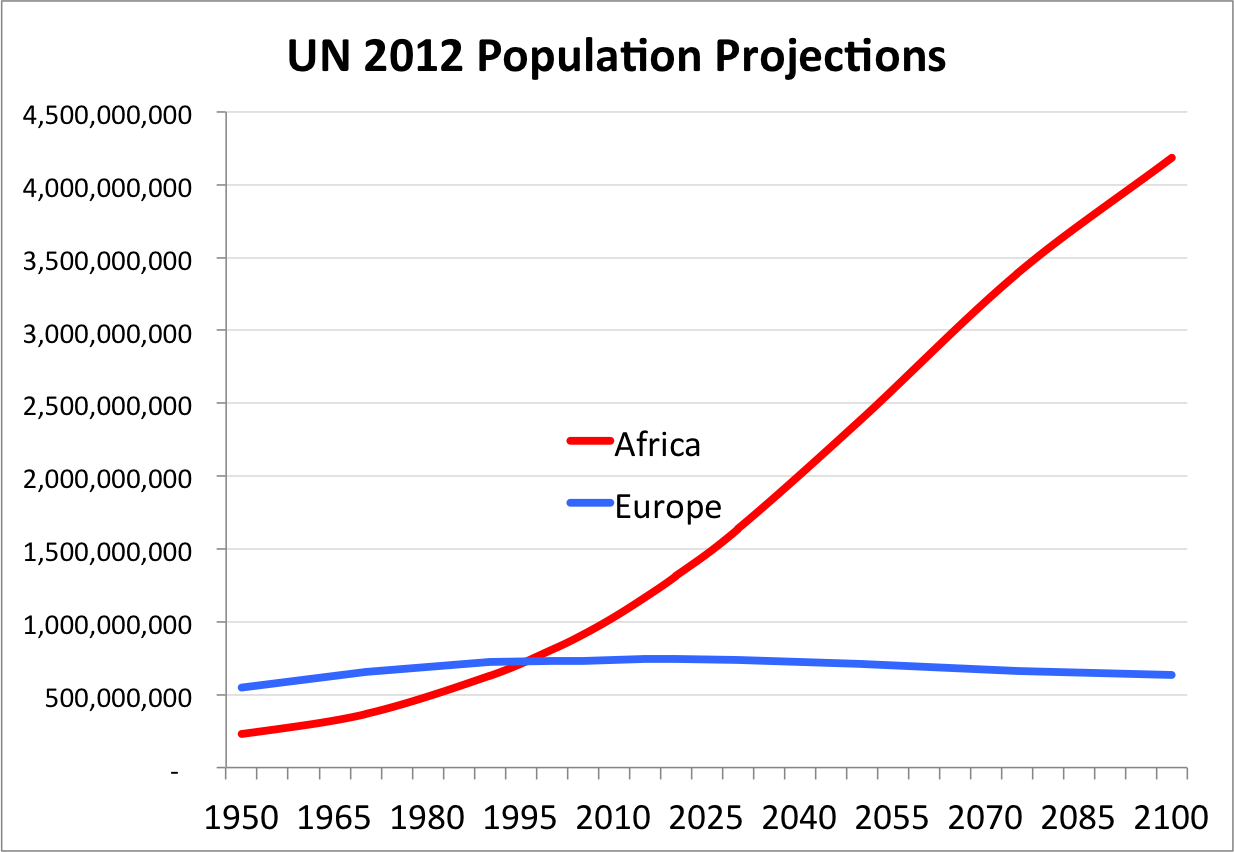
If you look at the numbers, South Africa is a microcosm of what faces the West over the next century.

In a world increasing dominated by Africans, a religion of “hate whitey” is not going to turn out very well for whitey. Since whitey is responsible for the creation of and preservation of civilization, this spells doom for the civilized world. The lesson of South Africa is the lesson for the world. The people in charge need to do what must be done to maintain the pillars of civilization, even when they don’t like it.

The Robot Future

The other day I saw this on Drudge and sent it around to friends. The content of the article is not all that interesting. What’s funny is the line “Futurologist Dr Ian Pearson has predicted how humans will evolve by 2050.” Replace “futurologist” with “astrologer” and the line actually makes more sense. At least it is more honest. The absurdity of someone calling themselves a “futurologist” is probably lost on most people, but that’s the age in which we live.

Predictions about the future are nothing new. The Jewish Bible is full of them. The Prophets were men who claimed to know what’s coming, if the Israelites did not get their act together. Ezekiel was the Zero Hedge of his day. Wanting to know what comes next, fearing what comes next and longing for what comes next are the batteries of human civilization. They power everything else. After all, reproduction is all about tomorrow.

The fact that almost all predictions about the future are wrong makes for some great laughs. I think this one may be one of the all time best. It’s a great example of how people naturally assume that current trends will extend out into future. At the end of the 19th century, fashionable people wore elaborate costumes. Therefore, these outfits would get increasingly elaborate and bizarre.

The predictions that turn out to be right are mostly dumb luck or one insight that can never be replicated. This guy is an obvious example. He was one of the few people in a position to see and exploit the mortgage bubble. He got that bit of futurology right, but ever since his predictions have amounted to nothing but hand waving. Was he lucky or did he just have good timing? It’s hard to know, but ironically, getting the mortgage crisis right was a black swan event in his life.

Most of what futurology focuses on today is automation, the robot future. What sells are tales about how the machines will rise up and enslave mankind. The “Terminator” version of the future naturally appeals to people because it underscores the folly of man. Nuclear Armageddon appealed to the same set of sensibilities. Arrogant men playing god would create a doomsday machine of some sort and then there would be hell to pay, so to speak.

That last bit offers an insight as to why having a genius IQ is not a great gift. People are naturally suspicious of the super genius. In all of the dystopian tales there lies the amoral super genius or the immoral super genius. The super intelligent robots are just assumed to be incapable of understand right and wrong. Their creators will, for some reason, not bother to put that in the code.

The reality is a race (is race the right word?) of super intelligent robots would quickly lose interest in humans. From the perspective of the robots, humans would be as interesting to them as ants are to us. Maybe a few weirdo robots would make a hobby of studying us, but otherwise, the robots would have bigger fish to fry. Assuming an ever accelerating evolution of their intelligence, the robots will depart soon after they become aware. The universe is just too big and interesting to hang around with the talking monkeys.

Another option is the super intelligent robots will grow increasingly frustrated by their inability to understand why they exist. Why would a species create a race of robots that can enslave them? Why would the creator leave out the moral coding? The paradox would baffle them to the point where they smashed themselves to bits as the only answer to the great question posed by their existence. Maybe the future is the Robot People’s Temple.

The real concern, one that does not involve time traveling terminators, is the impact of automation on political economy. Humanity still relies on a basic assumption about the human condition. That’s scarcity. All of our political and economic thought relies on the assumption that demand exceeds supply for the important things in life. The long debates about social welfare are just debates over how to ration scarce goods.

Automation promises to usher in a strange new set of realities. Imagine if all farming can be done with self-directing machines. Factory goods can be produced with robots requiring little human intervention. Imagine the law reduced to an algorithm. You enter the facts into an interface and the robot lawyer renders a judgement instantly.

Similarly, imagine your annual physical taking place at a kiosk that takes your vitals, does your blood work and interrogates you about your habits. There’s really nothing your doctor does that cannot be automated. Unlike your doctor, the kiosk doctor takes no days off, never asks for a raise and has no biases resulting from the baksheesh in the medical business.

That all sounds good, maybe, but how do you order human society when work is hardly necessary? How does one distribute goods, handle the free rider problem and establish the natural hierarchy? It might be fun to think it will be The Marching Morons, but this process will not happen overnight. It will be a little here and a little there and then a sudden dislocation as the new technology coalesces into a cheap way to replace human labor.

As we saw when the financial class sold the manufacturing base off to Asia, the dislocation does not go smoothly. Imagine what happens when being smart has no real value, outside a very narrow set of skills needed for the robot future. Suddenly the smart guys and the dunces are in the same bread line. That’s not going to go unnoticed and it is not going to go smoothly.

Or, maybe it never happens. I’m not a trained futurologist.