In another age, gold bugs used to bore the hell out of people with their theories about bringing back hard money after the coming collapse. The theory behind hard money is great until you look at the history of currency. All of the things that hard money is supposed to address have been evaded by rulers since Alyattes. It is fair to say, for example, that debasing the currency was the Romans favorite past time.
It’s why Bitcoin is just a libertarian fantasy. King Offa of Mercia figured out the value of monopolizing the currency around the same time Charlemagne figured it out in France. That was in the 8th century. Ever since, governments have made sure they monopolized the currency of their country. In the case of the US, monopolizing the currency of the world.
That does not mean the gold bugs were all wrong or that the Bitcoin people are all wrong. The key to prosperity is a stable currency so taking that out of the hands of feckless rulers would be a great leap forward. Similarly, an uncrackable digital currency could further limit the ability of government to play games with the currency. The question is on what should a currency be based?
In the beginning, gold and silver were convenient. They had transcendent value. But, gold is not particularly useful and the amount of it we have managed to dig out of the ground says nothing about the wealth of man. James Rickards has proposed a currency based on energy. A basket of energy stocks, like oil and gas, would provide the underlying value of the currency. That’s a fun book to read, by the way.
There’s this eBook that presents a couple of interesting graphs that gives a bit of an idea what an energy based currency would look like in the West. Rickards assumes the result will be a steady, slow deflation, which was the pattern in the free banking era. There’s also the fact that modern economies are energy based so tying the currency to the source of wealth seems logical.
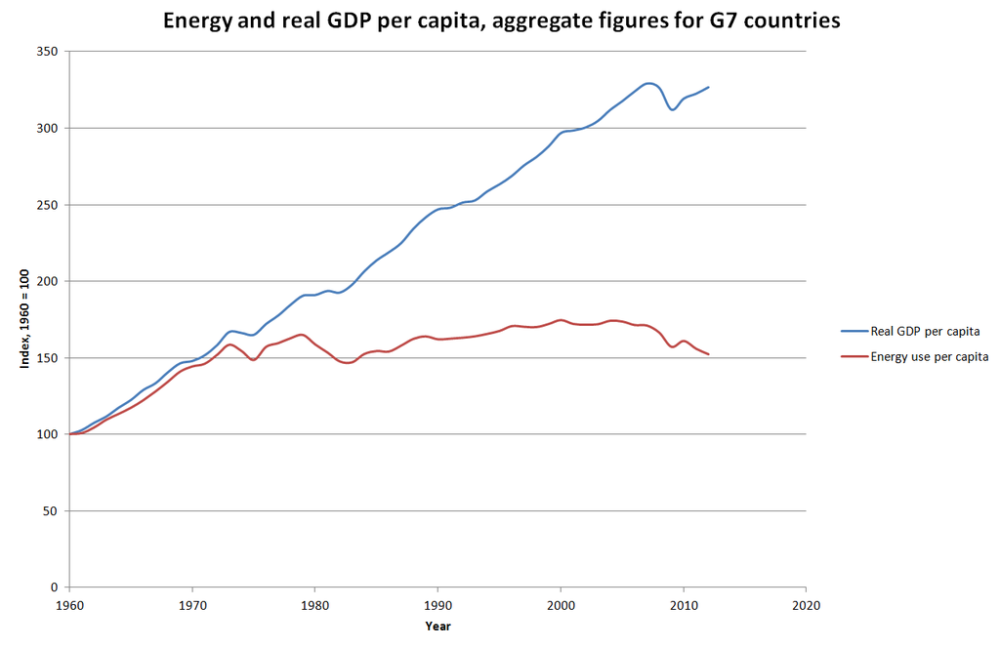
Here’s an interesting graph on energy and GDP in the West:
Here’s one on energy per unit of GDP:
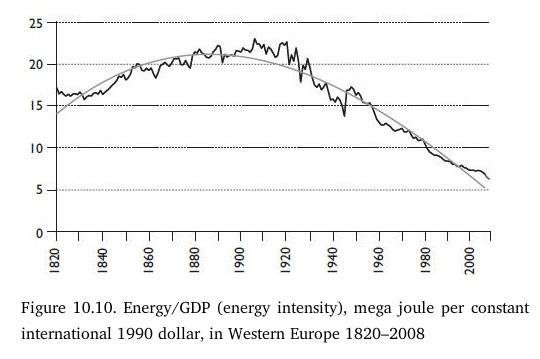
I don’t know the method of calculating GDP in these graphs, but I would assume it is: GDP = C + I + G + (X-M) as that is the preferred method of modern economists. I’m not sure it matters all that much as we know that energy is a declining part of our cost of living. Regardless, a currency based on energy would, all things being equal, have brought a mild steady deflation over the last century.
Now, all things would not be equal. We have seen crude oil prices fluctuate wildly over the last forty years. The impact on the economy would be magnified if everything was priced in oil, instead of only partially priced in oil. That’s the problem with the gold standard. But, energy is a different thing and there’s an argument that says a currency backed by energy would have a stabilizing effect on oil prices.
Now, Wall Street could not exist as currently constructed. The world financial system uses credit as its reserve currency:
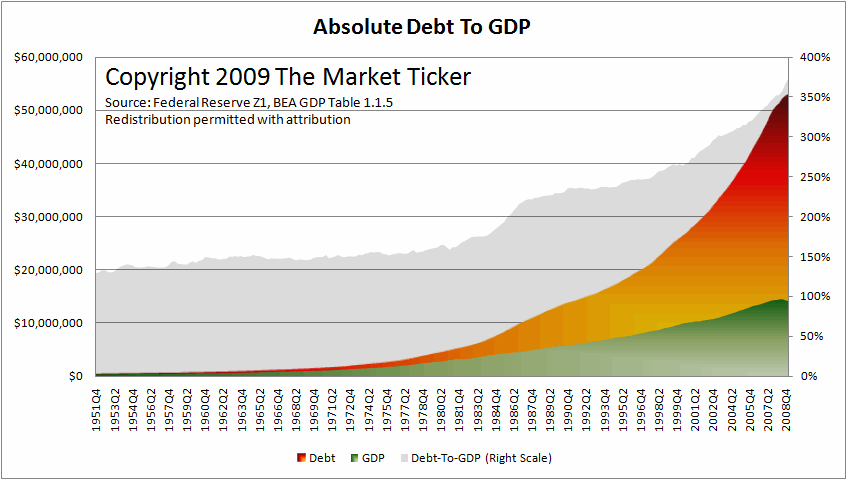
I’m old enough to remember when you had to have money to buy a car or a house. More important, if company A wanted to acquire company B, company A had to have the cash, or at least most of it, to do the deal. Today, a room full of MBA’s conjure it from thin air so that the clever can pretend to be big so they can eat the small.
That alone tells me we will not see currency reform without a near death experience. Even so, a total meltdown of the world financial system would not be enough to usher in currency stability. It’s just so much easier to steal when you can play games with the money.
We will see after the next crisis a move toward digital currency. That provides too many opportunities to control the population. Those bakers who refuse to pretend two guys playing house is marriage will see their ability to do any transactions frozen, thus making them non-persons. Black markets will be in barter as digital currency exchanges will prohibited to those involved in unofficial trade.
It’s hard to know, of course, as these things are debated in secret by the people in charge of the world economy. The current system of floating exchange rates was bubbling up through academia and international finance for decades before codified in the Louvre Accords. But, it is interesting as the history of the west is essentially the history of money.
Removing cash would be the greatest boon to the tax man since Milton Friedman invented withholding.