Weather Alert

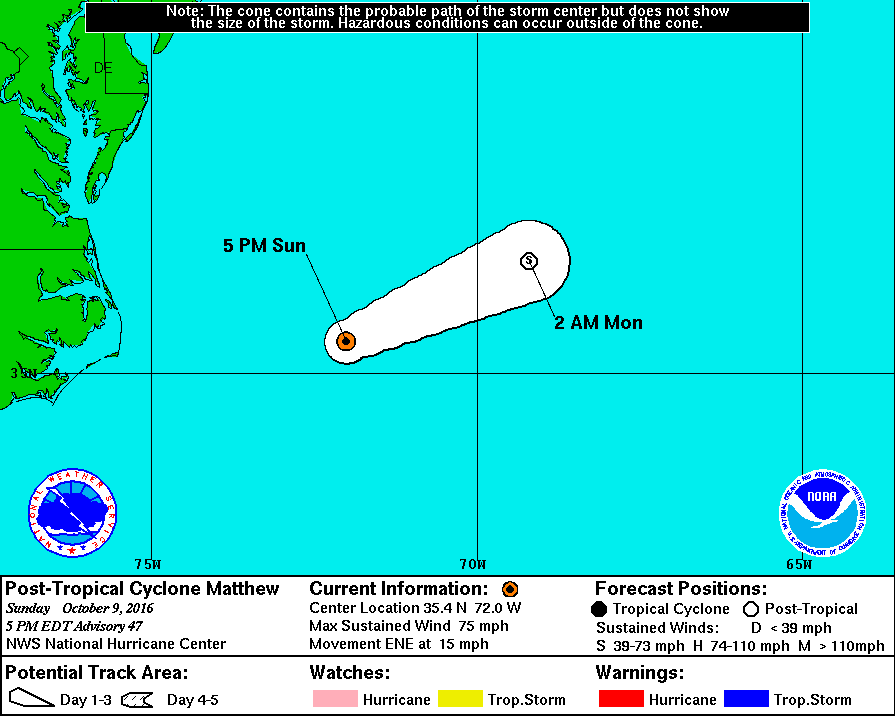
I am enjoying the mass panic and evacuation of South Florida at the moment, but I expect to be out of here by the time Godzilla strikes. The hosting service where this site resides, however, is located in path of the monster. These companies are pretty tough these days, with power generators and redundancy, but there is always a chance things go very bad. If this site is dark for some reason, the most likely reason is the hurricane. Or, they finally came for me, but the most likely reason is weather.

Best of luck to all of those in the path of the storm.

Trouble Brewing

One of things you cannot help but notice is that pretty much everything in America is some sort of scam run by the managerial class to extract money from the rest of us. The most common way to do this is via cost shifting and you see it in the so-called non-profit rackets. Everywhere you look, non-profits are working the tax code so that Cloud People can live self-actualizing lives, while we get to pay for it. It looks like that scam may be reaching its end.

When New Haven Mayor Toni Harp gazes out her office windows, she can see across the street to Yale University’s idyllic buildings and grounds — none of which are on her city’s property tax rolls.

Yale, a nonprofit despite its $25 billion endowment and sprawling property (it owns about half the land in the city, Harp says), doesn’t pay property taxes. And some officials in Connecticut, including Harp, would like to see that change.

They aren’t alone. City and state officials in other parts of the country, including Maine, Massachusetts and New Jersey, also are questioning whether they can continue to allow wealthy schools like Yale, or big nonprofit hospitals, to remain off tax rolls while they scramble for money to pay for police, fire, streets and other infrastructure and services.

In some cases, they are looking for ways of taxing what until now have been tax-exempt sacred cows.

For a long time now, the Federal government has strong armed states into going along with policies they would never implement on their own. They do this by threatening to withhold Federal funds for thing like roads and education. The result is state budgets have swelled as they take on the burden of the the Progressive fantasies, while the Washington politicians strut around like heroes for having cooked up these programs. The states are now running out of money to pay for this crap, so they are look for new taxes.

Of course, these colleges are working the same rackets. Yale could offer free tuition to its undergrads. They could expand their undergrad population and thus reduce tuition costs. Schools like Yale have the same sized student body they had after WWII, when the country was a third of its current population. Instead of doing those things, they have turned Yale into a five star resort whose primary purpose is to be a money laundering operation for the super-rich, looking to avoid taxes.

All of these cost shifting schemes have something in common and that’s leverage. State governments have been able to hide the cost of social programs through debt issuance. Colleges have become luxury resorts by passing those costs onto graduates in the form of student debt. Young people are holding north of $1 Trillion in debt at the moment, with close to 20% of it technically in default. What that is telling us is that this form of cost shifting is reaching its end as well.

There’s a Assembly of Notables vibe to stories like this because what we are seeing is the beneficiaries of the system desperately trying to keep the plates spinning. The people in power, the members of both parties, all know that either government spending at all levels is sharply reduced or that taxes are sharply increased. In all probability, both will be necessary. The trouble is the people with the money to be taxed are rich and powerful. Yale does not want to pay taxes and it does not want its patrons to pay them either.

As was the case in the French Revolution, what we are seeing in America is the use of debt to perpetuate a system that was evolved for a bygone era. Social democracy, which is what we have in America, is a 19th century concept implemented in the 20th century. Big parts of it are no longer useful, but no one knows how to reform it. There are millions still making a nice living doing busy work in the system and they will fight anything that resembles reform. The result is endless haggling over how to make 2 + 2 = 5.

The most likely outcome of this is we first see state governments begin to buckle. California is, for all practical purposes, insolvent. Illinois is probably going to be the first state to face defaulting on its pension obligations. All but a handful of states are facing very serious debt problems that will require doing what they previous assumed was unthinkable, like taxing hospitals and colleges.colleges. Next up will be a push to get rid of the tax breaks for charitable deductions. That’s when the whole non-profit racket collapses.

What will be interesting to watch is what happened when the people on the fringe of the managerial class start to be cut loose to save money. When hospitals need to cut costs, they will not be laying off nurses and doctors. They will go for the diversity coordinator and the patient liaison officer. Colleges are not going to drop the football team, but they will get rid of the Transgendered Studies people. A whole lot of people in self-actualizing careers will find out they are luxury items, not necessities. That’s when things could get fun.

The Traveler

Sometimes the world does change. For some reason the habits of the people shift from one mode to another. The American attitude toward divorce is the most obvious example for someone my age. I can recall my parents saying, “There’s no way he can run. He’s been divorced!” By the 80’s, I don’t think anyone cared much at all about the marital history of public figures. In one generation, divorce went from being a deal breaker to a non-issue for public figures. That’s a big change that people could watch happen in their lifetime.

Then other times you just start noticing something that has always been true, but for some reason you did not know it. All of us are prone to thinking that something new to us is actually new to the world. Millennials are especially prone to this. They carry on about the mundane as if they just discovered fire. But, it is not always easy to know if what you are seeing is a change in custom or just the accumulation of experience leading to a better understanding of something, that has been there all along.

Traveling, I cannot help but notice that I now have to navigate a thicket of thieves, hustlers and bandits, most of whom fly the colors of authority. For example, I check in at the airport and I’m told I will be charged $20 to check my bag. The airlines used to include this in the fee, but now they lie about it so they can pretend they are giving you a deal when you book the flight. Somewhere on the on-line booking site, I’m sure, there is language indicating that someone at the airport will rob you, but no one ever reads it.

When I was in the land of elves, I was charged $47 to check my bag. I fly often and on almost every flight, they beg people to check their items because they lack space in the overhead bins. Inevitably, there are people trying to rob the airline out of free stuff in exchange for them checking the carry on item. This feels new to me. I don’t recall having to go though this sort of stuff with the airlines. You paid a fee, they encouraged you to check your bags at no extra charge, and that was that.

It’s not just bag fees. Airlines have a million ways to rob the unsuspecting passenger. They charge for food, of course, but they also charge for things like a desired seat. I just flew on American and the man at the counter tried to “upgrade” me to an aisle or window seat. I reminded him that I was already booked in first class, where there is no middle seat. He tapped away at the keyboard for a minute, pretending to examine my claim against his company’s information, and then finally handed me a boarding pass. He had no shame.

This is not unique to airlines. Travelers are now familiar with the many people, who have their hands out, expecting something from the traveler. My swank hotel normally charges for water. Not bathing water, but the bottled water they leave in the rooms. The absurdity of this is never noticed, even when you point it out. I was once presented with a bill at check-out for a newspaper, as part of “guest services.” If they had not listed it on the bill, I would never have noticed, but it was like they wanted to rub your nose in it.

Highway robbery is not new, which is why we have the term. It just seems to me that the airlines, hotels and even restaurants used to go out of their way to let the traveler know they were not bandits. It used to be an axiom. for example, that you should eat where travelers eat, because you know the food is good and the  proprietor is honest. Today, it seems like the opposite is true. Places that cater to travelers are crooks, working every angle to separate the traveler from his money.

Last night I was out to dinner at one of the many places in Miami that cater to tourists. In the fine print of the menu, our menus are now legal documents, is a notice that they apply a 12.5% gratuity to the bill. Most people, as was the case with my host, just assume they decide the tip, based on the service. They conduct themselves accordingly and often fail to notice the included gratuity. By definition, a gratuity is voluntary, but this is no longer the case at many places catering to travelers. It’s just another hand reaching into your wallet.

I’ve traveled a lot in my life, going back to the days before metal detectors and weirdos fondling your business at check-in. Air travel was always a hassle, but it now feels worse. It feels like people that talk like me and look like me are part of an organized plot to rob people like me. Everyone now has a grift, an angle they are playing to “increase their per client yield” as the business dorks say. That’s just it, behind these schemes are business majors with econ degrees looking at the customers the same way a serial killed looks at prostitutes. It is a transactional experience.

When I travel these days I’m prone to dark thoughts about the future because all along the way, I’m navigating around one hustler after another. They are kitted out in costumes and language intended to fool me into handing over my credit card, which they will pillage like Vikings on holiday. This is the very definition of a low trust society. It did not always feel like this. Maybe it was and I never noticed, but I am noticing now. My default assumption when dealing with anyone while traveling is to assume they are a bandit.

On the way back from dinner, we passed a man waving his arms next to what one would assumes was his vehicle. My host wanted to stop and help. The man waving his arms looked Middle Eastern. I told my host to not stop as this has become a way to rob people. They pretend to be a traveler in distress, you stop to help and then they rob you. She gave me that look that women give to men when they are disappointed in them, but then she realized I was probably right and we moved on.

This is the dream world of economists and libertarians. They fantacize about the day when no one has any loyalty to anyone and everyone is a moist robot, calculating their advantage in every transaction. It is a world dominated by rootless men of commerce, who go from one deal to the next, without any thoughts of the future or the past. They invest in nothing because they have loyalty to no one but themselves in the moment. If you want to see the future, go to the airport. That’s what they are preparing for us.
The Others

The phrase “third world” is one of those terms that will probably fall out of usage over the next decade. The Cloud People never use it these days as it is dangerously problematic for them. It is one of those terms that is now freighted with a lot of bad thoughts and bad memories. That and the term made the most sense in the Cold War days when the civilized world and the fringes were divided between the Americans and the Soviets. Most people under 40 have no idea what the “second world” even was so having a third world today probably seems like nonsense to them.

The term was coined by a guy named Alfred Sauvy, a French demographer. He wrote an article comparing the countries no one cared much about, with the Third Estate. It was an idiotic and ridiculous comparison, but it stuck and was eventually embraced by banana republics and African potentates. It got picked up by American radicals as a cause and the term became associated with the ass-backward crap-holes almost always south of the equator. That bit of noticing is what’s now very dangerous.

The term still means something to geezers like myself and whenever I have a reason to experience the third world, I call it the third world. The thing that distinguished these societies from the advanced societies is the disorganization. Pretty much everything is a disorganized mess, especially the traffic. P.J. O’Rourke once observed that the degree of chaos in a country’s traffic correlates to the general chaos and lawlessness of its society. I no longer recall why he said it, but it has always stuck with me.

The reason, of course, is trust. Large scale social organization requires a relatively high degree of social trust. If you want to build a building, for example, you have to trust that the people in charge are not going to change the laws halfway through your project so that you capital has been wasted. You have to trust that the laws will remain pretty much the same, with regards to property and contracts. Otherwise, you are leaving your investment to chance. Contract law and private property are rooted in social trust.

Driving is one of those large scale things Westerners take for granted, but the whole enterprise relies on social trust. As a driver, you rely on the other drivers to operate their vehicle by the conventions of your culture. You assume the other drivers are going to act in a predictable manner. In low-trust societies, it is every man for himself on the roads, because no one assumes anything about anyone, other than they are out for themselves. The result is YouTube videos dedicated to insane drivers.

Anyway, I get through the airport and make it out to where I can catch a cab. The driver has one of those great Caribbean names, Vladimir Sanchez. For some crazy reason, a lot of Caribbean mothers named their kids after Tolstoy characters. There are a lot of Puerto Rican girls with German first names like “Heidi” for some reason. I once knew a Puerto Rican girl named Olga. Vlad was chatty, but I barely understood him as Caribbean Spanish is loaded with slang. But, he was cheery and helpful.

He also drove like a maniac and came close to slamming into a few cars on my short trip from the airport to the swank Miami hotel. That’s when it occurred to me, as my life flashed before me, that we will need a new term for the world that is about to be forced upon us. Calling some country south of the equator “third world” is not going to make much sense when most of American is operating much the same way. Instead, we will have terms for the “other place” and the “other people.” We’ll need a name for those not like us, but allegedly still “us” according to our masters.

For example. A Cloud Person heading to Miami for a meeting with other Cloud People will talk about being amongst the other people. Maybe Miami will just be one of the many “other places” that exist outside the fortified Cloud cities of Washington and Manhattan. Similarly, the Dirt People will talk about those almost ethereal people, who are mostly seen on their TV’s, but once in while are seen touring the favelas of America. Persians have a word, “biganeh” that literally means an unknown person or person of alien origins. We will all be biganeh to one another.

This may seem bleak, but the future always does. It is the way things are headed as the people in charge tear apart what took centuries and millions of dead to construct. When you come into a place like Miami, you see see why the Cloud People want this for everyone. They see the polyglot beef stew culture around their swank hotel and think that it is the glorious egalitarian future foretold in the prophesies. They never see Liberty City or Miami Gardens. They have no reason to care as that is an “other” problem to be managed by other people.

Friends and Enemies

For well over a year now, I have been talking about the Trump Effect™ and how it may be the single most important part of this election. Don’t get me wrong, Clinton winning is most certainly the end of America as an on-going concern. She will invite in 50 million foreigners, confiscate guns, auction off everything that is not nailed down in exchange for cash to her slush fund. She will weaponize the court by packing it with coreligionists. America will have become a banana republic and there is no peaceful way of returning from it.

That may be the end result, even if Trump wins the election, but what comes next will include a whole lot of people who are now fully aware of the reality of the political class. There are exponentially more people “fully woke” now than a year ago. Official Conservatism™ is circling the bowl, largely because the grassroots have looked around and decided guys like Jonah Goldberg are just low-tax liberals who hold them in contempt.

For a long time, the Cloud People have told the Dirt People that the great divide in America is between Liberals, who want to expand government and create a socialist utopia, and Conservatives that wish to restore limited government and a constitutional republic. The Bush administration put the lie to the latter and the mobilization of Wall Street behind someone’s wife in order to block Trump puts the lie to the former. Old school Progressive like Bernie Sanders are now outsiders on the Left.

In fact, among the Cloud People there is no divide. They unanimously agree that class solidarity comes before everything else. That’s made clear in this editorial from the Arizona Republic endorsing someone’s wife.

The 2016 Republican candidate is not conservative and he is not qualified.

That’s why, for the first time in our history, The Arizona Republic will support a Democrat for president.

This is the new team chant of Official Conservatism™. The logic here is akin to saying “They don’t have my favorite ice cream so I’m going to have rat poison instead.”

Trump responds to criticism with the petulance of verbal spit wads.

That’s beneath our national dignity.

By “our dignity” they are not speaking for you. You are not “our” and you better get that through your thick head.

Trump’s long history of objectifying women and his demeaning comments about women during the campaign are not just good-old-boy gaffes.

They are evidence of deep character flaws. They are part of a pattern.

These are not the words of serious people thinking seriously about the country. These are the words of teenage girls gossiping about one another in the bathroom. That’s what is dawning on many Dirt People. These feckless airheads allegedly carrying the people’s banner in the media are more concerned with their status among the beautiful people than anything else. There is no divide among the Cloud People. They think the Dirt People are revolting.

And increasingly the Dirt People are revolting. Even people like Ace of Spades are moving toward a break with Official Conservatism™ and the GOP.

The party — not just the party;the writers who are supposed to have telling the truth as their first mission, but instead of become nonstop liars all the time decrying Trump as a liar himself — has declared war on all of the Lessers beneath their station, those not in The Media and who should, therefore, not have quite as much of a say in things as they themselves have.

They’ve made themselves into exactly what they pretend to oppose — and exactly what I do in fact oppose.

Guys like Jim Geraghty, and other NR-types, used to quote Ace all the time, but now they don’t know his name. The reason is class loyalty. Ace has his ideas and loyalty to the managerial class is simply not a concern. Given the choice between Trump and Clinton, he rationally picks Trump. For the National Review types, this is treason. Class loyalty trumps everything or else, so Ace is now dead to them.

The sadness and frustration you see in that Ace post turns up all over as people begin to see the reality of their condition. More than a few look back at their support for Bush, for example, and wonder how all those big shots in conservative media were so wrong. They wonder why they never talk about it, much less admit it. The conclusion many are making is that it was just a scam, a con, a way to turn the virtue of conservative voters into a vice in support of the Progressive project.

Eric Hoffer wrote “What starts out here as a mass movement ends up as a racket, a cult, or a corporation.” That’s what happened with the conservative movement. By the 1980’s they had their charismatics, Reagan and Buckley. Next came the money making opportunities in talk radio and book selling. By the time Bush came along it was a racket, a bust out, where the only real concern was how much money these people could stuff into their pockets before the game was up.

The game is up now and the Dirt People are waking up to it.

A World of Problems

Back when the Germans were threatening to shut down Greece and sell it off for parts, it was fairly obvious that there was no way to “fix” the Greek problem. Even it were possible to radically overhaul their public sector, the debt payments are too high to maintain the level of social services expected from a modern social democracy. Default was unthinkable because close to 80 percent of Greece’s public debt is owned by public institutions, primarily the EU governments and the ECB.

The “solution” was to kick the can down the road until a miracle happened, but now the problem is back.

ATHENS—Greece’s economic recovery is proving elusive, challenging the forecasts of the country’s government and foreign creditors still counting on growth reviving this year.

The International Monetary Fund said last week  that the economy is stagnating, in the first admission from creditors that Greece’s recovery is off track again. Growth will only restart next year, the head of the IMF’s team in Greece said on a conference call with reporters, without offering details.

Of particular concern is that exports, which are supposed to lead Greece out of trouble, are on a slow downward trajectory, hampered by capital controls, taxes and a lack of credit.

“There is no chance we will see a rebound unless we see some bold political decisions that would introduce a more stable business environment,” said Dimitris Tsakonitis, general manager at mining company Grecian Magnesite.

The bailout agreement between Greece and its German-led creditors assumes rapid growth from late 2016 onward, including an official forecast of 2.7% growth in 2017. Private-sector economists believe next year’s growth could be closer to 0.6%.

Weaker growth would undermine the budget, likely leading to fresh arguments with lenders about extra austerity measures.

Greece is still grappling with the measures it has already agreed to. Late on Tuesday the country’s parliament approved pension overhauls and other policy changes that have been delayed for months, holding up bailout funding.

Greek government officials are sticking to their view that the economy is on the cusp of growth. “We are at the turning point at which we can we say with certainty that we are leaving the recession behind us,” Economy Minister George Stathakis told supporters of the ruling left-wing Syriza party Sunday.

The economy will get a push from investors as of the end of the year, when lenders are expected to provide some debt relief and the country qualifies for a European Central Bank bond buyback program, Prime Minister Alexis Tsipras said in an interview with The Wall Street Journal last week.

In other words, the miracle did not happen and the problem is now worse. This comes at a time when Europe’s biggest bank is in very serious trouble.

Hedge funds have started to pull some of their business from Deutsche Bank, setting up a potential showdown with German authorities over the future of the country’s largest lender.

As its shares fell sharply in New York trading, Deutsche recirculated a statement emphasising its strong financial position.

European regulators and government officials have kept a low profile in public over Deutsche’s deepening woes. However, in private they have struck a sanguine tone, stressing that in extremis there is scope under European regulation to inject state funds to support the bank, provided it is done in line with market conditions.

Marcel Fratzscher, head of DIW Berlin, a think-tank, said: “If push comes to shove, the German government would contribute because Deutsche Bank is the only global bank that Germany has.”

There is one solid rule with banking and that is when the biggest bank is in trouble, all the banks are in trouble. The reason is a bank in trouble seeks to increase its cash by unwinding its holdings. This puts downward pressure on the price of those assets, which forces all banks holding similar assets to revalue and perhaps raise their cash holdings, by selling assets. This can easily set off a cascading effect, which is popularly referred to as contagion. The ghost of Lehman now haunts Deutsche Bank.

Deutsche Bank has something north of €42 Trillion in derivative exposure. To put that into perspective, the GDP of Europe is €14 Trillion. The phrase “systemic risk” is starting to pop up in news stories for obvious reasons. Presumably the German government would step in and bail out the bank, but this is the same German government that invited millions of Muslims into the country. That and no one really knows how big the problem is at Deutsche Bank. There’s nothing more dangerous in the financial world than uncertainty.

If that’s not enough to have you stocking up on potable water and MRE’s, the news brings word that the Obama Administration is trying its best to start a war with Russia over Syria. They are ending talks with the Russians over the bombing of Aleppo. The Russians are threatening to impose a no-fly zone, while John Kerry is making noises about sending troops to Syria. The US position is completely nuts, which is what makes it so dangerous. The same people who screwed this up are now tasked with avoiding a mistake that will lead to a shooting war with the Russians.

The world always has some problem that could get out of control and bring the whole thing crashing down, but the odds are usually long enough to not worry too much. Pakistan is now threatening to nuke India, but that happens often enough to not take too seriously. Pakistan’s military understands that they will lose a real war with India. India understands that they will gain nothing by winning a war against Pakistan. This is one of those problems that can be managed by the permanent diplomatic service, with little help from the political class.

The three crisis I’m following all have some things in common. One is they will require hard choices from the political class to contain. In politics, a hard choice is one that causes a politician to lose support. Merkel’s government is already teetering so how willing is she going to be to make a bold move to rescue Deutsche Bank? The ECB proved unable to deal with the Greeks the last time. If Merkel is facing a financial crisis, who will she play bad cop with the Greeks when Tsipris inevitably comes calling, demanding a break on Greek debt?

The Syria debacle is the most concerning because it resembles so many European problems of the past. There’s a Seven Year’s War quality to it where you have two main players with the rest changing teams after every stage. With the US now increasing the troop levels in nearby Iraq, presumably to fight in one theater of this conflict, the chances of a mistake increase. In these situations, mistakes are often not mistakes, but even when they are, they become reasons to abandon dialogue in favor of military options.

We live in a world of trouble. One can be forgiven for having a sense of foreboding.

Carnival of Nonsense

The other day, I was on a conference call hosted by a youngish women who spoke mostly in riddles. She actually said, “intrinsically customize distinctive relationships” in a non-ironic way. She may have said other nonsense like this, but my eyes had glazed over and I was working on a revenge fantasy, not paying attention. That goofy phrase woke me from my daydream and that’s why it stuck in my head. I spent the rest of the call trying to unriddle what that could possibly mean and why anyone would say it.

Anyone familiar with life in large organizations is familiar with this sort of gibberish that seems to have started about two decades ago. My first recollection of creeping neologisms is in the 90’s when everyone and everything had to have the word “synergy” attached to it in some way. I can still recall a particularly good looking power-skirt enthusiastically telling a group of us that “synergy” was our key to success. I was sure then and I am sure now that she had no idea what it meant.

Echolalic babbling has become so common now that we tend not to notice it. This article on block chain technology I ran across the other day is a good example. I have an interest in the topic so I read these things when I find them, but “read” is not really what I do. Instead, I scan them looking for word combinations that are in a real language conveying actual information. I naturally filter out nonsense like “the diversity of such vertically connected organizations” because it is meaningless pap that just fills space.

The excessive use of jargon is not new. Pointless fields of study like the soft sciences are packed to the gills with jargon. Read a psychology paper and you have to keep stopping to think about the meaning of some word or phrase that more often than not has no real meaning, outside the narrow specialty within the field of psychology. The word is a signal that lets the reader know if they belong. For those who don’t belong, they are intended to scare you off so you don’t look too closely and discover the study is mostly nonsense.

That’s what happens in the corporate world where there are layers and layers of “managers” that only exists because the state has created the need. Companies fear being sued or being whacked around by the state, so they have elaborate processes to comply with the law. The army of do-nothings in the bureaucracy are there to make sure no steps are skipped. They just clog up the works, by forming committees and process management teams that try hard to keep the remaining productive workers from getting their work done.

There’s a chicken and egg issue here. Is this the result of women now dominating the workplace or did this evolve so that women could dominate the work place. Much of the jargon and gibberish we see is attached to elaborate processes, which naturally appeal to women. Males are results oriented while women are process oriented. Get a gander at how federal grants are doled out in the cognitive sciences and you see an elaborate process staffed almost exclusively by women. Perhaps the Muslims are not wrong about everything.

That aside, no one wants to believe their work is meaningless so it is natural to try and make what you do seem important to yourself and others. Larding up these busy work jobs with mountains of nonsensical jargon makes the people doing these jobs feel important. Mastering the corporate pseudo-language allows them to feel like experts and insiders, much in the same way academic jargon works. So, armies of middle managers go from meeting to meeting speaking in tongues to one another, proud that their calendars are full of meetings.

Theodore Dalrymple thinks there is something sinister to this descent into echolalic babbling, but I’m not sure. Orwell’s Newspeak was a part of an overall program of the state to oppress the masses. The proliferation of jargon we are seeing does not strike me as such. Instead, it is closer to what you see with small children on a playground. They have a limited vocabulary and lots of free time so they make up silly words and word games that sound pleasing, but mean nothing.

That’s what the boys and girls in the managerial state are doing when they cook up neologisms. It’s nursery rhymes for adults, who live and work in what often resemble daycare centers for adults. Instead of wrestling with the Legos to build a house, they spend their days wrestling with Excel to make a cool looking pivot table. Instead of memorizing rhymes, they invent bizarre word combinations like “monotonectally transform multimedia based channels” and put them into PowerPoint presentations.

It is another example, I think, of how Huxley got it right and Orwell got it wrong. The authoritarian model imagined in 1984 could never last because it had to rely on force and the math always works against such a system. The violence required to hold it together eventually exceeds the systems capacity for violence. The Huxley model of a world populated by infantilized adults, cheerfully engaged in busy work requires much less coercion from the state and it has a higher carrying capacity.

It turns out that the future is not “a boot stamping on a human face – forever.” The future is a conference call on which a cheery 30-something says things like “progressively coordinate functional strategic theme areas” – forever.

Evolutionary Madness

Back in the spring I did a post on the trouble with artificial intelligence. I fully admit to being a skeptic and I tend to avoid reading much of the cheer-leading for it. Automation will plod ahead, as we have seen. We will see “smart” devises popping up in our lives with varying degrees of success, but no one alive will see the robot future because it will always be the future, never the present. Human intelligence is much more complex and mysterious than the futurists understand so it is just really fast calculators, not Terminators.

The point I alluded to in the post is we have a very poor grasp of how humans manage to navigate the reality of life. Most people engage in a great deal of magical thinking, yet they manage to avoid killing themselves doing something stupid. We’re not even sure how to define this magical thinking, much less quantify it. Close to half of Icelanders believe in elves, which is nutty, but it does not seem to cause them much trouble. Americans believe in magic dirt, despite it being laughably ridiculous.

Self-evolving artificial intelligence could follow the same path as humans and develop all sorts of weird defenses against the harsh realities of life. Or, it could quickly discover that the big questions have no answer and therefore life is not worth living. Artificial Intelligence would quickly evolve into a suicide machine and be gone as soon as it becomes self-aware. The odds of it resembling Spock are close to zero, with the most likely outcome being that it quickly moves through homicidal sociopathy to suicide.

We really don’t know how or why humans all have heads full of nonsense. Humans everywhere have evolved complex beliefs in the supernatural. The working theory is that belief, as in religious belief, was one of the first modern human traits, along with language. Some argue that it is a happy accident, while others suggest the believers tend to be better at making babies, so we end up with more believers than would otherwise be predicted. If you have been reading this blog, you’ll know I’m in the former camp.

A guy calling himself  Donald Hoffman takes this further and argues that humanity has evolved to perceive a world that does not exist, but that allows us to thrive in the world as it exists. Here is a longish interview with him where he explains his theory in some detail. Here’s a shorter NPR summary of that interview that captures the high points. The even shorter version is we are all in a matrix of our own design where we eagerly take the blue pill whenever reality becomes too much for us.

To me, this makes perfect sense. My cat does not need to know a snake is or is not dangerous. He does not need to know much of anything about the snake. He simply confronts it as a threat and acts accordingly. In other words, Mother Nature is efficient. There’s nothing to be gained by endowing the cat with a  love of ophiology. There is great benefit to possessing an innate fear of snakes. Elephants being spooked by mice seems stupid to us, but from the perspective of the elephant, it is brilliantly efficient.

Putting this another way, humans did not evolve to acquire a detailed knowledge of the universe. We evolved in order to bring the next generation to sexual maturity. Understanding the world as it is, in great detail, is of no benefit and would possibly be a great detriment. Instead, we have evolved to perceive the world in a way that allows us to navigate it in the short run, with the highest possibility of success. For those disinclined to accept evolution, God has literally made us crazy, to our great benefit.

This “reality” means artificial intelligence, as in super intelligent entities able to fully grasp reality, is never going to happen. The more likely outcome is the self-evolving intelligence launches off onto a path to some form of insanity, maybe a familiar one or possibly something beyond our understanding. If it lacked the drive to reproduce, then it could simply evolve to some equilibrium and fall into what would look to us to be a dream state. In other words, the possible outcomes for the self-evolving intelligence are mostly a dead end, just as it has been in nature.

Election Reset

We had the great debate and my guess is nothing much changed from 24 hours ago. This election has always been about finding a reasonable alternative to Hillary Clinton, someone a large majority of Americans don’t like very much. One of the oldest rules of politics is that a well known, well established candidate polling below 50% is in trouble. Often, an incumbent that is in such a spot gets a primary challenger as his own party smells weakness, so a young gun is sent in to finish him off in the primary.

The one thing the sissy boys of Official Conservatism™ probably got right about this election thus far is that the other choices in the GOP primary would have probably started with a huge lead over Clinton. The collection of dwarfs assembled by the party had all been vetted to make sure they were the emptiest of empty suits, thus ensuring the Left could not say anything mean about them that anyone would believe. Guys like Jeb Bush and Marco Rubio would start out with the Cloud People seal of approval, thus beginning as an acceptable alternative to Clinton.

That’s why none of those options won the nomination. For good or ill, the GOP is the one place where the Dirt People can have a voice and they loudly rejected the dwarfs on the grounds they were nothing but low-tax liberals. Trump is not the ideal candidate, but he talks about the things normal people think are important and that made him look like a giant compared to the rest of the field. Going into the general, he was the high risk option, as far as an alternative to Clinton. As a result, he started from the trailing position in the polls

That has slowly changed over the last six weeks as voters were reminded of why they hate Clinton. Trump has also modified his approach, working on selling himself to the doubters, rather than throwing red meat to his fans. He has also avoided the traps the press has laid for him, which lets people know he can turn it on and off when he wants. People can tolerate a little bit of rough talk as long as they know the candidate knows when to behave. As a result Trump has closed the gap and may very well be leading now.

There’s another way to think of these things, which applies here. In every election, the three big categories are security, economics and culture. They are not of equal importance and some issues fall into all three buckets. Immigration, for example, has a bit of all three, depending upon how it is being discussed. The voters are looking for a general sense of which candidate is more compatible on each of these three areas. What holds it all together is the voter’s sense of the candidates trustworthiness on these matters.

For instance, Mitt Romney polled much better than Obama on the economy, but no one believed Romney. He had been on all sides of all issues for no reason other than expedience. Even though the things he was saying with regards to the economy made sense, the assumption was he was saying them because they polled well. Mitt is one of those pols who will come out in favor of bestiality, if some consultant tells him it is a winning issue. In his case, being right was of no value because he lacked authenticity.

In this election, Clinton’s honesty problem is not a big issue because her lying does not change the voter’s sense of where she stands on the big three items. On the other hand, Trump’s authenticity is a great benefit because it makes him trustworthy. You may not agree with his position on an issue, but you know what you are getting with Trump. His authenticity not only helps him on a personal basis, it helps him overcome the uncertainty issue all newcomers face. It makes him seem less of a risk.

This is why the walls are closing in on Clinton. If you look at the map, states are going from “too close to call” to “leans Trump.” If you look at the polling, states like Georgia and Florida are just about a lock now for Trump. Ohio has been abandoned by Clinton, suggesting her polling says it is over there. States like Colorado and Pennsylvania have now moved into the toss-up category. In all probability, more people were reassured by Trump in the first debate than were convinced Hillary is worth a second look.

There are more debates and plenty of chances for both to harm themselves. Hillary could fall over again or Trump could punch a hobo. At this point, you would rather be on Team Trump as the wind is at his back and his road forward is clearer and more controllable. Clinton will need some help and she has to hope everyone that has dirt to dish is too afraid to go public. Still, she has the media and most of the GOP behind her and that is no small thing. The state of the race at the moment is Trump ahead by a tiny bit.

The Great Debate

When I was a kid, I used to cringe when the geezers would complain about the political debates, calling them “made for TV circuses” or worse. I enjoyed them, simply for the tactics. The moderator would try hard to help the liberal and trip up the non-liberal, if there was one on the debate. If it was just three liberals then it operated as a window into the hive, if you were willing to sit through it and observe. The adults were always puzzled by my interest in these things and they would say I was very mature for my age.

I was so much older then. I’m younger than that now. These days I’m watching solely for the yucks. I want to see Hillary have a seizure and begin speaking in tongues. I imagine her fielding a question about Syria and responding with “Cabbage toaster broccoli banana” and then running around the stage clucking like a chicken. The woman is a horrible shrew and nothing she says means anything, because she is also a pathological liar. The fact that she has made it this far suggests we are in the end times.

Of course, Trump is great TV, even if you don’t like him, and I’m really not a fan of his style. The blustering New Yorker has never been my favorite American type, but he does get off some zingers that you just never hear a politician say these days. His crack about Rick Perry wearing glasses so people would think he is smart is the sort of thing a guy from Queens says. Trump is a man, who has been putting on shows for Americans going back to the 80’s, so he knows how to do it well.

The thing about these shows is they are mostly about reassuring voters that their guy is OK and the other guy is not Cicero or Churchill. Bush supporters were on pins and needles before the 2000 debate. When Gore made a fool of himself, the Bush people relaxed and felt like they had a winner. The Gore people got their turn in the next debate when Lieberman and Cheney had an mature, sensible exchange over important topics. After that debate, both sides were back where they started, sure that their guy was OK.

They say this time will be different, but my hunch is most Trump people will be happy if he avoids throwing a chair at the moderator or calling Hillary a fat cunt. Trump’s reputation for saying outlandish things is wildly overstated. Most of the time, he is simply saying what everyone knows, but no one on TV ever says. In some cases, it is manufactured outrage over something he said. Still, he will be baited by the moderator into talking about touchy subjects and his job tonight is to avoid the traps and play it safe.

Clinton has a tougher task because she is the establishment candidate. The irony here is that she got into politics to be the radical challenging the man and now she is the face of the man. If she tries to sound like anything other than the defender of the faith, she will come off as a phony or a bigger phony than typical. She just has to make sure she does not look like death or have one of those hacking fits where it sounds like she is coughing up a lung. if she topples over or is wheeled out in an iron lung, then it will be curtains.

These things are TV shows and that plays to Trump’s strength. The first debate is like the first impression in that it colors the rest of the contest. Amazingly, millions of people will tune it tonight not having thought much about either candidate. In a sane country, these people would be sterilized, but we let them vote so they are a part of the dynamic. Trump’s TV skills will give him an edge in creating a good first impression. Clinton’s shrill personality is just not made for these things so she is going to have to try and get under Trump’s skin and hope he says something off-putting.

Everyone in the media and in the Cloud Party knows all this stuff. They have been working with the moderator to make sure he understands the the finer points of arkancide. The post-debate talking points are prepared and the reports and analysis are ready to go. The moderator’s job tonight is to hit Trump with a few zingers so they can put his words into their reports and post-debate sound bites. The chattering skulls of the commentariat are practicing their one-liners in front of the mirror as I type this.

My bet is the post debate spin will be based on Clinton’s “presidential performance” and the “gravitas” she displayed versus Trump’s “amateurish and unserious” performance. The words “dangerous” and “reckless” will be tossed around by the talking heads with regards to Trump. That’s the game plan from Team Cankles. They want to run on the message that Trump is too dangerous and unpredictable, so you can be sure the media types have been told to push those points after the show.

By next weekend, Trump will have a jumped in the polls and he will be pushing 50%.