The Cult Versus The Clintons

It’s generally assumed that religions are punctilious about enforcing their rules. Particularly the rules regarding personal morality. This is due to the fantasy versions of religious history taught in public schools around America.

In those versions, the Puritans were severe sexually repressed fanatics who stoned women for showing a little ankle. Further back, the Catholic Church was slaughtering people throughout Europe for missing confession. Of course, modern Evangelicals are peeping in your bedroom to make sure you’re not having too much fun.

That’s all nonsense, of course. The truth is religions are terrible at self-policing. The exception is theocracy. When the church controls the state and has a monopoly of force, it then has the duty of enforcing the rules. Its legitimacy is largely based on enforcing the rules.

That means policing itself as well as the populace. If a member of the clergy gets caught stealing they will face a more severe punishment than a commoner because the church has to maintain its legitimacy. A crime against the state is a crime against the church and therefore must be punished.

Theocracy is a rarity in human organization. The norm is a separation. In a monoculture this is not a problem because the church can rely on their coreligionists in the state to manage the enforcement of man’s rules. The church is free to worry about the spiritual side of things. It’s why multicultural societies are rare and tend to violence, but a topic for another day.

Catholic France is a good example of where the state was run by Catholic men who were not men of the Church. Britain after the Synod of Whitby is another that comes to mind. Pre-Civil War America was a land with a secular government run by Protestant Christians who were more than happy to let the laws be informed by their faith. It’s why the Civil War can be viewed as a religious schism amongst American Protestants.

Religions in lands where the secular authorities are hostile have peculiar pressures on them to not police their own too rigorously. They tend to focus on crimes against the faith like heresy or apostasy. Challenges to the hierarchy of the faith are also monitored. The issues that could involve the secular authorities present a problem. Turning over a criminal to the secular authorities could both violate the faith and place the faithful at the mercy of those outside the faith.

An example of what I’m getting at is the Catholic Church scandals. Priests are supposed to remain celibate and those who don’t face sanction from the church, but not expulsion from the church. Even sex with minors does not get you tossed, as long as you confess the sins to a priest and make satisfaction for them. Turning the priest over to the secular authorities is not on the book. More to the point, it invites the secular authorities into the church, which brings about a whole bunch of new troubles.

Now, most of what happened in the Catholic Church scandals was just good old fashioned sloth and corruption. It was easier to sweep it under the rug so that’s what happened. Then there was the Lavender Mafia that grew like cancer on the priesthood. Those elements in the Church not only worked to cover up these things, those outside that element did not want to reveal the existence of a Gay Mafia in the Church. The result was a decades long cover-up.

Now, what does have to do with the Clintons?

The new religion that is growing in the ruling elite is facing the same problems all religions face. How do they police themselves without undermining the legitimacy of the faith? Compounding that problem is the fact that the religion is largely defined by its political activities. Turning over a defective member of The One True Faith means giving political opponents ammunition to use against the faith. The Clintons may be dirtbags, but they are still members of the faith in good standing.

Christianity sets out a clear path to salvation. Act in certain ways, believe certain things, participate in certain rituals and you are going to heaven. Your salvation is not determined by other men. The rules are taught to the faithful as a part of their participation in the faith. Your priest could think you are a jerk, but as long as you take communion, go to confession and live a Christian life, you’re all set.

The new faith is occasionalist, in that the rules are always shifting. What makes you a member in good standing is that the clerisy considers you are a good liberal. In part, that’s why Rousseau-ist cults are prone to radicalism. Being pious means being more pious than the other guy. The result is a race into fanaticism. It’s also why the only sins that Progressives take seriously are heresy and apostasy.

The Clintons present a challenge to the faith in that their sins are outside the Cult of Modern Liberalism. Bill Clinton is a deviant and a pathological liar, but he has been devoted to progressive causes. Similarly, Hillary is a humorless harpy and a crook, but she never goes against the faith. The extreme members of the faith don’t like her, but their reasons have nothing to do with her selling influence as Secretary of State.

This new religion, let’s call it Spiritual Marxism, has to figure out how to deal with sociopaths like the Clintons and that means building out fixed rules. For an occasionalist faith, as we see with Islam, this is nearly impossible. In the case of Islam it reduces the authority of Allah. For Progressives it means stripping power from the trend setters, the people largely responsible for keeping the flame burning.

But, the alternative is to sanction general anarchy and no religion can last if it an assault on order.

Mokita

A recurring theme outside the fever swamps is the growing collection of things that everyone knows, but we’re not allowed to discuss. I think a lot of it is simply due to the emerging religion of the post-national West trying to work out the orthodoxy. It’s hard to hail the triumph of egalitarianism when clearly most people are not equal. While that’s being hammered out, you’ll not notice it – or else.

On the other hand, ever human society has things it carefully places in its blind spot. Reality is simply too big and complicated to be anything other than messy for self-aware mammals. Religion used to solve this by blaming the gods, but now we just politely refuse to talk about those intractable or inconvenient aspects of human existence. Just for fun I thought I’d make a post of some of them.

Black people commit a lot of crime: The recent unrest in American ghettos has been great material for the TV news channels. The only thing better than burning buildings is seeing people loot the building first then set it ablaze. If they are doing it during the day it is even better as you can then get great closeups of the rioters.

The trouble is all the people doing this are black. In America, everyone knows black people commit an outlandish amount of crime. If you see black males on the street, everyone, including black people, assume they are up to no good. It is something everyone knows, but we choose not to discuss. When we are forced to talk about it, some other unrelated issue is brought into the discussion so we can talk about that, rather than the crime figures.

No one wants their kid to be gay. All parents say they are just happy if their kids are healthy. That’s mostly true, but no parent wants their kid to turn out to be a happy healthy homosexual. All of those pious Progressives haranguing us about the gays privately hope they never have to be in the same room with a gay, much less have one in the family. There’s a reason for all of the gay ghettos in places like New York, Boston and San Francisco.

Gay men are mostly assholes. Life for homosexuals is not a lot of fun. Unlike everyone else, their pool of potential mates is infinitesimally small. A normal man makes a pass at a women and it is not big deal if she is offended. A man makes a pass at a man and it is big trouble if the other guy is not into dudes. Life for gay people is not a lot of fun and that’s what makes them so unpleasant. We all know this, but what’s the point of saying anything about it? They are what they are and that’s punishment enough.

Lesbians are surly and unattractive. The pornography industry has convinced a lot of men that lesbians are hot super models or the girls down the hall, if you can just get them drunk. Of course, lesbians in the press avoid the normal kit as they know how TV works. Viewers want to see attractive people. That means lantern-jawed men and model quality women.

In real life, lesbians look like the guy who paved your driveway. They have bad haircuts and wear men’s clothes. For some reason, they like wearing men’s jeans and flannel shirts. Younger ones will have a face full of fishing tackle and tattoos. To add to the unpleasant visage, they are surly and miserable people. I’ve trod this earth a long time and I have yet to meet a sunny, bubbly lesbian.

The apple does not fall far from the tree. Education policy and all of our debates about crime, poverty and the underclass are all based on something we know is nonsense. That thing is the belief that the kid will grow up to be something different than his parents. The fact we all know is that almost all kids turn out to be, more or less, like their parents.

Public policy is based on the belief that the right teacher, the right program, the right social worker will magically overcome biology. We all know this is nonsense, but we go along with it because it beats the alternatives. The rare exception of the kid overcoming bad parents makes us feel good so we go along with the lie, even though everyone suspect it is a mistake.

Men are not all that interested in what women have to say. Here’s another biology issue. Males are programmed to seek mating opportunities. We fight one another, fight strangers, perform in public and do all sorts of things to increase out chances of mating. Whatever it takes to bag a female we will do. That includes pretending to care about what a woman has to say on most subjects.

The hard cold truth is women are bred for having and raising children. Men are bred for battling other males for the chance to reproduce. It’s why we used to say that men will trade money for sex and women will trade sex for money. The biological ends of men and women are the same, but the means are vastly different and neither side can offer much in the way of advise to the other, with regards to the means.

My guess is women don’t care what men have to say either, but most men assume that anyway. Women seem to think we are supposed to care what they have to say so we have all of these rituals where men pretend to care what the hot women in the office is saying about sales, but he is really just thinking about banging her.

The most bigoted people in America are black. In fact, blacks are actively encouraged to wear their prejudices on their sleeve. Every black comic does bits on white people. Famous black people put a lot of effort into “keeping it real” so they can be clear that they are not down with the blue-eyed devil. How many times have you heard a black guy say something like, “It is a black thing, you wouldn’t understand”?

What makes this most absurd is we also pretend that blacks are biologically incapable of being racist or prejudiced. No one, for example, ever says that Al Sharpton is a racist, because that’s not permitted. We all know that he is a hate-filled carbuncle of a man, but he’s black so we don’t say he is a racist.

Jews do run things. If you look around, it is not hard to notice that men of the tribe occupy a disproportionate amount of the nation’s high ground. Hollywood is run by Jews. The media is all run by Jews. Finance, obviously. Look at the list of richest 1000 and you see that 30% are Jews. It’s not a conspiracy or part of some master plan run from a secret location in Israel. Jews are just a wildly successful people.

Western societies reward intelligence and Jews are the smartest group of humans on earth. That means more of them will be equipped to succeed in a modern society, relative to their numbers, than we’ll see with other groups. Having smart people in charge of your country is a good idea so everyone goes along with it and never mentions it. The last time people noticed the Jews were in charge, a lot of bad things followed so we pretend not to notice.

Most people should not be allowed to vote. Paying attention to public affairs is tough stuff. First off, it’s boring. Thinking about the big game is a lot more fun than thinking about tax policy or abortion policy. Even if you have an interest in it, there’s so much bravo sierra in the media it is hard to keep track of things. Even smart people fall into lazy habits of rooting for Red Team or Blue Team without thinking about it.

Most people are not smart. In fact, most people are average to below average. We’re a country that lets retarded people vote. We all know this is a terrible idea, but we go along with it anyway. We hope that when it matters the serious people who know the right answers will also have the ability to convince the dumb people to pull the right lever. But, most of us suspect it would be better to just let the smart people vote, but we keep that to ourselves.

The Death of Pop

One of moonbat friends sent this to me today. Being a moonbat, he stopped at the nice graph that he most likely did not understand. What he cared about was the headline. As a moonbat, he worships black people (from a great distance, of course) and he naturally assumes non-moonbats are racists who hate black people. That’s why he sent it to me. He thought it would bother me that hip-hop the most important thing since pockets.

Being a normal, I already assumed that pop music was mostly black. Every day of my life I hear heavy base coming from a crapbox, driven by a white kid or an Asian. Rock music largely died out when black people stopped playing instruments in the 1970’s. Hip-hop went mainstream in the late seventies with The Sugarhill Gang. You can count on one hand the number of black guys playing instruments in rock bands since then.

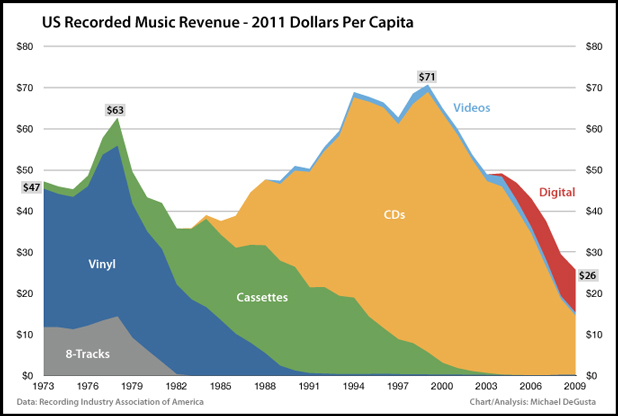
Anyway, not being a moonbat I looked at that story about the evolution of pop music and wondered what that has meant for sales. A little looking and I found this graph:

Interestingly, music sales started to fall off once hip-hop broke through to the mainstream. It continued to slide until CD’s got everyone to re-buy their music collections. The higher quality medium probably drove sales too. I know the first time I heard a CD (U2) I was stunned by the quality and immediately went out and bought a bunch of them.

Music companies were smart enough to know this was a great way to re-sell their catalogs, which they did. All of the big bands from the 60’s and 70’s not only released their old stuff, they released stuff that had not made the cut the first time. After a decade it started to fall apart as people learned how to rip mp3’s and pass them around to friends and strangers on-line.

Once you net out the boost from digitizing and repackaging music from the 60’s and 70’s, hip-hop has been a disaster for the pop music business. Demographics has something to do with it, but you cannot get around the fact that sales are at all-time lows, despite the country having more than a third more people. There’s a lesson in those numbers that extends beyond the music business.

Something similar happened with the NBA after the Jordan years. Thinking the key to prosperity was to embrace the hip-hop culture, the league encouraged the players to go full gangster rap. The result was a cratering of their TV audience, two labor stoppages and a decline in revenue from which they have yet to recover. Maybe it was just a coincidence, maybe not, but the sport still has an image problem.


Rapacious Vermin

Way back in the olden thymes, I was sitting on a couch at a friend’s house, watching the news while having beers with friends. Bill Clinton had just slithered out from under a rock and was defending himself against pot smoking charges. That’s when he uttered his famous line about never inhaling. My response at the time was that Bill Clinton is a man who really enjoys lying.

In the South, this sort of politician is a part of every states lore. The archetype, of course, is Huey Long, but Southern politics are littered with minor versions of the Kingfish. It’s not just that these guys are crooked or unethical. Their crimes are usually trivial and venal, in the grand scheme of things. It’s that they enjoy the action. They love being on the edge, never quite sure if they will hang on or fall into the pit.

That’s the thing to remember with the Clintons. They really enjoy lying and all the intrigue that goes with it. That’s what gets them off. It’s at the heart of their relationship. They are like two con-men competing with one another as to who can run the most outlandish con. All the analysis of their relationship, it seems to me, has missed the mark because these are not normal people. They are sociopaths.

That’s what makes the coming response to the Clinton Cash book one of the most anticipated events of the summer. I heard the author on the radio detailing his findings and it is a very well thought out case. The author clearly went into it with an understanding of how the Clintons were likely to respond. Like a good bunko cop, he seems to have thought things through a few steps, anticipating how these two tend to play the game.

The thing with the Clintons, in addition to their love of lying, is their Chechen morality. Faulkner described the Snopes clan in his novels as having a vermin-like rapacity. That’s the Clinton way of life. Nothing is ever on the level and they are devoid of anything resembling a moral framework. They are moral nullities. That means they will do anything they need to do to win.

It’s what always baffles their critics. Presented with an ironclad case against them, the Clintons will respond with some lie that is so outlandish, no one can believe anyone would says such a thing. Bill Clinton was out the other day claiming the author of the book was jammed up in some sort of ethics issue over the book. Bill Clinton would call him a child molester if he thought it would work.

The problem as you see in this piece is their adversary this time did his homework on them. There can only be a few ways to defend yourself against corruption charges. One is to dispute the facts. Another is to smear the people. The other is to offer up an alternative explanation that fits the presented facts. This is often the best strategy because it quickly turns into a he said/she said controversy, where the accused looks like the innocent party.

Peter Schweizer let the the big foot liberal media operations vet his data before publication. That inoculated him against claims of shoddy research. He’s also a well respected writer so calling him a nut is unlikely to work. By letting the liberal media have special access to his research, he cut off the usual avenues for team Clinton, which is to make a bunch of bogus claims about the accuracy of the charges.

I don’t think any of it matters. The American media is too morally compromised when it comes to the Clintons to turn on them now. The political class is long past policing themselves. The people bankrolling Hillary don’t care that she is a sociopath. In fact, they prefer it. If your plan is to auction off what remains of the country it’s better to have someone in the White House who is a moral nullity.

At the end, Athens was not undone by a cunning Alcibiades, leading them into a foolish war with Syracuse. Julius Caesar did not defeat a robust and confident Senate on his way to becoming Emperor.  Eventually, a ruling elite loses its capacity to police itself and defend itself. That’s what has happened in America. The people in charge lack the will and moral authority to enforce the rules, which is why Bonnie and Clyde of the Ozarks have been able to flourish in Washington for close to three decades.


China Learns From Obama

I’ve made the point a many times here that Obama’s health care bill was mostly an assault on the remaining Christian holdouts in American society. It may have started as an “honest” attempt to move the country closer to state run health care, but it became an excuse to take aim at Christians. As is always the case with the Left, economics is subordinate to culture.

If you look at the controversial bits of that bill, they all revolve around making Christians do things that are against their faith. Making Churches offer health coverage to homosexuals couples or making Catholics buy rubbers for their employees has nothing to do with health and everything to do with the culture war. If you force people to act in contradiction of their faith, they will eventually lose their faith.

At least that has been the thinking for 2000 years. Now we see the ChiComs doing the same thing with their Muslims.

Chinese authorities have ordered Muslim shopkeepers and restaurant owners in a village in its troubled Xinjiang region to sell alcohol and cigarettes, and promote them in “eye-catching displays,” in an attempt to undermine Islam’s hold on local residents, Radio Free Asia (RFA) reported. Establishments that failed to comply were threatened with closure and their owners with prosecution.

Facing widespread discontent over its repressive rule in the mainly Muslim province of Xinjiang, and mounting violence in the past two years, China has launched a series of “strike hard” campaigns to weaken the hold of Islam in the western region. Government employees and children have been barred from attending mosques or observing the Muslim fasting month of Ramadan. In many places, women have been barred from wearing face-covering veils, and men discouraged from growing long beards.

American progressives can only dream of such heavy handed tactics, but they are not deterred. The next round of “health care reform” will probably mandate homosexual marriage for Catholics. That sounds ridiculous, but consider that two guys getting married was a punchline just twenty years ago. There are men alive today who recall when being on welfare was shameful.

In the weird theocracy of empire America, yesterday’s absurdities are today’s conventional wisdom. Today’s commonly held truth is tomorrow’s heresy. In 1982, everyone knew that you could not become president if you led a private life of perversion. In 1992 everyone knew that you would not run for president, much less win, if you were a black guy raised overseas and were named after the dictator of Iraq.

Having government minders in churches making sure no one says anything unapproved may sound crazy today, but how far fetched is it really? The mayor of Houston demanded the right to pre-approve all church sermons not so long ago. The Supreme Court just heard a case where one side was demanding that large chunks of Christianity be ruled a thought crime.

This will not end well.

Ross Douthat and Changing the Subject

I saw this in my twitter feed today:

Here’s the article in question. I’m told Ross Douthat, in addition to having an odd name, is a reasonable fellow that reasonable people should read, if they wish be thought of as reasonable. The Conventional Right loves quoting him. Pseudo-intellectual poseurs like Ezra Klein often cheer him. Douthat’s presence at the NYTimes tells me he likes money more than being right, but there’s no crime in that. Pay me enough and I start writing paeans to Obama.

Still, experience says you have to treat the non-liberals in the pages of the times a little different than other people you read. They often employ an esoteric language that allows them to go unnoticed by the Cult, but point out inconvenient bits of reality. It’s a weird compromise and I really don’t know how these people do it. They say prisoners in the worst gulags get used to it in time so maybe that’s it.

The last time I followed certain of my colleagues into an argument about poverty, economics and culture, it took severalthousandwords to find my way back out. Thistime I’m going to try a briefer intervention, stressing again that I think conversationsabout policing are a more productive response to what’s happened in Baltimore than leaping up a level to the persistent right-left argument about the welfare state. But since that debate is happening no matter what, it might be helpful to describe a framework in which I think these arguments should take place, because quite often the two sides can’t even decide on where the argument should start. So here, for your consideration, are two premises about the last fifty years of American history.

One of the byproducts of having a religious cult take over your country is everything gets jammed into a binary model. The hive minded can only view the world in relation to the walls of the hive. You’re either inside or outside. Even those not in the dominant cult adapt to this framework.

1.) The modern welfare state has succeeded in substantially cutting our country’s poverty rate. This is a point that both right and left sometimes obscure, the right because it complicates a simple “we fought poverty, and poverty won” narrative about the Great Society, the left because it complicates claims that Reagan or Gingrich gutted welfare spending and crushed the fortunes of the poor. But the basic evidence seems very convincing: Whether it’s Scott Winship analyzing the numbers from the center-right or Harvard’s Christopher Jencks doing the same from the center-left, you can see dramatic reductions in the poverty rate since the 1960s, with various public programs, means-tested and otherwise, pretty clearly playing a substantial role.

This is a favorite tactic of Progressive types. “If both sides agree then it must be the truth!” This is a logical fallacy as there’s nothing in the premise to even suggest that both sides can only agree when they are right. Both sides are habitually wrong about all sorts of things so it’s just as likely that they are wrong now. Of course, the point of this bit of rhetorical jujitsu is to cut-off debate. Just accept it and shut up.

If you dig into the source material, they are very weak cases. Yes, our poor people are less poor and we have, during that period of declining poverty, spent trillions on poverty programs, but the causality is debatable. All anyone can say for certain is we spent a lot of money and all Americans are richer than forty years ago. In fact, the whole earth is richer.

2.) The modern welfare state has not succeeded in producing clear improvements in opportunity, mobility and human flourishing. Recall that the hope for the Great Society’s social programs, from the vantage point of 1964, was not merely to raise the incomes of poorer Americans. Their architects also aspired (to quote the chief of them) to make America “a place where every child can find knowledge to enrich his mind and to enlarge his talents … where leisure is a welcome chance to build and reflect, not a feared cause of boredom and restlessness … where the city of man serves not only the needs of the body and the demands of commerce but the desire for beauty and the hunger for community.” And if you try to translate these soaring hopes to quantifiable indicators, the impact of public spending has not been at all what was hoped. The poor have more money, but their chances at upward mobility are persistently weak and basically unchanged relative to several generations ago. Schools have more money, but academic performance looks stagnant and big racial gaps endure. Cities have more money, but crime rates are only now returning to the levels of the early 1960s, and today’s peace has been purchased by incarceration on a scale that would have seemed horrific (because it is) a half-century ago.

This was always the argument against anti-poverty programs. It is feature of progressive thinking to forget all of the arguments from the past. The primary argument against the Great Society was that handing people checks did not address their poverty. In fact, paying people to be poor would only keep them poor. Here we are fifty years on and Goldwater was right.

These two realities, taken together, do not necessarily point toward either a left-wing or a right-wing diagnosis of our situation. You can acknowledge both realities and believe that the key issues are all economic, that the welfare state just needed to be even stronger still (and various other economic policies more worker-friendly) to make up for the devastating impact of global capitalism on wages and job security and the devastating social impact of rising inequality. Or you can acknowledge both and believe that the programs themselves are often part of the problem, that they raise incomes but also increase dependency, encourage idleness, crowd out the basic institutions of civil society, and so on through the libertarian critique. Or you can acknowledge both and argue (as I have, occasionally) that the cultural revolutions of the 1960s go a long way toward explaining how the poor in our era can have more money but less access to other basic human goods. (And therefore, because those goods are connected to economic advancement, less money than they might have had absent those revolutions.)  Or you can talk, reasonably and non-ideologically, about the multiplicity of causes behind all broad-based social trends.

But I think just getting to the point where we could all agree that 1) public spending can make people less poor and 2) public spending hasn’t delivered on the Great Society’s social promises would be a big win for reasonable debate. Because that combination of realities, and the various questions that it raises, is why this argument exists, why it’s genuinely interesting, and why it isn’t going away anytime soon.

This last bit is a dopey version of what you see from conventional conservatives after a race riot like we had last week. It is a systematic and studied avoidance of unpleasant realities. Conservatives are so afraid of being called racists, they turn themselves into knots trying to prove they never for a minute noticed that all the rioters were black.

This tendency in the hands of progressives is aimed at shifting the focus away from the fact that they have been in charge for more than half a century and none of the prophesies have come true. West Baltimore is worse now than it was at the start of the Great Society. Acknowledging that means questioning the one true faith and that can never happen so let’s talk about something else.

Energy Money

In another age, gold bugs used to bore the hell out of people with their theories about bringing back hard money after the coming collapse. The theory behind hard money is great until you look at the history of currency. All of the things that hard money is supposed to address have been evaded by rulers since Alyattes. It is fair to say, for example, that debasing the currency was the Romans favorite past time.

It’s why Bitcoin is just a libertarian fantasy. King Offa of Mercia figured out the value of monopolizing the currency around the same time Charlemagne figured it out in France. That was in the 8th century. Ever since, governments have made sure they monopolized the currency of their country. In the case of the US, monopolizing the currency of the world.

That does not mean the gold bugs were all wrong or that the Bitcoin people are all wrong. The key to prosperity is a stable currency so taking that out of the hands of feckless rulers would be a great leap forward. Similarly, an uncrackable digital currency could further limit the ability of government to play games with the currency. The question is on what should a currency be based?

In the beginning, gold and silver were convenient. They had transcendent value. But, gold is not particularly useful and the amount of it we have managed to dig out of the ground says nothing about the wealth of man. James Rickards has proposed a currency based on energy. A basket of energy stocks, like oil and gas, would provide the underlying value of the currency. That’s a fun book to read, by the way.

There’s this eBook that presents a couple of interesting graphs that gives a bit of an idea what an energy based currency would look like in the West. Rickards assumes the result will  be a steady, slow deflation, which was the pattern in the free banking era. There’s also the fact that modern economies are energy based so tying the currency to the source of wealth seems logical.

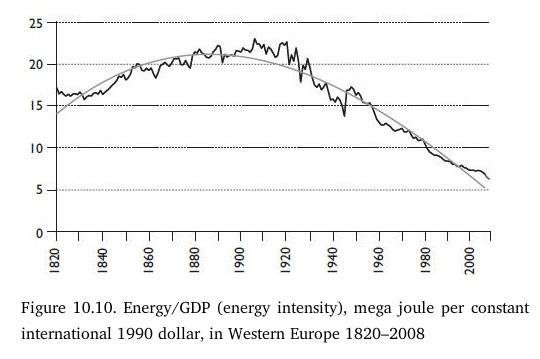
Here’s an interesting graph on energy and GDP in the West:

Here’s one on energy per unit of GDP:

I don’t know the method of calculating GDP in these graphs, but I would assume it is: GDP = C + I + G + (X-M) as that is the preferred method of modern economists. I’m not sure it matters all that much as we know that energy is a declining part of our cost of living. Regardless, a currency based on energy would, all things being equal, have brought a mild steady deflation over the last century.

Now, all things would not be equal. We have seen crude oil prices fluctuate wildly over the last forty years. The impact on the economy would be magnified if everything was priced in oil, instead of only partially priced in oil. That’s the problem with the gold standard. But, energy is a different thing and there’s an argument that says a currency backed by energy would have a stabilizing effect on oil prices.

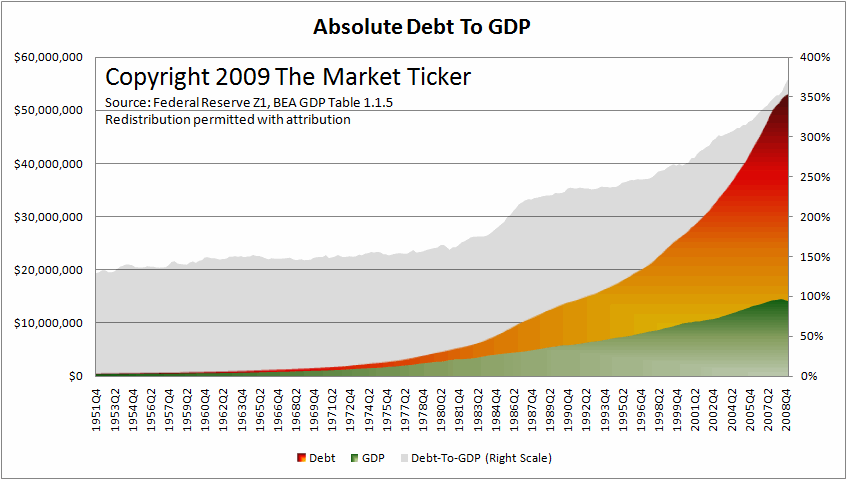
Now, Wall Street could not exist as currently constructed. The world financial system uses credit as its reserve currency:

I’m old enough to remember when you had to have money to buy a car or a house. More important, if company A wanted to acquire company B, company A had to have the cash, or at least most of it, to do the deal. Today, a room full of MBA’s conjure it from thin air so that the clever can pretend to be big so they can eat the small.

That alone tells me we will not see currency reform without a near death experience. Even so, a total meltdown of the world financial system would not be enough to usher in currency stability. It’s just so much easier to steal when you can play games with the money.

We will see after the next crisis a move toward digital currency. That provides too many opportunities to control the population. Those bakers who refuse to pretend two guys playing house is marriage will see their ability to do any transactions frozen, thus making them non-persons. Black markets will be in barter as digital currency exchanges will prohibited to those involved in unofficial trade.

It’s hard to know, of course, as these things are debated in secret by the people in charge of the world economy. The current system of floating exchange rates was bubbling up through academia and international finance for decades before codified in the Louvre Accords. But, it is interesting as the history of the west is essentially the history of money.

The Messiah and David Brooks

I wrote the other day of the religious aspects of Cultural Marxism. In fact, I find it more difficult to the use the term “Cultural Marxism” the more I think about the outlook of our cultural elites. Cultural Marxism assumes a consciousness of purpose, an end in mind, when I don’t see evidence of that in these people. What I see is a grasping in the dark for what, no one can seem to describe.

This David Brooks column is what I mean.

Lately it seems as though every few months there’s another urban riot and the nation turns its attention to urban poverty. And in the midst of every storm, there are people crying out that we should finally get serious about this issue. This time it was Jon Stewart who spoke for many when he said: “And you just wonder sometimes if we’re spending a trillion dollars to rebuild Afghanistan’s schools, like, we can’t build a little taste down Baltimore way. Like is that what’s really going on?”

The audience applauded loudly, and it’s a nice sentiment, but it’s not really relevant.

The problem is not lack of attention, and it’s not mainly lack of money. Since 1980 federal antipoverty spending has exploded. As Robert Samuelson of The Washington Post has pointed out, in 2013 the federal government spent nearly $14,000 per poor person. If you simply took that money and handed it to the poor, a family of four would have a household income roughly twice the poverty rate.

Yet over the last 30 years the poverty rate has scarcely changed.

To be perfectly honest, I think Brooks is a gold plated phony. By that I mean he has carefully cultivated a persona that satisfies the sort of people who run the NYTimes, PBS and tax-dollar funded think tanks. He makes a living flattering people who have the money to keep him in the lifestyle to which he has become accustomed.

That said, he can write and that lets him break the bad news to his patrons in a way that allows them to accept it. In this case, it has to do with the multi-generational war on biological reality, otherwise known as the War on Poverty. This project has largely been a Baby Boomer project to rebuild America into an egalitarian utopia.

As Brooks notes, it has been mostly a failure. I think he overstates the success, but there’s an argument that it has done some good. All of those government employees would be living in squalor if not for the trillions in social welfare transfers. The same can be said of the vast war machine we have financed for seventy years. I know families that are now third generation defense contractor.

The sadness in the tone of his piece is what is worth noting. As the Boomers begin falling into the abyss, they have to look around and wonder if it was worth it. If you were born in 1950, for example, you grew up in America that is vastly different than today. It’s one your grandchildren will never enjoy. The trillions spent knocking down what you inherited could maybe have been spent more wisely.

I don’t think Brooks and his coevals in the managerial class are just looking at the material side of the ledger. They are looking at the spiritual side. They have spent their whole lives waiting for the prophesies to come true and we are no closer to the egalitarian paradise than fifty years ago when much of this madness began.

In a fantastic interview that David Simon of “The Wire” gave to Bill Keller for The Marshall Project, he describes that, even in poorest Baltimore, there once were informal rules of behavior governing how cops interacted with citizens — when they’d drag them in and when they wouldn’t, what curse words you could say to a cop and what you couldn’t. But then the code dissolved. The informal guardrails of life were gone, and all was arbitrary harshness.

That’s happened across many social spheres — in schools, families and among neighbors. Individuals are left without the norms that middle-class people take for granted. It is phenomenally hard for young people in such circumstances to guide themselves.

Yes, jobs are necessary, but if you live in a neighborhood, as Gray did, where half the high school students don’t bother to show up for school on a given day, then the problems go deeper.

The world is waiting for a thinker who can describe poverty through the lens of social psychology. Until the invisible bonds of relationships are repaired, life for too many will be nasty, brutish, solitary and short.

Put another way, the organic ways in which society managed the unproductive classes were blasted to bits by a bunch of people convinced they knew better than the dozens of generations that came before them. The proposed replacement for those ways have utterly failed, meaning everything guys like Brooks grew up believing was nonsense after all. Meathead is learning that Archie was mostly right.

I have to chuckle at the last paragraph. Brooks and his coevals are in the pumpkin patch waiting for the “thinker who can describe poverty through the lens of social psychology” because it will take a super genius to unriddle this problem! After all, if the credentialed members of the managerial elite are stumped, well, no mortal can solve this problem.

Steve Sailer is working from the premise that we are going through a replay of the late sixties and early seventies. The coalition of fringes is once again blowing apart and taking a bunch of us with it. There’s some truth to that, but history only sort of repeats itself.

Forty years ago as the optimism of the sixties devolved into the cynicism of the seventies, the faithful still had communism, socialism and Cultural Marxism to keep them going. The spiritual side was still there, even if the material side was a bust. Today, there is a spiritual exhaustion to go along with the material disasters.

No one knows what to do next. So they wait for the messiah.
Religion of the West

When listening to that Richard Spencer interview on Red Ice, the thing I found most interesting is the bafflement by people in the Dissident Right as to why the people in charge of the West seem to have a death wish. John Derbyshire calls is ethnomasoichism, a form of self-hatred that extends to everyone like them.

Listening to Spencer fumble through an explanation, he said one thing that caught my attention. He kept coming back to the idea of a spiritual awakening or renewal that he thinks will precede a restoration of national identity. He was not all that clear on the point so I may be misunderstanding him.

Regardless, it brought to mind something about the Roman Empire from the second century forward. That is, the proliferation of odd cults, mystics and what we would think of as Eastern mysticism. Hadrian was into the Eleusinian Mysteries. One of the later emperors fell in the grips of a mystic whose name escapes me at the moment. Of course, Christianity got going in this time, starting from a Jewish heresy into a full blown religious movement.

None of this would be possible if the old gods and the old ways were still satisfying the people. After all, there’s no need for a new religion if the old religion is scratching that itch that is there in every human society. One of the things that’s true about the Roman empire is it was a miracle it did not collapse at any point after the reign of Commodus. The reason the people, including the ruling elite, were looking for new religions is they had largely lost faith in the old one.

We tend to look at the West as a collection of countries and people located in Europe, jostling with one another for supremacy. Another way is to look at the West as the Christian flowering, the Christian era. Starting from the second century, Christianity evolved and spread until it was largely formalized in the fourth century. The fall of the Western Roman empire in the fifth century let Christianity spread throughout Europe with the conversion of barbarians over the next two centuries.

What’s happening today is Christianity is dying out in the West. No one in the European ruling class is animated by his Christian faith. In fact, they mostly mock those remaining Christians in their own lands. In the US, No one in the ruling party is Christian. Some fake it for old time sake, but otherwise there are no Christians in the Democratic Party. The GOP still has some Christians, but most of that is for show, as their party is the natural home of the remaining Christians in America.

It’s a conceit of the modern ruling elites that they have shrugged off the sky gods and the oogily-boogily, but it is just a conceit. Belief is one of the oldest of human traits, co-evolving with speech. Belief, like all traits, varies from person to person and between groups. To think that this trait suddenly fell out of the human animal a generation ago is simply ridiculous.

That does not mean there always has to be an invisible man in the sky. An anthropomorphic god or gods probably came along long after the first conceptions of the super natural. There are plenty of modern examples of belief without the man-like god or gods. Buddhists, for example, have no invisible men in the sky. Natives of the Americas did not have man-like gods.

The point here is that the collapse of Christianity as a legitimizing and organizing faith has left the people in charge searching for a replacement. Socialism and Communism filled the void until they were laughed off the stage by reality. Even the Soviet rulers threw in the towel on the spiritual side of Bolshevism after Stalin.

The grasping around at these crazy fads like climate change and anti-racism is just a search for some legitimizing answer to the eternal why. Even silly materialist fads like Apple and Uber are driven by the need to the fill the spiritual void. It’s not an accident that every dedicated Apple user has  memorized the standard response to why they over spend for a bit of electronics.

This is a blog post, not a dissertation so I’m going to keep and short and stick with the broad outlines, but I think what’s driving this weird worship of the alien, specifically brown people migrating north, is spiritual envy. They envy the natural identity and belonging these people have as members of the oppressed. Generously inviting the noble savages into your neighborhood scratches that age old spiritual itch.

The cults and mystic faiths that floated around the late Roman Empire borrowed heavily from the old ways. Even Christianity cherry picked items from the old pagan religions. Climate change obviously borrows heavily from the Jewish Bible. Cultural Marxism looks a like liberation theology, without the Christianity. It’s Gnosticism updated to the modern era.

The absurdity of these weird cults and theodicies suggest we are in that transition period between the end of the old ways and the birth of some new way. Something is going to take the place of Christianity, just as Christianity took the place of the Greco-Roman gods. I have no idea what, but I will not be around to see it.

This is obviously a huge subject and I’m still noodling my way through my own thoughts on it.

Stupidity as Fashion Statement

I was watching an old Dirty Harry movie last night. I think it was Magnum Force. In it, Callahan is assigned to Human Resources to interview rookie cops. On the panel with him is a very lesbian looking old bag who lectures Harry about  the progressive new way the police will hire cops. Harry responds dismissively with a line about how that’s very fashionable.

Fifty years on and we keep repeating that scene over and over in different settings.

Local nitwit surprised that math does not yield to wishful thinking

Brian Hibbs, the owner and operator of Comix Experience, is having a difficult time confronting the reality presented by San Francisco’s new minimum wage law.

The law passed in November by a huge majority requires that wages increase, as of May 1st, to $12.25 and will end up at $15 by 2018.

Anticipating only a slight increase in his costs, Hibbs was originally supportive of the law. But, then he did the math:

I was appalled! My jaw dropped. Eighty-thousand a year! I didn’t know that. I thought we were talking a small amount of money, something I could absorb.

We’re for a living wage, for a minimum wage, in principle. . . . But I think any law that doesn’t look at whether people can pay may not be the best way to go.

The problem he faces is that comic books and graphic novels, the cornerstone of the business, have their retail prices printed on the covers, so he can’t raise those prices to offset the increase in costs. Also, his store’s usually staffed by only one counter worker, which makes reducing the store’s labor costs impossible.

The solution he’s come up with is to start a special club with an annual fee of $240, whose members will get special perks.

His comments and his business’ story drew the attention of a local news station, which reported on Comix Experience and another local book store, Borderlands Books, which has resorted to crowdfunding in order to generate extra revenue.

With that publicity, customers have directly commented to Comix Experience on the wage change:

‘I’m hearing from a lot of customers, ‘I voted for that, and I didn’t realize it would affect you.’

Hibbs is a self-identified progressive, but he’s looking for answers. Then he asked a profound question:

Why can’t two consenting people make arrangements for less than x dollars per hour?

He admits to believing in capitalism, and according National Review, he’d “like to have the market solve this problem.”

This last bit is something that is a pet peeve. Capitalism is not the same as markets. I’m for free markets to a point, but I’m not in favor of predatory capitalism fueled by currency manipulation. Letting Amazon use negative interest rate debt to clobber retail is not market competition.

Further, saying you “believe” in something means you think there is some chance it does not exist. In other words, you are pretty sure X is true, but you have no evidence that X is true. For that reason, no one says, “I believe in gravity.” Capitalism is a thing that exists, whether or not some hippie dipshit believes in it.

Of course, what he really means is he likes making money, but he resents the fact others make more money. That’s the core of Progressive populism. It is resentment that one particular set of career choices don’t pay very well. Comic Book Guy think he should make as much as a banker and hates the fact he makes the same as a janitor at the bank.

None of these people are very bright. They get caught up in these progressive fads because it beats thinking and it sure as hell beats standing alone. I doubt he so dumb as to think raising his labor rates would not impact his business. It was was just easier to go along with his idiot neighbors. He cares more about being one of them than being in business.