Thoughts On Elites

A famous line from the movie The Usual Suspects is “The greatest trick the Devil ever pulled was convincing the world he didn’t exist.” Even after all these years, it turns up in comment sections and social media. It is a good line to bear in mind when thinking about who is actually ruling over us. In America, our elites have spent a long time convincing us that there are no elites. The fact is though, every society has an elite and it is usually a stable, semi-permanent one. The people in charge tend to stay in charge.

Here is an interesting bit of data that underscores the stability of a nation’s elites. In the 16th century, the Spanish conquered the area that is now Guatemala. The Spanish were not settlers like the English, so a local Spanish elite came into rule over the conquered people, who were often used as slaves in mining and agriculture. Since 1531, 22 families have controlled Guatemala’s economy, politics and culture. Another twenty-six families have served as a secondary elite, often marrying into the core elite.

The result is one percent of the population, descendants of the Conquistadors, has controlled the country for over four hundred years. This dominance has been locked in by a set of marriage rules, which created a self-perpetuating marriage strategy. For example, both the bride and groom had to bring a certain amount of wealth into the marriage. The result was both families would negotiate marriages much in the same way it was done in medieval Europe. These rules have their roots in the Siete Partidas, that dates to the 13th century.

Of course, elite families marrying one another is not a new idea, but it is more than just wealthy families using marriage to solidify alliances. There is a biological factor to it. The people in the elite got there originally by having elite cognitive skills. Modern elites like to throw around the term meritocracy, but they know biology counts for a lot. It is why you do not often see a member of the elite marrying one of the servants. Arnold learned that lesson. The one on the left is from the house cleaner, while those on the right are with a Kennedy.

 

Another thing about elites is they tend to get what they want. One of the benefits of being in charge is you get to shape the institutions you control. A great example is the Fabian Society. This was not some program hatched by mill workers in their free time. It was a hobby for British elites in the late 19th and early 20th century. The Fabians managed to get most of what they wanted pushed through over time. The reason for that is they convinced their fellow elites it was a good program.

An interesting bit from the Fabian program, which they called the “True Radical Programme” was intended to be far more radical than the other reform efforts. They wanted it to be seen as way-out on the fringe. Yet, things like women’s suffrage, paying MPs a salary and public education eventually became normal. It is something to keep in mind when thinking about the war on men or the waves of anti-white agitation we see in the media. Today’s crazy elite culture is tomorrow’s new normal.

Of course, the real reason elites tend to get what they want is they are better than the rest of us. They are smarter, better socialized and they have greater access to the stock of knowledge relevant to being in charge. Americans despise the idea of a ruling elite, so the people in charge spend a lot of time pretending they do not exist. It is why our form of democracy works so well. The people keep voting for different candidates, but the people in charge never change. That is what we are seeing with Donald Trump right now.

That is probably why the global elite is so worried about the rising tide of nationalism through the West. The constant moaning about “threats to our democracy” really do not mean the people in charge care about actual democracy. The game of bad cop/worse cop we see in our politics is not a bug. It is a feature. The process of voting has been rigged by the ruling class such that the results are fixed. No matter which candidate you choose, you get the same results, because the same people own all of the candidates.

What nationalism does is tie the candidate to a group of people. The politicians of Germany care only for the interests of Germans, not migrants and refugees. Once “them” is no longer as important as “us”, the definitions get more granular. Each pol them looks at his district or province as “us” and the rest of the country as “them.” This makes it exceedingly hard for a national elite, much less a global elite, to corrupt the political system with cash, favors and access to elite society. That is bad for global elites.

This is another reminder that civic nationalism is a sucker’s play. The rules we have in place today are designed to lock in the status quo. No challenge to the status quo, therefore, can be based on assiduously adhering to the rules. In fact, the goal is to turn adherence to the rules into a destabilizing force. When the people in charge no longer trust the rules to protect their position, they change the rules. It’s why Progressives are campaigning to end freedom of speech. The truth is their enemy.

The Moral War

One of the stranger bits of the current year is how people all over the ideological map are claiming to be “woke”, “aware” and “red-pilled” despite believing things that directly contradict things other “woke”, “aware” and “red-pilled” people believe. The millennial Jewish girl is woke about the patriarchy, while her last boyfriend is red-pilled on the JQ, mostly from having dated her. Knowing “what’s really going on” used to be exclusive to conspiracy theorists, but now it is common in outsider politics.

The truth is, the truly woke understand that the current crisis is not a dispute between tribes or a dispute about facts. It is a moral war where one side controls the moral paradigm and imposes their will on the rest of us The current fight is about control of public morality, not public institutions. Facts and reason only play a supporting role in this fight. Being right on the facts helps win respect, thus giving one moral capital, but the point of the game to define public morality.

A useful way of seeing is this post on National Review about health insurance policy, which is about a “conservative” way of providing universal health insurance. It has all the usual stuff we have come to expect from the pseudo-experts. What is not so obvious is the implied embrace of moral orthodoxy on health care. That is, our collective moral duty is to make sure everyone, even non-Americans, has health insurance and presumably, free access to health services.

A few decades ago, no one thought it was our collective moral duty to make sure everyone had health insurance and equal access to health care. We understood that poor people had to rely on charity. In the 1970’s, the free clinic, where young doctors volunteered as part of the training, was a staple of poor neighborhoods, especially urban ghettos. No one thought they were a failure as a citizen because the blacks in the ghetto did not have access to world class health services.

Today, the political class starts with the assumption that only a thoroughly immoral person does not dream of a world where everyone gets health insurance and access to the finest medical care. Since this is impossible, the default assumption is that the state must take control of the health care system. That means the “far right” is debating “their friends on the Left” about what color drapes to use in the health care commissar’s offices, because the Left won the moral argument.

It is why the emerging resistance to the prevailing moral order has to focus on the moral side of the fight, rather than appealing to facts and reason. There are things that can be factually true, and morally abhorrent. Ethic cleaning, for example, is an effective way for one population to solve a problem of another population. Europeans are the result of just such a process. While the efficacy of genocide, from the perspective of nature, is undeniable, we consider it to be morally repugnant.

With rare exceptions, like cannibalism in times of starvation, the moral always triumphs over the factual. What we see as moral, and immoral, is determined not just by what our rulers tell us, but also by what our peers say. We naturally trust the people close to us first and then to the people who seem to share our interests and then the people who look and sound like us. We will embrace the morality of our kin over the morality of strangers, even when those strangers rule over us.

Over the last several generations, the people who now rule over us have used every weapon in their arsenal to break our natural trust The war on families, communities, schools, the sexes, are all part of an instinctive strategy to break the natural bonds of loyalty that form public morality. It is why having the facts on our side has never meant a damn in political debates. A deracinated public, untethered from its traditions and alienated from its neighbors, inevitably accepts the morality of the ruling elites.

This is the ultimate red pill. The sermons blasting from the megaphones of the mass media may be offensive and insane, but they provide a moral framework. The lack of a credible alternative means most people just fall in line. This has the added benefit of providing social proof. It is hard to be against what is being preached to you when no one else is speaking out against it. People naturally want to be led, but they also naturally want to be seen by their peers as moral people.

This is why the challenge to the prevailing orthodoxy has to be a challenge on moral terms, not facts and reason. Appealing to people’s sense of propriety will also be more effective than appealing to their reason. This only works if the people making the appeal have standing and can provide the sort of social proof people crave. It’s why Jared Taylor has worked so hard to build an organization that offers an alternative moral framework, but also an alternative community.

It is a fact of history that no revolution succeeded when the ruling elite was unified and had moral authority. Social change, whether it is a great wave of reform or an outright revolution, blossoms in times when the elites are in conflict. The cracks arise when the people begin to doubt the moral authority of their rulers. The challenge is to create that alternative moral framework and communities that embrace it. Only then will elements of the ruling class seek to be tribunes of the people.

The Narcotic of Minor Celebrity

Last year I started showing up at dissident events and I started to interact with some of the important figures on-line. The main reason was to get to know some of these people a little better. You get a better sense of people when you see them in person and interact with them. Frankly, I figured if I was getting quoted and linked to by people in this thing, I should meet them and get to know them. It turned out that many of these people wanted to meet me.

Now, I am no rock star, so it is not as if people are chasing me down the street looking for a selfie or autograph. Even so, it is flattering to have someone walk up to you and thank you for your efforts. I was approached at a bagel shop recently by someone who recognized my voice and decided to see if I was the man behind the voice. I am not particularly good at handling these encounters. I usually resort to false modesty, as I do not have a lot of experience with it. I also have no great desire to be famous.

Now, there are famous people who are incredibly good at being famous. They enjoy it and they know how to handle it. I once saw a famous guy do selfies for fans, while carrying on a conversation with a friend. My guess is that the truly famous, the people most everyone recognizes, look at celebrity in the same way that most of us look at filling out a time sheet or an expense report. It is just a part of the job. Those fans asking for selfies are just part of the package.

On the other hand, minor celebrities are obsessed with getting noticed. A guy like Milo is a good example. His glib homosexual routine was a good compliment to his writing at Breitbart, but then he got a little famous. The desire to see himself on TV and internet had him doing increasingly nutty things to get attention. Whether you are a fan of Milo or not, he has real talent, but it has come to a sad end for him. His desire for fame exceeded his ability to maintain it.

Milo’s story arc is a familiar one, but the proliferation of social media has brought a new version of this, the e-celeb. Mike Cernovich is probably the best example. He has no real talent for anything, as far as anyone knows, but he is good at getting attention on social media. One of the things you cannot help but notice is how much he obsesses over his follower count and impressions on Twitter. Followers and friends are the coin of the realm, so all of the internet celebrities focus on growing those numbers.

This lust for recognition is certainly at the root of the endless in-fighting we see among the alt-right personalities. An alt-right person gets some traffic to their YouTube channel and before long they are picking fights with everyone, they used to call allies. Because the drama results in more traffic, it becomes a feedback loop. The uptick in traffic releases endorphins in the brain of the e-celeb. It is like crystal meth for these guys as each hit increases their craving for the next hit.

Another side of this is the leaders are picked from the pool of people desperate for attention. Some glib or photogenic person pops up on social media and they attract a crowd. Before long, the other e-celebs are inviting him onto their platforms to get some secondhand traffic. The result is the influential people are being selected for their vanity and lust for celebrity, rather than intelligence or mental stability. That is why more than a few weirdos have turned up as alt-right celebrities.

It is possible that this benefits dissident politics eventually. The dominant media has a filtering mechanism to make sure no one with unclean thoughts ever gets access to their platforms. The result is a dreary sameness. The breathtaking lack of self-awareness scares off more people than it convinces. The people who survive the e-celeb gauntlet and establish themselves as trusted voices could turn out to be much shrewder and savvier as a result of it.

A guy like Nick Fuentes is a good example. He has a creepy maturity to him that has gained him a lot of attention. He is like Bill Mitchell in a child’s body. He is an alt-right version of the movie Big. While he does a fine job on his YouTube shows, he often goes onto social media and posts stupid and childish things. People who talk about their IQ on social media tend to be mentally unstable. On the other hand, Fuentes is a kid so maybe he figures it out and gets better.

That said, it could be that new media and social media have evolved in a way that allows the people in charge to keep challengers out on the fringe. Instead of smart subversives quietly doing what it takes to weasel into the orthodoxy, they are having purse fights with e-celebs and disqualifying themselves in the process. Since your internet activity is now part of your permanent record, all those youthful mistakes will later be used against you as an adult.

In other words, YouTube is a favela for political and cultural dissidents. The people dominating the space will be narcissistic attention whores, willing to do and say anything to get views. The result is they drive out anyone with ability, so outsider politics remains a land of unwanted toys. The narcotic of minor celebrity is not a byproduct of the communications revolution, but a product of design. Either way, the narcotic of minor celebrity is the new opiate of the masses.

The Death of Sportsball

Down at the Hater’s Ball, we were joking around at the banquet about the things you stop enjoying when you become race aware. Pop culture is an obvious one, given the absurd levels of anti-white vitriol we see on TV and in movies. I mentioned that sports stop being fun, as you spend all your time noticing the propaganda and lose track of the games. I am not the first guy to notice this. At Mencken last year, I was hanging out with a couple of people who despised sportsball because of the endless racial agitation in it.

Back in Lagos, I am enjoying my free evenings by watching some television and catching up on some movies. I happened to catch about five minutes of a basketball game. It was Cleveland versus Toronto. The announcers were carrying on like LeBron James had just cured cancer, whenever he put the ball in the hoop. Some famous black guy was on the sidelines doing back flips for some reason. It was like watching a bizarre African circus, but the stands were packed with whites. I lasted about five minutes and turned it off.

The NBA has always been an odd business. The people who own the teams are the types who do business from card tables and folding chairs. They keep a bug-out bag ready and leave their car idling in the parking lot, just in case. The owners are all Jewish. The players are all black. The fans are all white. The NBA is pretty much a long running advertisement for upside down world, where blacks are the elite and whites are at the bottom. It is, in many respects, a metaphor for where we are as a society in the current age.

Anyway, it got me wondering how these sportsball leagues remain in business, despite their hostility toward their customers. Going to sporting events is a civic nationalist sort of thing if you think about it. It is the last place we have where people from the community can meet in public and enjoy something together. The downtown shopping area is dead. Malls are dying off. The movie theater has been replaced by the home theater system. A sportsball game is one of the last public gathering places we have now.

As with so much of our society, the sportsball model assumes the sorts of social arrangements that come with an 80% white society, where people trust one another and take pride in their place. You have an emotional attachment to the local teams because they represent local pride, even if the players are mercenaries. In a world where all relationships are transactional and one place is as good as another, what is the point of following the local team? That seems to be showing up in surveys like this about the NBA.

Another tell that sportsball is headed for a bad time is what is happening with college sports. There, fan loyalty has the added hook of attendance. Alabama football not only plays on state loyalty, they have tens of thousands of graduates who can show their pride by supporting the football team. That means donations. Talk to the people who fund raise for athletic departments and they will tell you that the younger graduates are far less willing to give than previous generations. The “culture of giving” is not there with millennials.

It is not just the changing demographics of America; it is the berserk impulse by the people running the sportsball leagues to destroy what makes sports appealing. Here is a story about how NASCAR is trying to grovel at the altar of multiculturalism. I can guarantee you that not a single racing fan in the South has said to his friend, “You know what would make NASCAR perfect? More blacks.” Sports used to be an escape and a celebration. Today, even NASCAR is a sermon and warning. How is that sustainable?

The funny thing is the sportsball leagues appear to understand that their model depends on fooling whitey about their intentions. I went to opening day for the Lagos baseball team and the pre-game ceremonies would have made Leni Riefenstahl blush. I enjoy some flag waving still, but I was offended by the volume and intensity of it. There were calls to hero worship the military, the cops, some civic group they trotted out. I went to see a baseball game and instead I got an Orwellian rally to celebrate the great leader and his works.

The reason they lay it on so thick is they feel they have to. They say flag waving is the last refuge of a scoundrel, so a sport worried about its appeal will resort to claiming it is your patriotic duty to love baseball. Looking around at the crowd that day, I saw very few non-white faces. It was all white families and white businesspeople skipping out of work. Baltimore is a 70% black city that has to import its sports fans. When America is 70% non-white, from where will they import their fans then? Will it matter?

Given what has happened with the NFL ratings the last few years and the drop in live attendance for all sports, sportsball is in for a rough time. Professional sportsball is not the same business as selling cheap junk from China. For sportsball to work, there has to be an emotional bond between customer and team. That means the fan has to trust the owners of the team are on their side. In our deracinated, low-trust society, which cannot happen. Therefore, it is hard to see how the sportsball model holds up much longer.

Bad Seeds

In a few years, the majority of children in the United States will be non-white. That means in a generation, the majority of adults will be non-white. Most white Americans do not understand this, but slowly they are starting to wake up to this reality. Whether or not our rulers fully grasp this or the implication of it is a mystery. It is entirely possible that their hatred for bad whites is so all-consuming that they have not thought it through. Or perhaps, as some people argue, the great replacement is the point of the project.

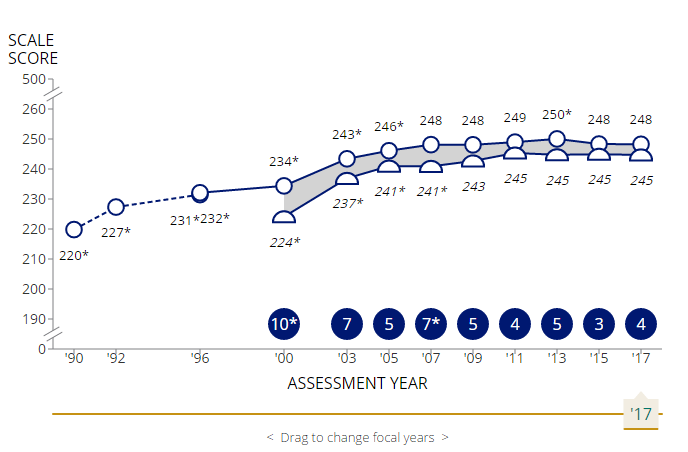
Regardless, the darkening of America will have consequences. This story on the 2017 NAEP test scores is a good example. The results, unsurprisingly, are not positive, but they are predictable. The race gap that has allegedly haunted the ruling class for generations has not changed a bit. Of course, that’s not in the press coverage, but you can easily find it by going to the source. The only change in the race gap happened when they added a category for mixed race, thus moving some blacks out of that group.


The comparison between whites and mixed race students is interesting.


Whenever these sorts of results are published, we get two predictable reactions. One is the Progressive lament about the schools. Left-wing Progressives will demand more money for the schools in order to fix all these terrible gaps. Right-wing Progressives will claim it is the fault of public schools and maybe unions. You can see some of that in the comments to the news story. The other response will be from the remaining stalwarts on our side of the divide, pointing out that biology refuses to yield to wishful thinking.

The thing is though, no one thinks much about what is going to happen as the the mix of students gets more swarthy. We are probably seeing that in these numbers. The gaps did not change, but the mix of students is changing. That means the results will continue to decline going forward. Maybe our rulers will keep yelping about the schools, but at some point, they will probably change the standards or start faking the data so the obvious is less obvious. That’s the thing about diversity. It can only work in a no-trust society.

Of course, it’s going to mean schools start competing with one another for white and Asian students. Since the foolish decision to desegregate schools, it has been a game of Old Maid, as school districts and municipalities employ clever ways to dump their unwanted blacks onto some other sucker. The future will have that plus rules to keep the children of ice people trapped in their schools. In time, a Democrat administration will create rules that prevent whites from moving away from blacks in order to “balance the schools.”

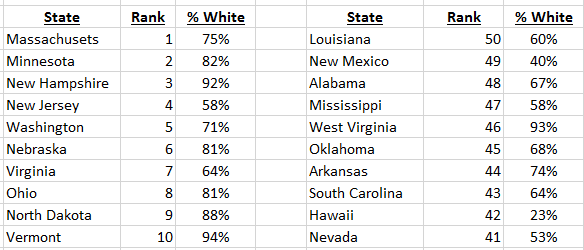
The state and city break down tells a familiar story. The test results track closely with demographics. A city like Detroit finishes at the bottom, because it is a black city, while Austin finishes at the top, because the black population is eight percent. The state breakdown is also familiar. It reveals that not all whites are the same, but the non-white population is very consistent. I took a look at the top-10 and bottom-10, along with the white population for each state. West Virginia is letting white people down.

The two outliers in the top-10 are states with high numbers of South Asians, as well as more blacks from the talented ten percent. The financial capital and the political capital of the world warp everything around them. Even Maryland feels some of it. Otherwise, the results track closely with the white population. That means if you want your state’s test score to improve, you need to attract Asian migrants and figure out how to encourage blacks to move to another state. You may want to pass on Hispanics too.

This is just one example of what happens when you get more diversity, but it is a good one. High quality public schools are largely an Anglo thing. It spread to the Continent, along with other liberal ideas, but is not a big deal in the rest of the world. East Asian societies are an exception. As America moves to majority-minority status and becomes a low-trust society, the very idea of public schools will probably disappear. How long before the people in charge figure out that testing is largely pointless and put an end to it?

Look around South America, that’s a pattern you see. The white population simply does not care all that much about the non-white population, beyond making sure they are not around them. A very similar pattern has existed in the Levant for centuries. Every hill and village is its own country. That’s the other thing about diversity. It breeds a callousness between different tribes of citizens. In one of life’s ironies, one of the first things that will die in the diversity paradise is civic nationalism. Ben Shapiro should plan accordingly.

Who We Aren’t

For the last few years, whenever someone says “it’s not who we are” it means the conversation has veered into the heretical or that some line of argument is viewed as a challenge to official orthodoxy. Amusingly, the people most prone to blurt this out are so-called conservatives. It is how they police the boundary to their right. The funny thing though, is no one ever tries to define “who we are” in concrete terms. Instead, we get a long list of things, ruled outside the set of things that constitute “who we are.”

This is something that becomes clear in the debate about David Reich’s book, Who We Are and How We Got Here. As John Derbyshire noted in his review of the book, Reich is reporting real facts about who we are as humans, but he puts almost as much effort into re-asserting all the cliches about who we are not, even when those cliches contradict his own research. Everyone gets how this works and why he felt the need to do it. To the people in charge, defining the “not who we are” stuff is who they are as morality police.

As is often the case, that constant push by our masters to enforce their moral framework tends to turn us into thoughtless reactionaries. The Bush years were a great example of this phenomenon. If the Left had remained silent on Bush, he would have been a one term President and few people would have supported the Iraq war. Instead, crazy liberals turned all of us into warmongers, simply in reaction to the unhinged opposition to the Bush administration. The opposite of what the Left says is not necessarily the truth.

As a result, the temptation on our side is to focus exclusively on what the revolution in the human sciences is telling us about ourselves, particularly those bits that confirm what we have always believed about the human animal. It may be just as useful to look at what science says about who we are not. After all, the people in charge are acting on those assumptions about who we are, namely the blank slate. Many on the right are also operating from a set of assumptions about who we are as a species.

The first thing that bears scrutiny is the demolition of the post-Boasian conventional wisdom. As Peter Frost explained years ago, Boas may have started out trying to strike a balance between nurture and nature, but his followers went on a berserk rampage against the nature side of the balance. This really cannot be underestimated. The last half century, being a smart person meant a war against observable reality, under the color of science. Now, no smart person can deny the supremacy of nature over nurture.

That is an easy one. Another thing that bears scrutiny is the collapse of the pots not people narrative to explain the archaeological record. It has been extremely important for the people in charge that we believe the natural state of man is cooperative. The assumption being that people naturally wish to get along with one another, despite the trivial physical differences. An essential part of the prevailing orthodoxy, from the Right and the Left, is that all human beings seek order so they can go about making and trading stuff.

The data is now confirming that this is not reality. Humans have been raiding and sacking one another since the dawn of man. More important, humans with a genetic edge, some small advantage, like lactose tolerance, were able to conquer the people around them and that meant killing the men and raping the women. They did not just take over an area and incorporate the people within it. The story of man is the replacement of one people by a better people, better because they had some edge rooted in their DNA.

There is another side to this. The demolition of “pots not people” as the official narrative means the demolition of homo economicus too. Humans are much more complex than the libertarians and so-called conservatives would have us believe. It means defining man as “a creature who seeks the greatest amount of wealth, with the least amount of effort” was only, at best, a superficial observation in the moment. Man is motivated by much deeper forces within his nature. One is his biological desire to conquer those not like him.

Another one of those forces is a desire to understand his place in the universe. It is increasingly clear that belief, which often manifests as religion, is one of the earliest traits of modern humans. The research at Gobekli Tepe reveals that this complex set of structure pre-dates agriculture. In fact, the archaeological record shows that settlement was the result of a long evolutionary process, driven by shared interest and communal identity, not rational self-interest. Selfish transactionalism is not who we are.

The fact is who we are is who we believe we are. We define ourselves within the bounds of biological reality. Much of what we have believed about ourselves over the last century is turning out to be at odds with that reality. Modern science may not be telling us who we are, but it is surely telling us who we are not. We are not amorphous blobs that can be shaped into anything, regardless of race. We are not transactional economic units that exist merely to buy more stuff. We are not that. We are not what modernity has said we are.

We are something else.

Protest Cults

Over the years, I’ve seen a lot of left-wing protests. The first I recall was on the Mall in Washington in the 80’s. I no longer recall what they were protesting, but I recall a stubby old women with a bullhorn hanging off her hip. She was screaming something rhythmic, but the audio was unintelligible. The whole scene was just a freak show for no other purpose than for the freaks to be seen. Tourists took pictures and everyone else just ignored it. It was just a part of the rich pageantry of American democracy.

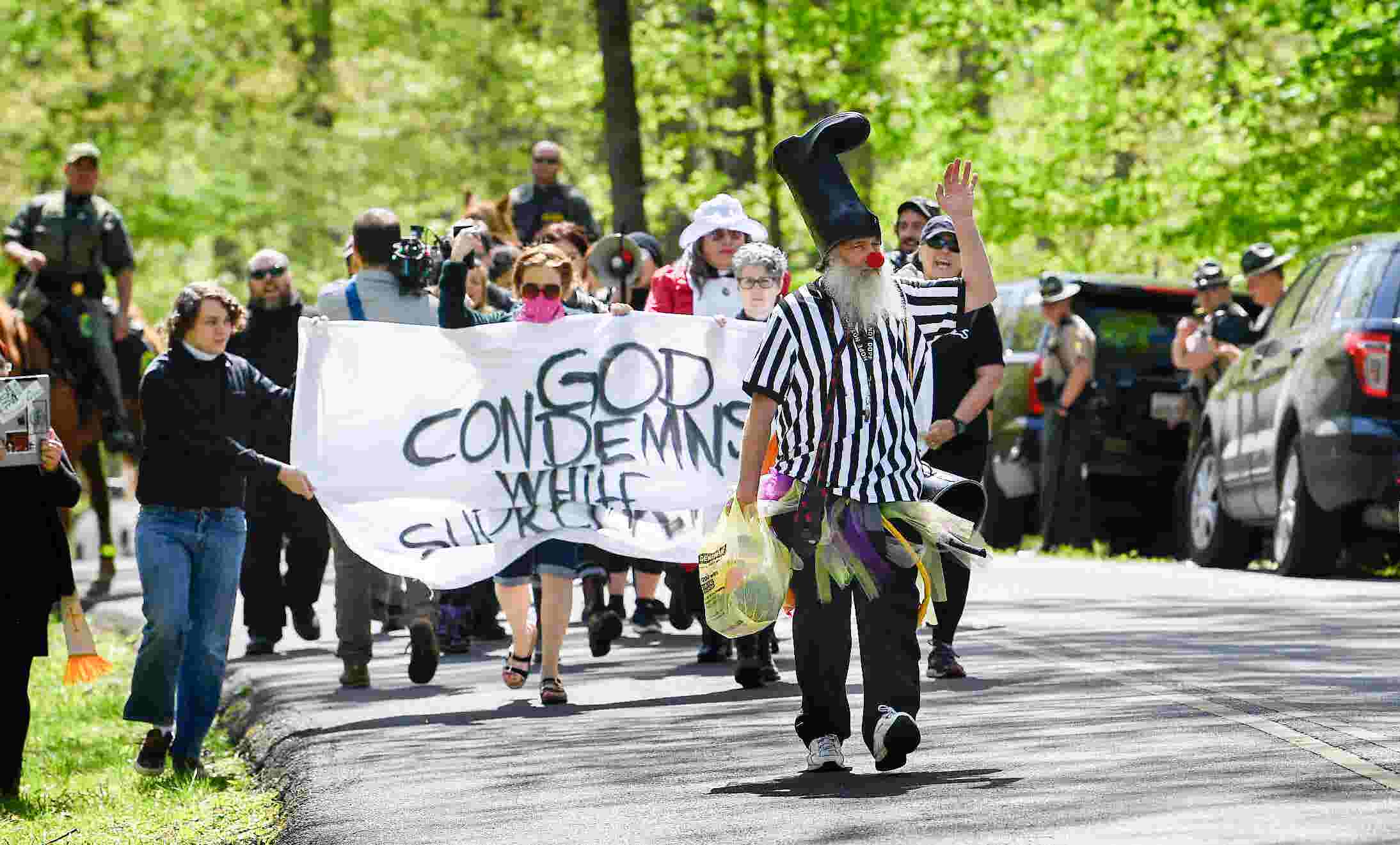
With some exceptions, that’s the model for all lefty protests. At American Renaissance last year, Antifa and a local women’s group put on an all day freak show for the conference attendees. Some were there to “protests the Nazis”, but most were there for reasons that ran from the obscure to the mysterious. Some appeared to be having some sort of hallucinatory break with reality, rhythmically screaming and twirling around or just making crazy faces at people. Again, the point was to put on a show for onlookers.

This year, the authorities penned them up so passersby could not see them. The only way to get a clean look at the protesters was from the top floor of the conference center and you needed binoculars. I counted maybe 40 people in the protest pen at the peak and at least ten were “media.”  The rules against masks and weapons scared off many of the Antifa, but the rest stayed away knowing they would not be able to put on a show. If a protests happens in the woods and no one sees it, did it really happen?

The general consensus on these groups is that outside of the ones financed by Soros and the Democrats, they are just fringe loonies looking for a reason to protest. The guy with the boot on his head shows up at all sorts of events. There’s an enormously obese black guy, who gets wheeled into protests around the country. He usually just sits in a beach chair so people can take pics of him. Then there are the anarchist that just want to smash things and rumble in the streets. Again, it is just a performance that means nothing.

For the last month or so I have been monitoring a bunch of social media accounts of prominent protesters. Mostly it was in preparation for AmRen, but when you scan a lot of them you can’t help but notice the patterns. These people define themselves within their movement by their association with specific events. There’s no normal human back and forth, just trading links and pics from the events they attended. The other type of post is sympathy for some fringe action, as if they get credit by proxy, for the action.

An example of what I mean is this HuffPo piece. Christopher Mathias is actually just an Antifa member they pay to submit field reports for them. Like everyone in these protest movements, he struggles with his sanity. His “report” is actually just a testament to the fact he was there. The protest was a flop as hardly anyone showed up and they were sequestered in a holding pen away from everyone. That left little social credit to be gained from the action, other than tweets and selfies from those who bothered to attend.

I recently had some interaction with a local group affiliated with Antifa, at least that’s what they said. They may have been boasting, but they were definitely into the protest life. That was the thing. All they talked about was where they had been and the “actions” they had done. It was what got me thinking about these protest groups functioning like a cult, where the events are social credits within the subculture. If all you talk about and all you focus on in your life is the events you attended, the attendance has a lot of value to you.

What it brought to mind is people who get into narrow hobbies like model trains or some sort of collecting. They get together not to trade information about their hobby, but to display what they have or what they know. Their events are peacocking festivals so they can display their social capital. Oddly, prisons work on a similar dynamic. Prison ink is about advertising your history in the system and your violence capital. That suggests the protest culture is entirely inward looking and not really about getting our attention.

This would explain why they have started to fight with one another. The alt-right has retreated from the real world and has stopped fighting with Antifa on-line. The affiliated actors like TWP have evaporated. If your thing is to protest other fringe groups and those fringe groups have left the field, you end up protesting yourself. Or in the case of some, like Lacy MacAuley, they start jump from one momentary issue to the next. It’s the old gag. Question: What are you rebelling against? Answer: What have you got?

None of this may seem all that interesting, but it raises questions about modernity. This phenomenon did not exist in the 19th century or the 15th century. These subcultures rooted in vague and shifting causes did not exist in our grandparents age. A major reason is the splintering of society on the rocks of diversity. There’s also the collapse of mainstream Christianity and the related collapse of traditional social arrangements. These sorts of subcultures were denied oxygen in a thriving and dominant mainstream culture.

The Hater’s Diary II

I have only caught Nick Fuentes online, here and there, so I had not formed an opinion of him prior to the conference. To be perfectly candid, I tend to not pay much attention to young people. Never trust anyone under thirty is a good policy. On the other hand, sensible people I know say he is a bright young prospect with a lot of talent. I was most curious to see how the younger people reacted to him. Old people tend to think positively of young people who sound like old people, but young people often hate those guys.

For starters, he is a slight fellow. I am always surprised by this as everyone on video tends to look average size to me. More important, he is a natural speaker. You can be trained to be a good public speaker, but you will always look like you were trained to be a good public speaker. For some people, it comes naturally. Fuentes is a natural. How he stands, how he scans the audience as he speaks, his hand gestures all work to support the content of his speech. It is easy to see why he has become an on-line star.

I am not sure if I got an answer on his appeal to his generations. His speech was on the utility of gassing the boomers, so half the crowd was not particularly happy with him. The millennials seemed to be the most engaged, which I found interesting. Maybe they still feel young so they can relate to him but appreciate his maturity. The young guys were engaged, but it was hard to tell if they were listening. It was not like he was mobbed by the young people seeking a selfie, but the ones I asked said nice things about him….

The protest was a dud. At the peak, they had between 30 and 40 people, but it was a late arriving crowd and they left early. My guess is the ban on masks and the ban on backpacks had the biggest impact on turnout. That and they were put into a pen that was too far away for anyone to notice them. That left them to mill around and signal to one another, which meant no drama. There was no way to interfere with people coming and going and no real way for them to provoke law enforcement into doing anything to them…

I ran into a reporterette from NBC. At least she claimed to be from NBC. I did not see her credentials. She tried using her feminine wiles to cozy up to me and dig for information about the financing of American Renaissance. Later, J’Onquarious suggested I should have told her the man behind the event was George Soros. That would have been some great 5-D chess, but I could not have pulled it off without laughing. It is another reminder that the people in liberal media are all soulless dirtbags who lie on spec…

One group that I have praised in the past is Identity Evropa. I got to spend some time talking with the head of that group, Patrick Casey. He is a very sensible young man without a lot of ego. He just wants to build up the group and avoid unnecessary confrontations and publicity. It is basically a Dissident Right social club for young college age males. It is the kind of organic organization that is required to build a foundation for the future. If you have a few bucks to spare, they could use it and they will use it wisely…

I met Greg Hood, who writes for American Renaissance. Most people in this thing consider him the best writer going and that is probably right. He is very much on board with the notion of dialing back the e-celebs and focusing on organization building. Something he pointed out that I did not consider is that the cycle of provocation and response we see with the e-celebs is addicting. That and it inevitably means the liberal media picks our leaders. They ignore Jared Taylor and instead focus on some internet personality.

That has been a theme here thus far in the casual conversations I have had with the prominent alt-right/Dissident Right people. The lesson of the last year is that too many supposedly responsible people have gone out of their way to court attention. The result is bad publicity, lawsuits and lots of public feuds. That is encouraging. It means the right people are learning the right lessons. As I am fond of pointing out, this is a social war where the battlefield is public morality. It is not about changing facts. It is about changing attitudes…

Of course, the great John Derbyshire was in attendance. I must admit that I still find it odd for someone of his stature to compliment my work. He took the time to chat with J’Onquarious and me and said something to the effect, “I want to thank both of you for the work you do.” He does not have to do that, but that is why he is one of the giants in this thing. The fact is, Derb and Sailer have done more for our cause than anyone. Jared Taylor does great work, but those two cast very long shadows…

During a break, someone handed me a Rebel flag decal. In my youth, Rebel flags were common, and no one really thought much of it. They were a symbol of Southern pride, but no one felt that strongly about it. In a time of universal deceit —having a Rebel flag is a revolutionary act. I think I will affix my decal to the bumper of the Jaguar. That seems like the right thing to do for some reason. Perhaps after the cocktail hour. Now, I go to drink and socialize with the rest of the haters…

The Hater’s Diary I

A Jaguar is quite comfortable at high speed, as long as the road is smooth and straight, but in the turns, it is a little twitchy, so you don’t have confidence in it. I’m not sure why the car rental place gave me a Jaguar, but if you’re going to the Hater’s Ball, there’s no reason not to go in style. That said, I did not find the car all that special. The interior is not much better than a high-option Toyota and the media center is baffling. The car also turns itself off when you stop at a light. This is to save energy, but it is very annoying.

The secret lair of American Renaissance is about an hour outside of Nashville, so it is a pleasant drive if you like thinking about the diversity of America. The hills of Tennessee are nothing like what you see along the along the coast and the people are just as different. I got off the highway and drove some of the back roads. Tennessee is a blend of the old south and Chechnya. You have the gentility and sophistication everyone associates with the South, but there is that crazy hill people element too….

Pulling into the park, I was confronted with a team of armed men. The authorities had set up a mobile command center at the entrance to the park and the place was swarming with park rangers in tactical gear. I saw at least one K-9 unit and everyone was questioned before they could enter the area where the conference center, villas and restaurant are located. To get inside, you had to submit to cavity search. The park police take things seriously this year, which means the lunatics are in trouble…

I caught up with the great J’Onquarious Williams at the reception. I introduced him to F. Roger Devlin. Both seemed flattered to be on the company of the other, which amused me greatly. AE’s graphs and charts have touched millions of eyes on social media and Devlin’s essay Sexual Utopia in Power pretty much started the whole man-o-sphere thing. The two of them have done more to influence people than all the e-celebs combined, yet both are oblivious to it. They just enjoy doing what they do…

There are a lot of new people here again. That’s always a good sign. It’s not cheap to attend and it is a hassle to get here. There’s also the risk factor. I would expect people to come once every few years, so it is a positive sign to see lots of new faces. That means there is increasing interest. The room is once again packed and there are lots of young people. Even better, there are more women this year, mostly spouses of attendees. That’s another sign that more and more people see this as important and worth their effort…

One person not here is Richard Spencer. Despite his absence, he is a topic of conversation. I’ve been querying people about their opinions of him. The general feeling is he probably needs to take a break and regroup. Even among the sorts of people who attend these things, the alt-right has lost a lot of its luster. There’s no disavowing or anything like that. It’s just that the missteps have not gone unnoticed. As I wrote the other day, people judge leaders by their results. The last year the results have been poor…

I had a long conversation with Greg Johnson and his crew. Some on the alt-right don’t like Greg, but that’s to be expected. He’s been involved with this stuff for a long time and that inevitably means turning off some people. It’s human nature. There’s no doubting his intelligence. He is a very smart and a very well-read guy. He’s also committed to this thing. He travels all over the world doing events and giving talks. Make no mistake. No one is getting rich warning European people of the looming demographic disaster.

What recommends Greg Johnson is the fact he does think about the mistakes that have been made of late, including his own errors. It’s easy to pluck the mote from the eye of others, but most of us struggle with the beam in our own. As J’Onquarious noted, I offered my unsolicited opinions. Many people would have told me to perform an unnatural act, but Greg was polite and engaged my arguments. Whether or not it will make any difference is unknown, but it speaks well of him that he was interested enough to listen…

Today is the long day. There are half a dozen speakers, including Nick Fuentes. I’m not all that interested in what children have to say about anything, but I am curious to see how the young people respond to him. Fuentes is one of those guys who was born old, but he is still a kid speaking mostly to kids. The future of this thing is not geezers like me, but young guys prepared for the world as it will be in the coming decades. The youth movement will need respectable faces to help educate a skeptical public..

More tomorrow…

The Hater’s Ball

As this goes up, I am winging my way to a secret location in the Smokey Mountains to attend The Hater’s Ball. This is my second trip to American Renaissance and I’m excited to be attending. I look forward to meeting my fellow haters. I had a such good time last year, I’m thinking this year could be a bit of a letdown. Even so, getting together with others in the struggle is a great way to spend a spring weekend.

I’m taking the opportunity to get in some down time next week, so posting may be a bit light and there will be no podcast. I’ll probably do a post or two over the weekend on the conference, if time permits. We’ll see. In order to avoid getting burned out, I’m going to sprinkle in a light week every month and next week will be the first foray into the world of sloth. Perhaps that will be enough to keep the dark thoughts at bay.

This week I have the usual variety of items in the now standard format. Spreaker has the full show. I am up on Google Play now, so the Android commies can take me along when out disrespecting the country. I am on iTunes, which means the Apple Nazis can listen to me on their Hitler phones. Of course, the Hitler Phones are so slow now, you may never finish. Of course, there is a download link below.

This Week’s Show

Contents

Direct Download

The iTunes Page

Google Play Link

Full Show On Spreaker

Full Show On Odysee